


Start with the child’s inseam and the bike’s lowest saddle setting, because that single match decides whether the first ride feels natural or frightening. For most 2 to 4 year olds, the right buy is a light, plain 10 or 12 inch balance bike they can sit on with both feet flat and knees slightly bent.
Age labels, colours and add-ons can help you narrow a shelf, but they can’t prove control. A toddler must be able to stand over the bike, move it without fighting the weight, and stop with their feet before any brake or basket matters.
First decide whether your toddler needs a balance bike now, should wait, or can skip straight to pedals
A child is ready for a balance bike when they can walk steadily, follow simple stop and wait instructions, tolerate a helmet, and sit on a correctly sized bike with both feet flat. If one of those pieces is missing, waiting is the safer buy.
- Buy now for a steady walker who wants to scoot, can listen near paths or playgrounds, and fits a low saddle with bent knees.
- Wait for a toddler who still falls often while walking, refuses a helmet, runs off in unsafe spaces, or can only touch the ground on tiptoe.
- Skip to a pedal bike for a tall, confident 3.5 to 4 year old who already glides on ride-ons, can steer and stop calmly, and can fit a very low pedal-bike saddle. Some families remove the pedals at first so the bike works like a balance bike.
- Avoid powered or electric balance bikes for a normal first ride. They add speed, weight and extra safety complexity that a 2 to 4 year old beginner doesn’t need.
Measure inseam against minimum saddle height: the fit check that decides everything
The first sizing rule is strict: with the child sitting on the saddle, both feet should be flat on the ground and the knees should bend slightly. That position lets them walk the bike, push into a glide, catch a wobble and brake with their shoes.
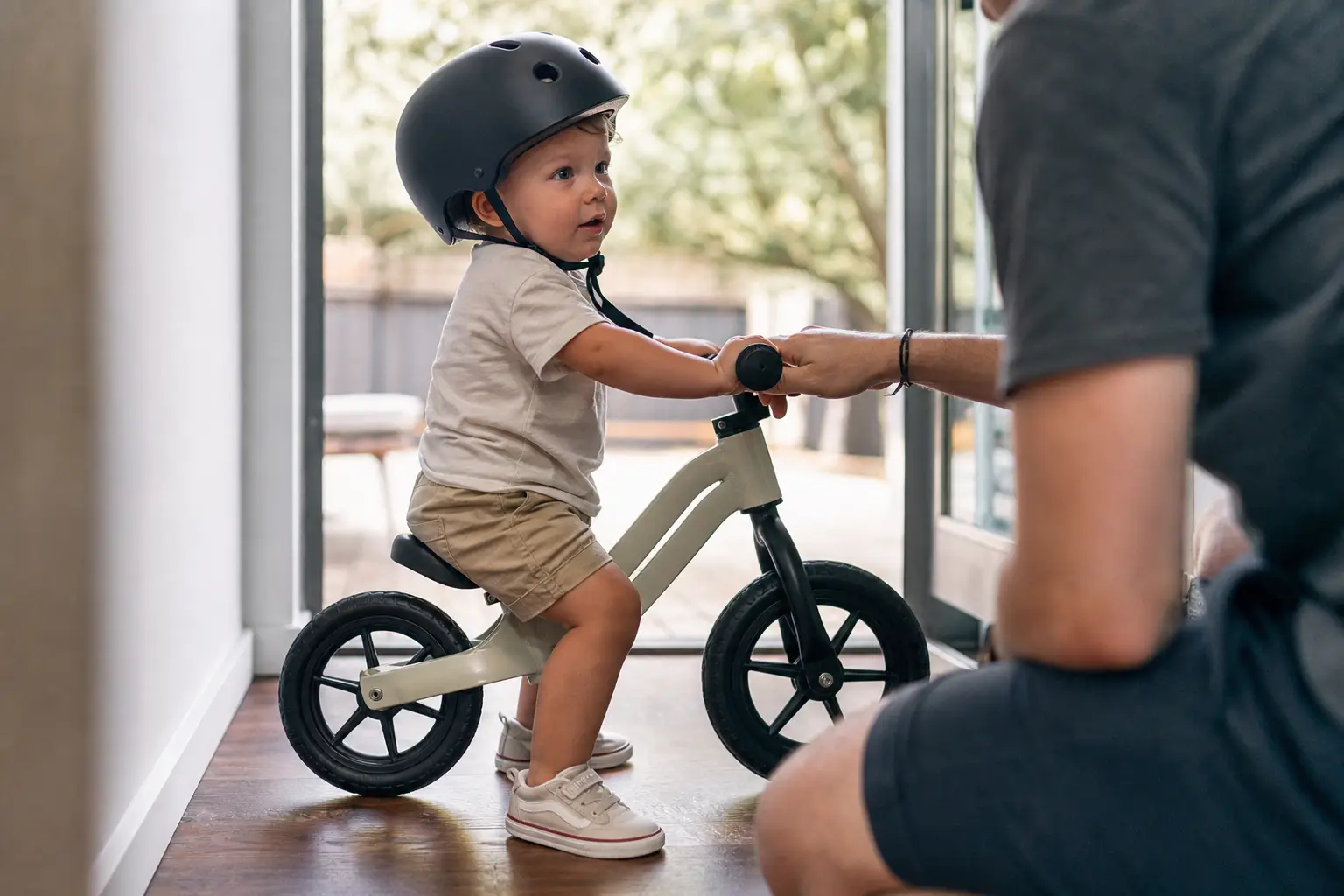
- Put the child in the shoes they will ride in and stand them upright with feet flat.
- Measure from the floor to the crotch. That is the inseam you use for buying.
- Find the bike’s minimum saddle height. For first rides, aim for the saddle to sit about 1 to 2.5 cm below the child’s inseam.
- Check the maximum saddle height too. Around 5 cm of growth above the current inseam keeps the bike useful for more than a short spell.
A child with a 30 cm inseam will struggle on a bike whose minimum saddle height is 35 cm. A 25 to 28 cm minimum gives that same child a much easier start. This is why two bikes both labelled for age 2 can feel completely different in the driveway.
Typical very small 10 inch balance bikes often start around 23 to 30 cm at the saddle. Common 12 inch toddler bikes often start around 26 to 31 cm and rise to roughly 35 to 44 cm. Larger 14 inch and convertible models often start around 35 cm or more, which suits many older preschoolers but can defeat a small beginner.
Keep the bike under control: why weight matters almost as much as size
A toddler handles the whole bike, not just the saddle height. They lift the front wheel, drag it around, drop it, restart it, and sometimes carry half of it while turning.
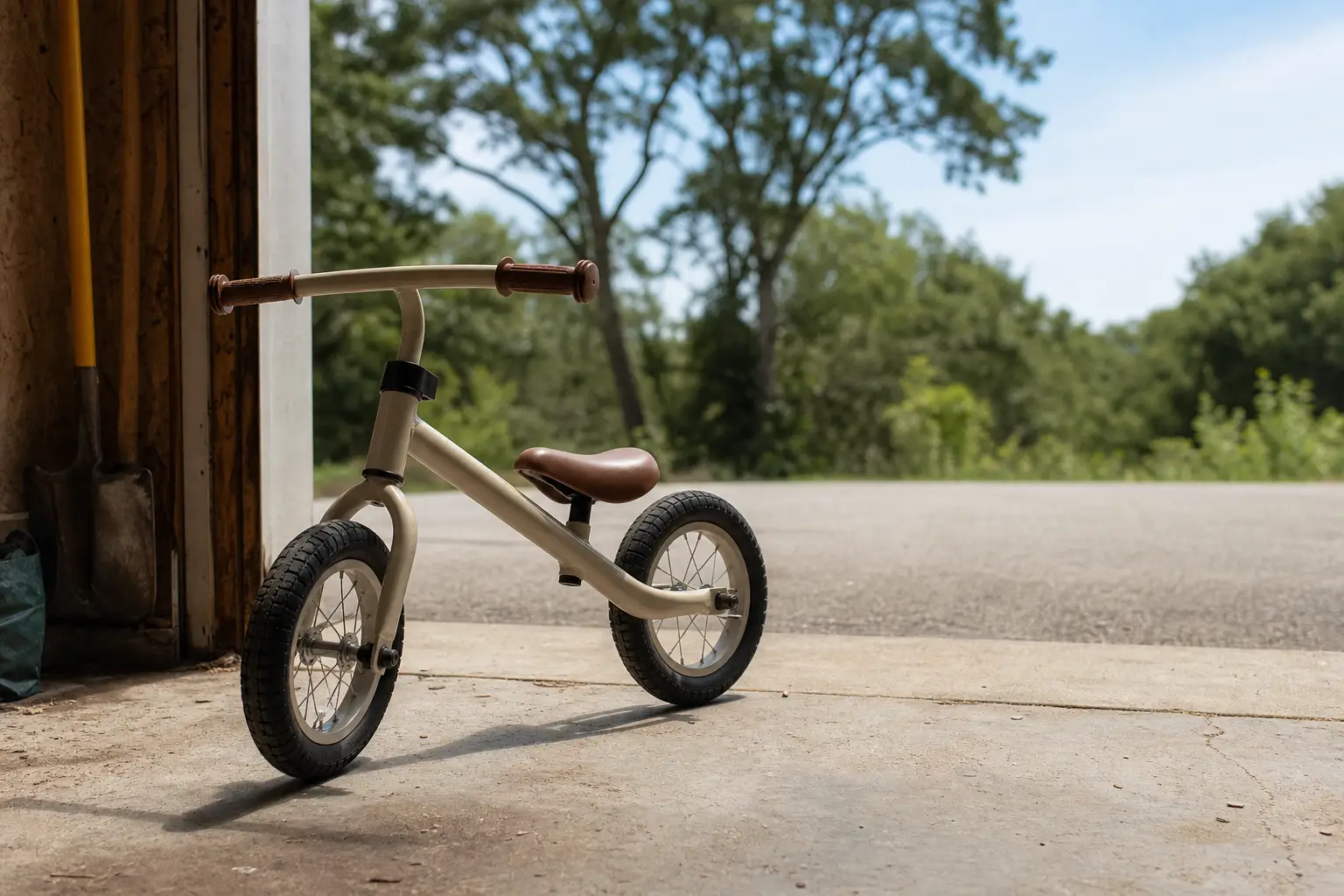
Use 30 percent of the child’s body weight as a practical ceiling. For an 11 kg two-year-old, a 4 kg steel bike is about 36 percent of body weight and will feel like work. For a 16 kg preschooler, the same bike is closer to 25 percent and may be manageable.
Many good toddler balance bikes sit around 2.2 to 3.5 kg. Heavier budget steel models can run over 4 kg. Air tyres, hand brakes, steel frames and pedal-conversion kits can all add weight, so treat every extra feature as something the child has to push.
Match tyres and frame material to the surfaces they will actually ride on
Tyres change the ride more once the child starts gliding faster or leaving smooth pavement. For the first few sessions on a flat courtyard or indoor hall, light and easy usually beats plush.
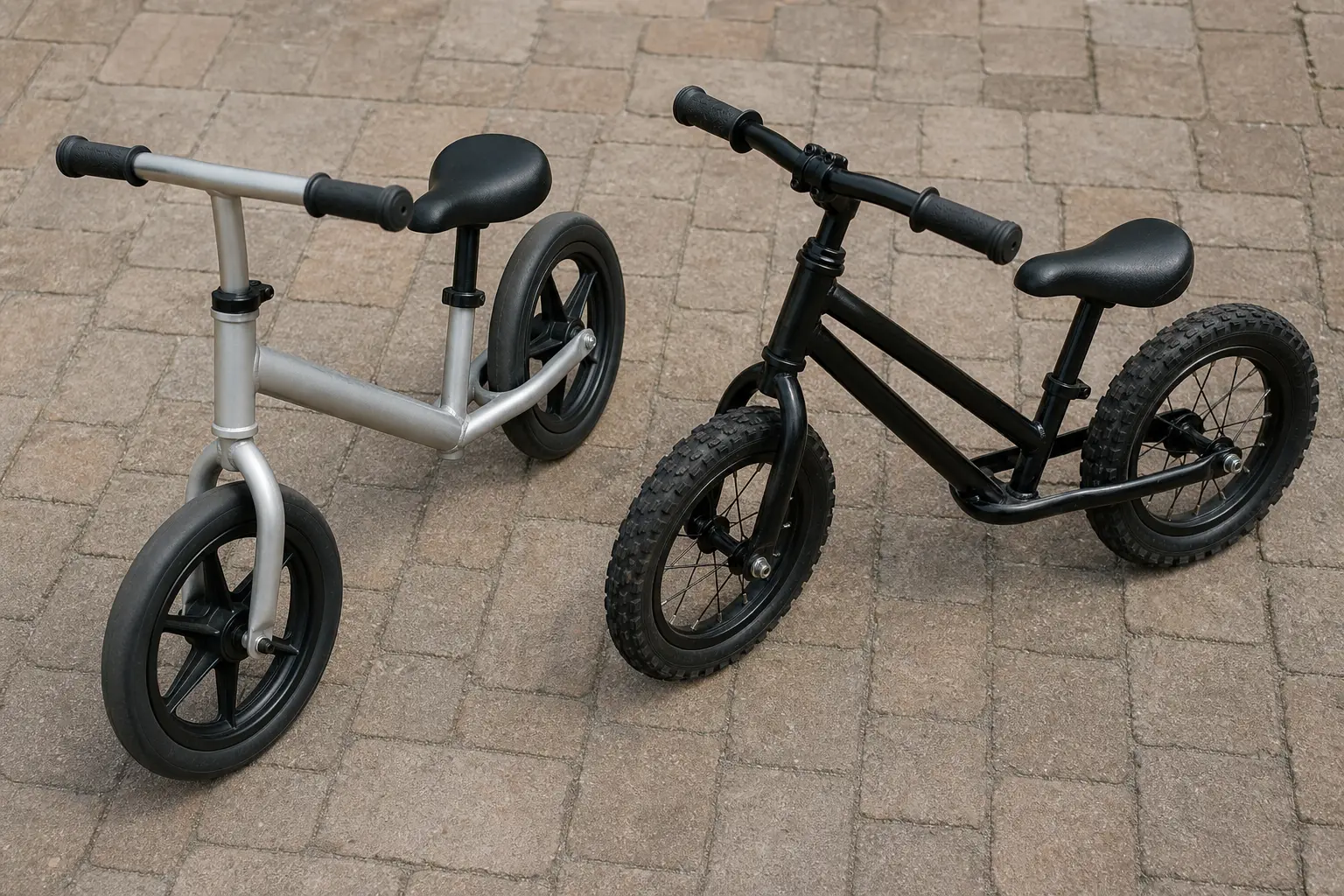
- Foam, EVA or solid tyres are light, cheap, puncture-proof and low-maintenance. They suit smooth pavements, indoor halls and short low-speed practice. They give less grip and cushioning on gravel, damp ground, kerbs and leaning turns.
- Pneumatic air tyres add inflation and puncture care, and can add weight. They give better cushioning, traction and rolling comfort on parks, grass and uneven paths. For a confident 3 to 4 year old, this is one of the upgrades they can feel straight away.
- Steel frames are common at the cheaper end. They are strong and inexpensive, but they add weight and can rust if stored damp.
- Aluminium alloy cuts weight and resists rust better, which is why it appears often on premium children’s bikes.
- Magnesium and composite frames can also be very light. Judge them by the full bike weight, saddle range and build details, rather than the material name alone.
- Wooden bikes can look great, but many offer less adjustment and need more care in wet storage. Choose one only if the saddle range clearly fits the child now and leaves usable growth.
Before paying, check the details a toddler will hit and grab: capped handlebar ends, grips with bumpers, covered or recessed axle bolts, a clear minimum-insertion mark on the seatpost, and clamps that tighten without slipping. Store the bike dry and re-check fasteners after washing or heavy use.
Put brakes, footrests, bells and baskets behind fit, weight and stopping with feet
A brakeless toddler balance bike can be a normal safe choice on flat supervised ground when the child can stop with flat feet. The problem is a high saddle, a fast slope or an unsafe riding area, not the absence of a lever on day one.
A hand brake becomes more useful around 2.5 to 3.5 years, when many children have the hand size and attention to learn it. It can save shoe soles, help on gentle slopes and make the later move to a pedal bike feel familiar.
- Check brake reach before paying for it. A short-reach lever that moves easily is useful. A stiff adult-style lever is decoration for tiny hands.
- Use the pinky test in a shop: if an adult can’t squeeze the lever easily with a little finger, a toddler is unlikely to use it well.
- Treat footrests as optional. Children naturally lift their feet while gliding, and badly placed rests can hit calves or interrupt the stride.
- Skip baskets, bells, bags, stands and character extras until the bike already fits. A handlebar bag adds weight where steering is most sensitive.
Shortlist by rider type and budget: what a fair price looks like at each tier
Price only makes sense after fit and weight pass. The bands below are local-equivalent ranges as of 2026, since tax, freight and retailer margins vary by market.
| Tier | Typical fair range | What you should expect | Best for |
|---|---|---|---|
| Entry | 50 to 90 | Steel or plastic-heavy build, foam tyres, basic bearings, usually no brake, often 3.2 to 5 kg. Fair only if the saddle fits and assembly quality looks credible. | Occasional smooth-ground use, especially for a stronger older toddler. |
| Good basic branded | 90 to 170 | Better adjustability, child-sized grips, more reliable parts support, often foam tyres, sometimes steel. | Most 2 to 3 year old beginners if the bike stays near or under the 30 percent weight rule. |
| Premium light | 170 to 260 | Usually under 3.5 kg, higher-grade frame materials, better wheels and bearings, better grips, sometimes air tyres and a child-friendly rear brake. | Daily use, smaller riders who need low weight, or confident 3 to 4 year olds riding rougher paths. |
| Convertible or larger 14 inch | 250 to 400 plus | More growth and possible pedal transition, but extra parts can make the balance phase heavier and taller. | Tall, strong preschoolers close to pedalling. |
| Luxury or race | 400 plus | More brand cachet or specialist materials than most toddlers can use. | Rarely necessary for a first balance bike. Spend on fit, helmet and safe practice space first. |
The useful jump from entry to good basic is usually adjustability, better small-child contact points and more dependable parts. The useful jump to premium is lower weight combined with better tyres or a brake that a child can actually use.
Compare balance bikes
Live prices from more than 20 shops, updated daily.
Avoid the common buys that look sensible in the shop but fail on the first ride
Most bad buys come from buying for the box rather than the child standing next to it. Run these checks before you accept a cute colour or a big discount.
- The age range looks right, but the minimum saddle height is too high. Measure inseam first and check the printed saddle range.
- The bike is bought big for growth. If the child can’t control it today, it may sit unused until the useful learning window has passed.
- The brake is listed as a premium feature, but the lever is too far away or too stiff for small hands.
- The frame is sturdy but heavy. A 4 kg bike can be fine for a strong 4 year old and frustrating for an 11 kg beginner.
- The tyres are chosen for adult logic. Foam is fine for smooth early practice; air tyres are the better spend once speed, distance and rough ground enter the picture.
- The used bike is cheap, but has cracked grips, missing bar-end plugs, exposed bolts, slipping clamps, rust at the joints or tyres that are hard and degraded. Walk away.
- The product has poor instructions, unclear safety markings or vague seller information. For children’s products, credible local compliance markings and clear assembly guidance matter.
FAQ: sizing, helmets, brakes, training wheels, used bikes and first-ride readiness
What if my child is between two balance-bike sizes?
Choose the smaller bike if it gives flat feet and bent knees now while still leaving some saddle height to grow. Choose the larger one only if its minimum saddle is still about 1 to 2.5 cm below the child’s inseam.
Can my child use a skate helmet on a balance bike?
Use a helmet certified for cycling in your market. Some helmets cover more than one sport, but a skate-only helmet is a different product if it lacks cycling certification.
Should the brake be on the front or rear for a toddler balance bike?
For this age, a usable rear hand brake is the more relevant upgrade when a brake is offered. The lever must be short-reach and easy to squeeze; otherwise feet remain the real stopping system.
Are training wheels a cheaper alternative?
They can get a child moving, but they practise upright pedalling more than balance and leaning. Research on learning to cycle has found children moving from balance bikes to pedal bikes rode independently earlier on average than children moving from training wheels.
Is a used balance bike a good idea?
Yes, if the frame and fork are sound, clamps hold firmly, wheels spin freely, grips and bar ends are intact, and the saddle range fits. Avoid used helmets unless you know their full history, because hidden impact damage is hard to judge.
What should the first ride look like?
Start on a flat, open, traffic-free surface and let the child walk while seated. Gliding comes after they discover the bike moves under them. Stop before they are tired or reckless.
Verdict: choose the simplest light bike that fits today and lets them stop confidently
Buy by numbers first: inseam against minimum saddle height, then bike weight against the child’s body weight. If the child can sit with flat feet, bend their knees, move the bike without a fight and stop with their shoes, you’ve solved the hard part.
For most first riders, that means a light 10 or 12 inch bike with a low saddle, sensible grips and tyres matched to the surface. Add air tyres and a real child-sized brake for faster 3 to 4 year olds, but don’t let extras pull you away from fit.
This article was created using AI, following our team's editorial standards.


