


For regular wet-trail day hikes, start with a light waterproof mid that locks the heel, clears mud and leaves room for swollen toes. Choose trail shoes if your pack is light, the route is maintained and fast drainage matters more than keeping cold water out.
Buy autumn boots only if cold rain, rough ground or a heavy pack justify them
Many autumn walkers carry more footwear than their routes require. A high collar adds weather coverage and keeps out debris, but it doesn't automatically provide meaningful ankle protection.
- Choose non-waterproof trail shoes for mild weather, maintained paths, light packs and routes with unavoidable deep crossings. They drain and dry faster after flooding.
- Choose waterproof low hiking shoes for quick day walks through dew, showers and shallow puddles. Their low collar lets water and debris enter sooner.
- Choose light waterproof mids for repeated rain, shallow bogs, wet vegetation and mixed hill paths. This is the practical category for most regular autumn walkers.
- Choose trekking boots for heavy multi-day packs, scree, prolonged rough ground and repeated abrasion. Their stiffness and slower drying are unnecessary on easy woodland paths.
People with previous ankle injuries, orthotics, reduced foot sensation or significant instability need individual fitting. A hiking boot is no substitute for a prescribed brace or clinical advice.
Judge waterproofing by the whole boot and repeated soaking
A membrane is only one part of the barrier. Seams, tongue construction, upper treatment, abrasion and drying conditions decide how the boot feels after several wet outings.
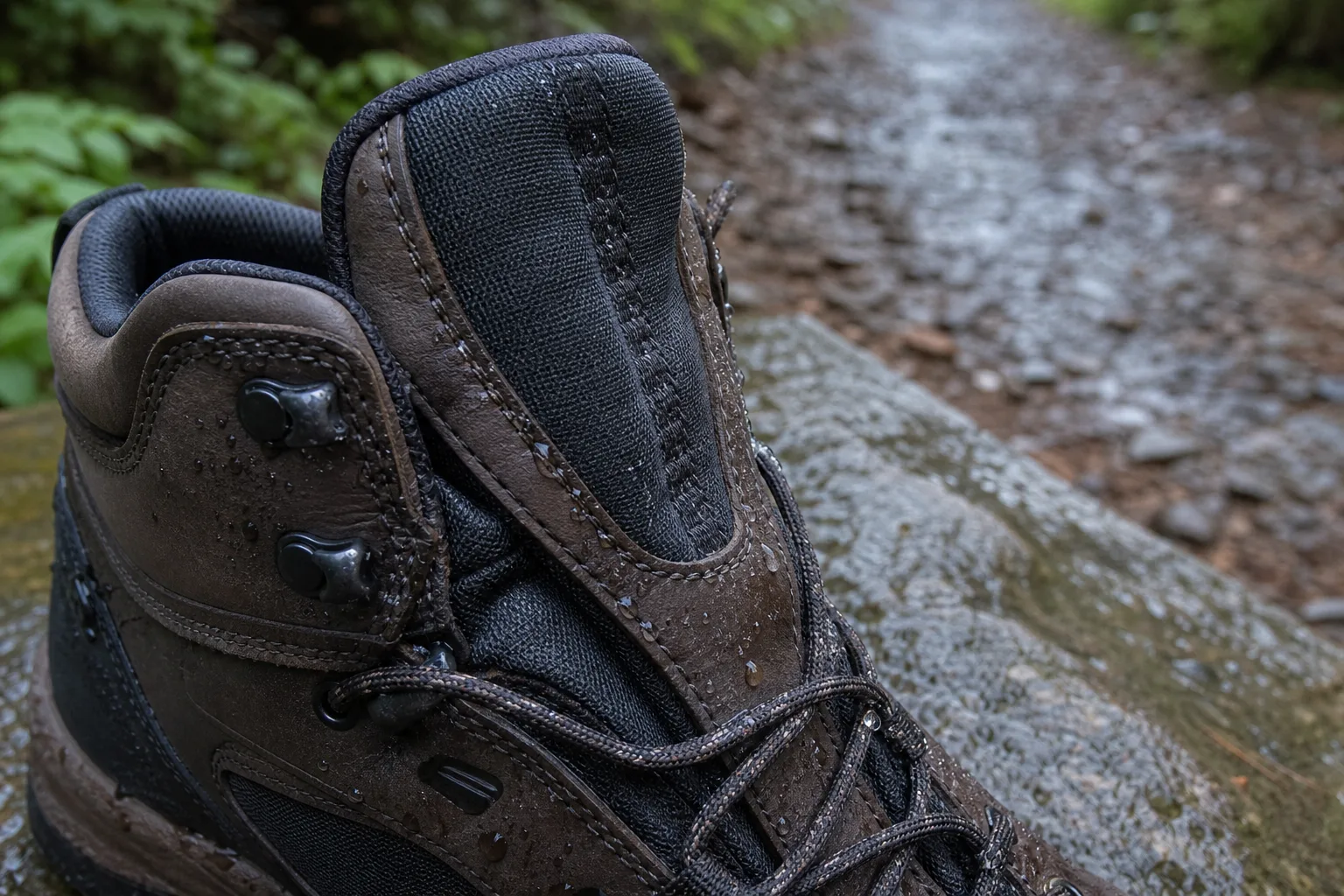
The membrane can remain leak-free while the outer material wets out, gains weight and leaves the foot cold and clammy. Cooler autumn air makes reduced membrane ventilation easier to tolerate, though hard uphill effort can still produce more sweat than the liner can release.
- Check how high the tongue is fully gusseted. This sets the practical depth of water protection.
- Prefer fewer upper seams and a protective toe cap or rand for repeated contact with soaked rock, roots and brush.
- Expect nubuck or full-grain leather to resist abrasion well, with extra weight and slower drying. Synthetic panels usually break in and dry faster.
- Look for an upper that beads water. Clean off mud and renew the correct treatment when the surface consistently darkens and saturates.
- Treat published whole-footwear leak testing as useful evidence. A membrane name alone doesn't create a universal, cross-brand performance rating.
Match rubber compound and lug geometry to wet rock, mud or mixed trails
Choose tread for the ground that dominates your walks. Rubber compound controls friction and wear, while lug depth, spacing and braking edges control penetration and mud clearing.
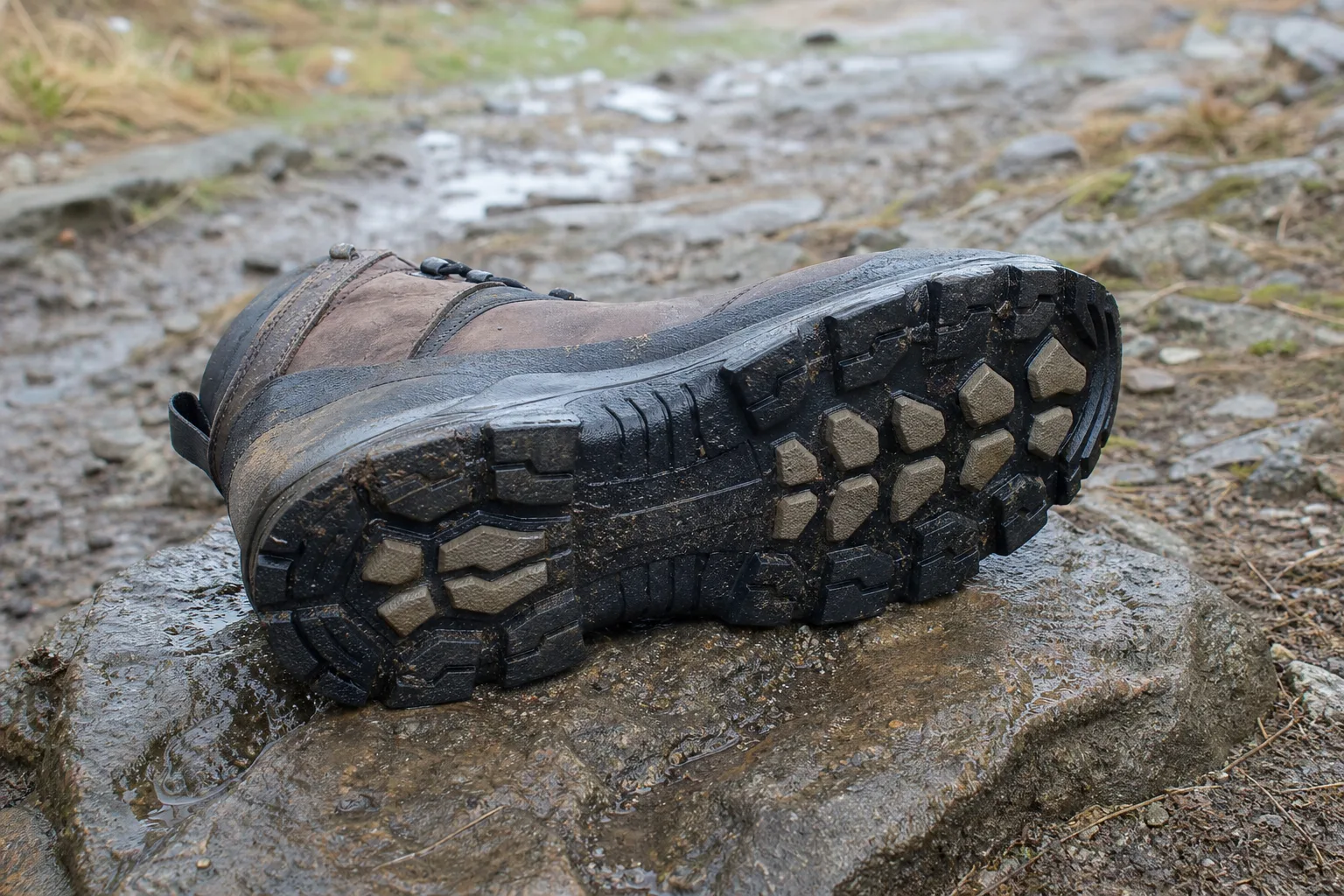
- Mud, peat and loose soil: choose deep, widely spaced, multidirectional lugs with a clear heel brake.
- Wet slabs, paving and smooth rock: choose a wet-grip compound with broader contact zones and moderately shallow tread.
- Mixed hill trails: 4 to 5 mm multidirectional lugs are common. Inspect spacing and rubber coverage because depth alone says little about wet grip.
- Road-to-trail routes: avoid extreme mud lugs. They can feel unstable and wear quickly on pavement.
In the shop, inspect the centre of the outsole for exposed foam or sparse rubber. Twist the heel against the forefoot too. A sole that twists freely will feel less planted while edging across roots and uneven rock.
Get fit right in the afternoon, then prove it on climbs and descents
Fit outranks price, membrane branding and sole technology. Break-in can soften materials, but it cannot correct the wrong length, width, volume or heel shape.
- Measure both feet and size for the larger one. Check length, width, arch position and overall volume.
- Shop late in the day, when activity and heat have enlarged your feet.
- Wear the hiking socks, insoles and orthotics you will actually use.
- Start with about 10 to 15 mm ahead of the longest toe, then confirm it dynamically.
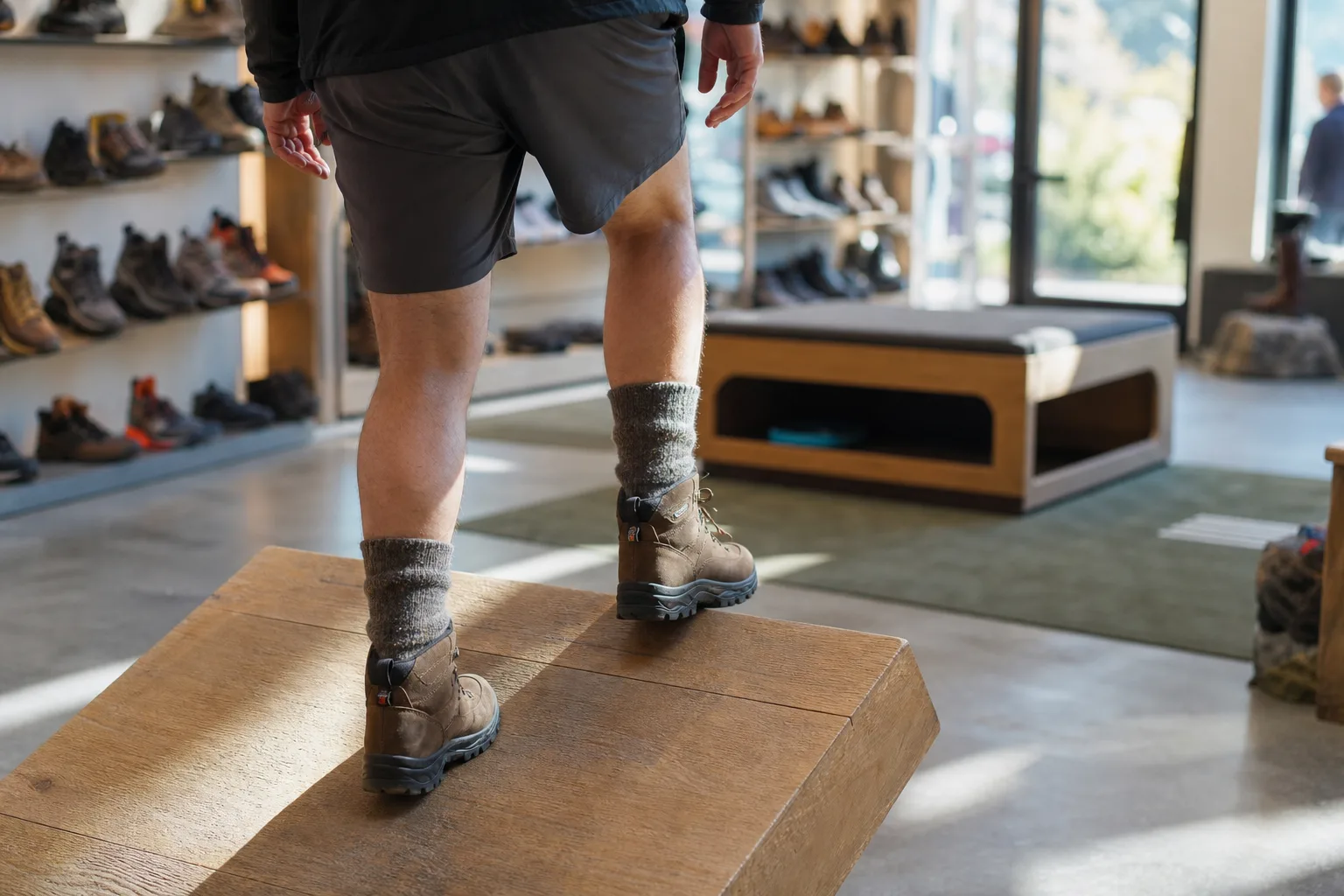
- Lace firmly and walk uphill. The heel should stay seated without crushing the instep.
- Walk down the test slope repeatedly. Reject the boot if any toe touches the front.
- Check that the foot's widest point sits at the boot's widest point, without pinching or bulging over the sole edge.
A slight toe tap on a shop ramp becomes a serious problem during a 15 km hilly walk with an 8 kg pack. Persistent heel lift, numbness, misplaced arch support or pressure against an ankle bone also means the boot should go back.
Choose underfoot stability for terrain and load
Torsional stiffness, heel hold and platform width usually tell you more about trail stability than collar height. Research on high collars finds some restriction of ankle inversion in controlled conditions, while evidence for preventing sprains during dynamic movement remains weak or mixed.
- A firm heel counter limits rear-foot movement inside the boot.
- A broad platform is harder to tip than a narrow, tall sole.
- A shank or rock plate spreads pressure from stones and resists twisting.
- Firmer midsoles suit heavy packs and long rocky routes. Very soft cushioning can feel vague on wet side slopes.
- Separate forefoot and ankle lacing zones let you secure the heel without squeezing the toes.
Stiffer boots earn their weight under a multi-day load or across hours of angular rock. On easy paths they reduce natural movement, add fatigue and require more adaptation.
Compare autumn footwear and price tiers
The mainstream light-mid tier is the value centre for regular autumn day hiking. Premium construction pays off when rough terrain, pack weight or high mileage can use its added structure and durability.
| Footwear type | Best suited to | Autumn behaviour | Typical tier |
|---|---|---|---|
| Non-waterproof trail runner | Fast travel, light packs, maintained paths, deep crossings | Lightest option, drains quickly, limited cold-water and debris protection | Entry to mainstream |
| Waterproof low shoe | Experienced walkers on maintained or moderately rough trails | Handles dew and shallow puddles, floods sooner through the low collar | Mainstream |
| Light waterproof mid | Regular day hiking in rain, mud and wet vegetation | Moderate structure, toe protection and practical weather coverage | Mainstream |
| Trekking boot | Heavy packs, scree, rough paths and prolonged wet brush | Durable and supportive, with more weight, break-in and drying time | Premium |
| Mountaineering boot | Snow, crampons and technical terrain | Rigid and compatible with specific traction systems, excessive for ordinary paths | Technical |
Across retail snapshots available in March 2026, the useful spending steps look like this:
- Entry: synthetic uppers, basic EVA cushioning, proprietary waterproof liners and fewer width choices. Suitable for occasional maintained trails if grip and fit are sound.
- Mainstream: often around 50 to 100% more than entry footwear. The extra money buys better heel construction, lacing, toe protection, outsole documentation and fit choice. This is usually the largest functional jump.
- Premium trekking: typically around a third to half more than mainstream. Expect firmer PU or TPU support, stronger rands, more leather, specialist lasts and possible resoling.
- Technical: pays for rigid construction and traction-device compatibility. Buy it only when the route requires those features.
Resoleability needs confirmation before purchase. In one March 2026 specialist-retail snapshot, only 43 of 147 men's waterproof hiking boots carried a resoleable tag, and repair makes sense only while the upper, lining and membrane remain sound.
Compare light waterproof hiking boots
Live prices from more than 20 shops, updated daily.
Avoid marginal sale fit, excessive stiffness and break-in myths
Buy several weeks before a major trip and protect the right to return the boots. A large discount cannot rescue a cramped toe box or loose heel.
- Sale fit: selected footwear discounts often reach 15 to 25%, with deeper clearance reductions on fragmented sizes. Walk away if the remaining size is marginal.
- Excessive stiffness: backpacking construction adds cost and weight on maintained paths. Match structure to terrain and load.
- Heat drying: radiators, fires, very hot boot dryers and hot car storage can damage leather, foam, adhesives and membrane laminates.
- Forced break-in: soaking boots deliberately risks foot injury and material damage.
Light synthetic mids may need little beyond fit confirmation. Stout leather trekking boots can require several weeks of progressive wear, with every stage comfortable before distance or load increases.
- Wear them indoors with the real socks and insoles.
- Walk locally on flat ground.
- Add short hills and repeated descents.
- Move onto uneven trail.
- Increase pack weight and distance gradually.
- Complete one representative wet, hilly walk with the expected load before the trip.
Autumn hiking boot FAQ
These checks help settle the claims that product pages leave vague.
Does a clammy boot mean the membrane has leaked?
No. A saturated outer can feel cold and damp while the membrane remains intact, and sweat can overwhelm vapour transfer on climbs. Repeated wetness at the same seam or flex point after the boot and sock start dry gives more reason to investigate a leak.
How should wet hiking boots be dried?
Remove the insoles, loosen the laces and dry the boots at normal room temperature with airflow. Keep them away from radiators, fires and excessive dryer heat.
Should I wear thick socks or two pairs?
Use the sock system fitted with the boot. Extra thickness consumes internal volume and can create pressure. Wool or synthetic socks manage moisture better than cotton.
Should hiking boots be one full size larger?
No fixed size increase works across brands and lasts. Use 10 to 15 mm of initial toe room, then confirm heel hold, width and downhill clearance.
Does a Vibram outsole guarantee wet grip?
No. Vibram supplies several compounds with different priorities. Megagrip and Idrogrip indicate a wet-grip focus, while tread geometry, rubber coverage and the boot maker's implementation still matter.
Will a mid-height boot protect a previously injured ankle?
Collar height alone is unreliable. Significant or unresolved instability needs professional advice, and evidence for a properly selected brace and rehabilitation is stronger than relying on a taller boot.
Verdict: choose precise fit, suitable wet grip and lasting weather protection
Most regular autumn day hikers should buy a light waterproof mid with secure heel hold, 10 to 15 mm of proven toe clearance and tread matched to their main terrain. Trail shoes remain the smarter purchase for mild maintained routes and frequent deep crossings. Whichever you choose, complete a loaded wet walk before the big trip.
This article was created using AI, following our team's editorial standards.


