


Choose by the point in your routine that needs help: a wake-up light starts before the alarm, a daylight lamp requires a close, timed session after waking, and upgraded room lighting follows you around the home. If low mood or sleep trouble persists or affects daily life, skip the shopping decision and speak to a doctor or qualified healthcare professional.
Choose a wake-up light before the alarm, a daylight lamp after it, or medical advice for persistent problems
Treat all three as everyday comfort and routine tools, not treatments for depression, insomnia or circadian-rhythm disorders. A lamp cannot diagnose the cause of difficult mornings, make up for too little sleep or guarantee better mood and alertness.
- Choose a wake-up light if the abrupt alarm is the problem and light can reach the bed.
- Choose a daylight lamp if you can sit close to it soon after waking and follow a repeatable routine.
- Improve room lighting if you move straight from bedroom to hallway, kitchen and bathroom.
- Buy nothing if your current lighting feels comfortable, you move around safely and the alarm already works well for you.
Compare the three at a glance: timing, realistic light level, routine and limitation
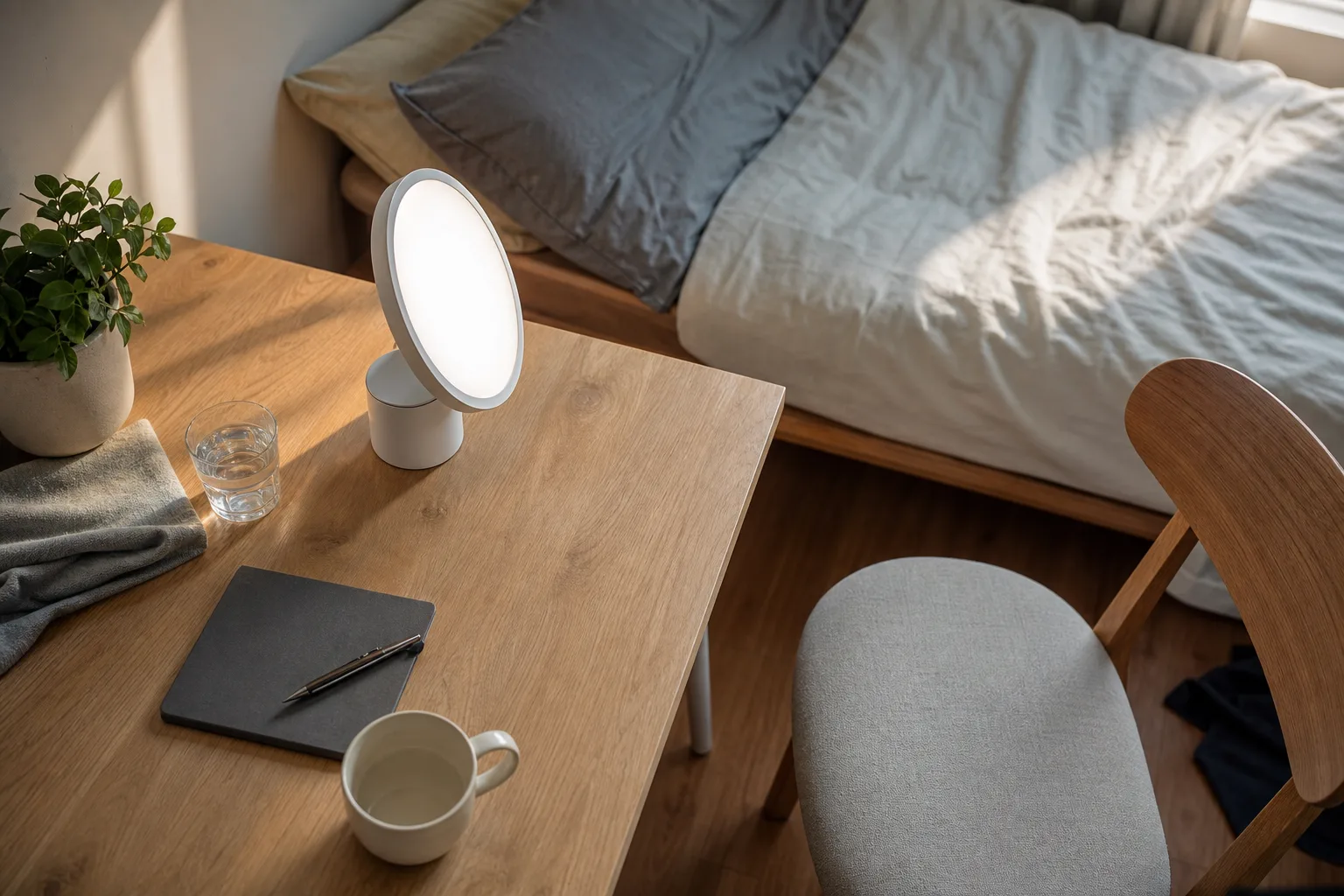
Timing decides the category before brightness enters the discussion. Similar words such as “daylight” and “sunrise” hide three different jobs.
| Option | When it works | Typical light level | What you must do | Best fit | Main limitation |
|---|---|---|---|---|---|
| Wake-up light | About 20 to 45 minutes before the alarm | Around 200 to 300 lux close to the bed on representative models | Set the sunrise and sleep within its useful beam | A gentler arrival of the alarm | Far below the concentrated output of a daylight lamp |
| Daylight lamp | Soon after waking | Often advertised as 10,000 lux at around 10 to 25 cm | Sit at the stated distance and angle for the instructed period | A fixed breakfast or desk routine | Brightness falls sharply as distance increases |
| Better room lighting | After switch-on, or earlier with scheduling | Usually low hundreds of lux across domestic spaces | Improve lumens, placement, diffusion and controls | Moving safely and comfortably through the home | Diffuse room light cannot reproduce a controlled close-range exposure |
Judge lux at the distance you will actually use
Daylight lamps win for concentrated brightness, while their headline figure says very little without a measurement distance. Lux measures light arriving at a surface, and lumens measure the total visible light emitted by the source.
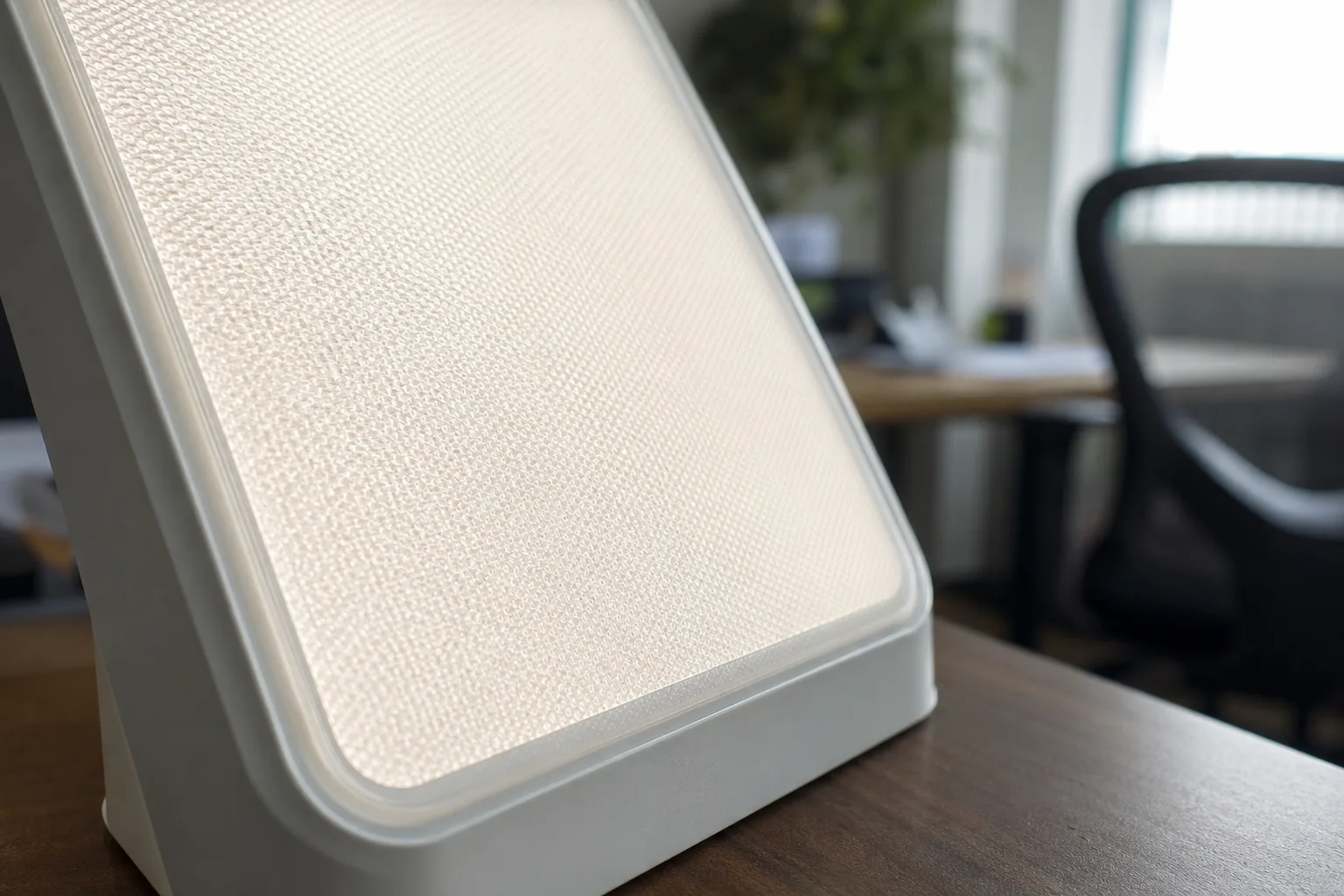
One representative lamp provides 10,000 lux at 20 cm, 5,000 lux at 30 cm and 2,500 lux at 50 cm. Another reaches 10,000 lux only at 10 cm. Close to a broad diffuser, the exact falloff is more complicated than the familiar rule that doubling distance quarters illuminance, so use the manufacturer’s measured table.
- Find the distance attached to the 10,000-lux claim. Reject listings that omit it.
- Check illuminance near eye level. A measurement on a horizontal table tells you less about light reaching the eyes.
- Measure the proposed position at home. A 10 cm working distance can clash with a breakfast plate or laptop.
- Prefer a broad, diffused surface if your head moves while reading or working. Direct staring is unnecessary.
Match the light to the clock
A gradual dawn and a bright post-waking session belong on opposite sides of the alarm. Moving either one to a convenient but unsuitable time changes the experience.
- Wake-up light: start the ramp roughly 20 to 45 minutes before the intended wake time. Adjust the final brightness if it wakes you too early, and retain an audible or vibrating backup when oversleeping has serious consequences.
- Daylight lamp: use it soon after waking at a consistent time, while eating, reading or working. Representative instructions often pair about 30 minutes with 10,000 lux, one hour with 5,000 lux and two hours with 2,500 lux. Those are manufacturer schedules, not personal medical instructions.
- Room lighting: switch on bright, diffuse light promptly after getting up. Scheduling helps if a wall switch is hard to find while groggy, but the switch must remain powered for smart automation to work.
Avoid casual high-output daylight-lamp use late in the evening because it can increase alertness and shift sleep timing in an unwanted direction. Shift workers and people trying to alter their sleep phase should ask a clinician about timing.
Prioritise dimmer, warmer evenings
Tunable room lighting earns much of its value after sunset, when lowering brightness matters at least as much as changing the shade of white. Correlated colour temperature describes appearance: about 2,700 K looks warm, 4,000 K looks more neutral, and 6,500 K looks cooler or bluer.
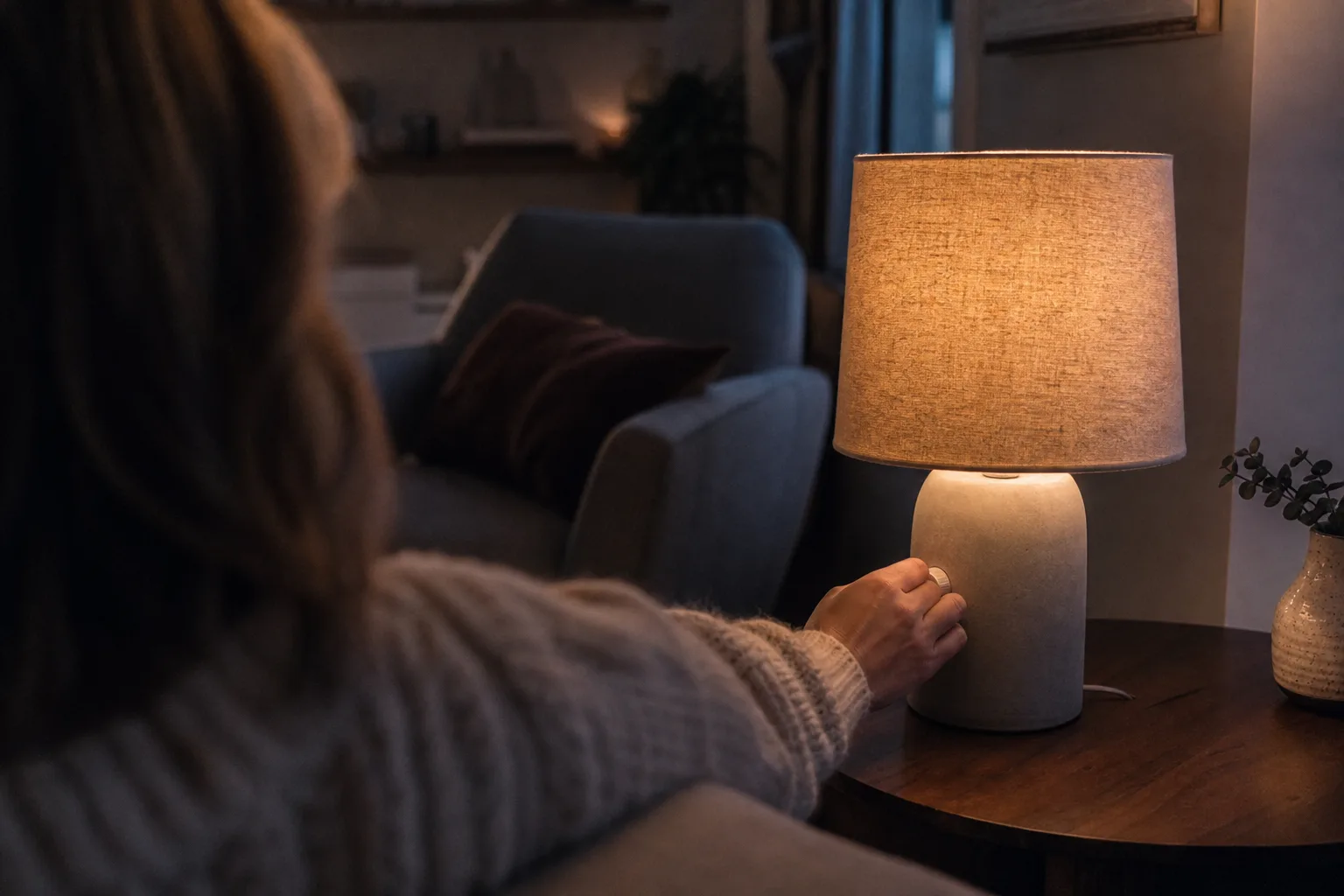
Colour temperature alone cannot describe biological effect. Two lamps with the same kelvin rating can have different spectra, and exposure also depends on brightness, direction, duration and time. Consumer packaging rarely gives melanopic measurements, so use practical controls instead.
- Morning and daytime: use bright, well-distributed white light. Around 3,500 to 5,000 K is often more comfortable in a room than a stark 6,500 K.
- Final hours before bed: dim first, then move towards roughly 2,200 to 2,700 K and keep bright sources away from the direct visual field.
- Shared morning and evening rooms: choose dimmable, warm-dim or tunable-white lighting. Saturated smart-bulb colours have little buying value for this job.
Less specialised room lighting is often the smarter and cheaper upgrade
Choose a room upgrade when the whole route through your morning feels dim. If you get up at 06:30 and spend the next 40 minutes moving between a bedroom, hallway and kitchen, a panel beside the breakfast chair helps during only one part of that routine.
Residential guidance places bedrooms around 100 lux, living spaces broadly between 50 and 300 lux, and kitchens around 150 to 300 lux, with more light at detailed work areas. Treat those figures as design guidance rather than a recipe for one extreme-output bulb.
- Buy ordinary bulbs by lumens and colour temperature. Ignore old “watt equivalent” language when better data are available.
- Spread light across several diffused sources. Bright walls and ceilings reflect light, while a single exposed high-lumen bulb often creates glare.
- Choose fixed-white LEDs for the lowest purchase cost, warm-dim bulbs for compatible dimmers, or tunable-white smart bulbs for scheduled morning and evening scenes.
- Keep physical control available. App-only operation brings cloud, compatibility and support risks.
Basic replaceable LEDs cost a fraction of many smart bulbs and are easier to maintain. Smart lighting’s extra money buys schedules, dimming and colour-temperature changes. Running cost remains small beside purchase price: an extra 30 W used for 1.5 hours on 180 mornings consumes about 8.1 kWh.
Compare tunable white bulbs
Live prices from more than 20 shops, updated daily.
Pick by routine, then check safety, positioning and controls
The right product is the one you can position and operate every dark morning. A powerful lamp that sits too far away contributes less than a modest product used as specified.
- Daylight lamp: suits desk users and people who eat breakfast in one place. Compact panels travel easily but commonly require 10 to 15 cm; mainstream desk panels often give 10,000 lux at 15 to 25 cm.
- Wake-up light: suits people who dislike abrupt alarms and couples with similar schedules. Check adjustable sunrise length, final intensity, sound backup, two alarms, display blackout and bedside depth.
- Room lighting: suits families, shared homes, renters who can change bulbs and anyone who moves immediately after waking. Layered ambient and task light usually feels better than one glaring source.
A daylight lamp should be explicitly UV-free or UV-filtered. Never substitute tanning, UV skin-treatment, reptile or germicidal equipment. Look for a stable base, intact cable, correct plug and voltage, a traceable manufacturer and a clear warranty. A credible IEC 62471 photobiological-safety claim should identify the applicable standard or risk group instead of relying on vague “eye safe” wording.
Integrated LEDs are common in wake-up lights and may be unreplaceable, so warranty length matters. Ordinary replaceable bulbs are easier to maintain. For any connected product, check whether alarms and schedules continue locally when the internet or manufacturer’s cloud service is unavailable.
FAQ: claims, smart sunrises and common mistakes
The common mistakes come from comparing numbers measured in different places or expecting one light source to cover every hour of the day.
Can I put a 10,000-lux lamp across the room?
Usually no. If the manufacturer specifies 10,000 lux at 10 to 25 cm, the illuminance across a room will be dramatically lower. Use the measured distance table and plan the lamp’s real position before buying.
Can smart bulbs replace a wake-up light?
Several scheduled bulbs can brighten a bedroom gradually. A dedicated wake-up light also brings a controlled bedside beam, an alarm sound, snooze and local clock functions. Smart bulbs are the better choice when whole-room illumination matters and you already have a reliable alarm backup.
Does a UV-free daylight lamp make vitamin D?
No. Skin production of vitamin D requires UVB, while a proper visible-light daylight lamp filters or excludes ultraviolet output.
Does 6,500 K guarantee a stronger morning effect?
No. Kelvin describes the appearance of white light, while spectrum, brightness at the eye, direction, timing and duration all matter. Choose a colour you can use comfortably at the required brightness.
Does CRI 90 prove that a lamp has a greater circadian effect?
No. A CRI of 90 or above improves how colours appear compared with the common CRI 80 level. It does not establish the lamp’s biological effect.
Verdict: fix the moment that feels dark
Buy a wake-up light for a gentler alarm, a daylight lamp for a deliberate close-range routine after waking, or better room lighting when you move through a dim home. For most whole-room upgrades, tunable white earns its premium through bright neutral mornings and dim warm evenings. Persistent low mood or disruptive sleep problems belong with a doctor, regardless of the lux figure on the box.
This article was created using AI, following our team's editorial standards.


