

Judge the complete packed set in your child’s hands before buying. It should fit real food, comply with school rules, come apart for cleaning and survive three child-operated opening and closing cycles without help.
Keep what works: replace only gear that fails the filled, child-operated test
Existing gear deserves another school year if the child can use it independently and it still seals properly. You don’t need a matching set or a compartmented box just because September displays are full of them.
- Keep current containers if they fit the usual bread and fruit, stay closed in the bag and suit your washing routine.
- Choose a molded plastic bento for a child aged roughly 3 to 8 who needs one latch, visible portions and few loose pieces.
- Use modular household containers for dry lunches and older children who can manage several lids without losing them.
- Add a vacuum food jar only when warm lunches are allowed and the child can open the preheated jar safely.
- For children with motor, sensory or developmental differences, judge button pressure, lid noise, bottle width, suction and the number of pieces directly. The age badge gives little useful information about these factors.
Check the school’s bottle, material and hot-lunch rules before choosing a design
The school handbook can eliminate an otherwise suitable bottle or lunch box immediately. Policies can require clear plastic, ban glass or metal, prohibit squeeze bottles, allow water only or cap capacity at around 24 fl oz.
- Are glass, metal, insulated or squeeze bottles prohibited?
- Must the bottle be transparent, and is there a capacity limit?
- Are straw or flip lids allowed at desks?
- Can the child refill during the day?
- Are food jars and warm lunches allowed, and can staff help with lids?
- Is refrigeration available?
- Does the school require names on bottles or specific allergen separation?
Perishable cold food needs an insulated bag and effective cold sources. A conservative method uses two gel packs around 5 by 3 inches, with one above and one below the food. For a warm meal, use a dedicated food jar, preheat it with boiling water, empty it, add piping-hot food and keep it closed until lunch.
Run the small-hands test with the lunch packed, chilled and at full carrying weight
The child should complete the entire lunch routine with the box cold and the bottle full. A 1.26 lb box becomes about 3.68 lb after adding 1.10 lb of water and 1.32 lb of food. Heavier systems can reach roughly 4.12 to 5.03 lb under the same illustration.
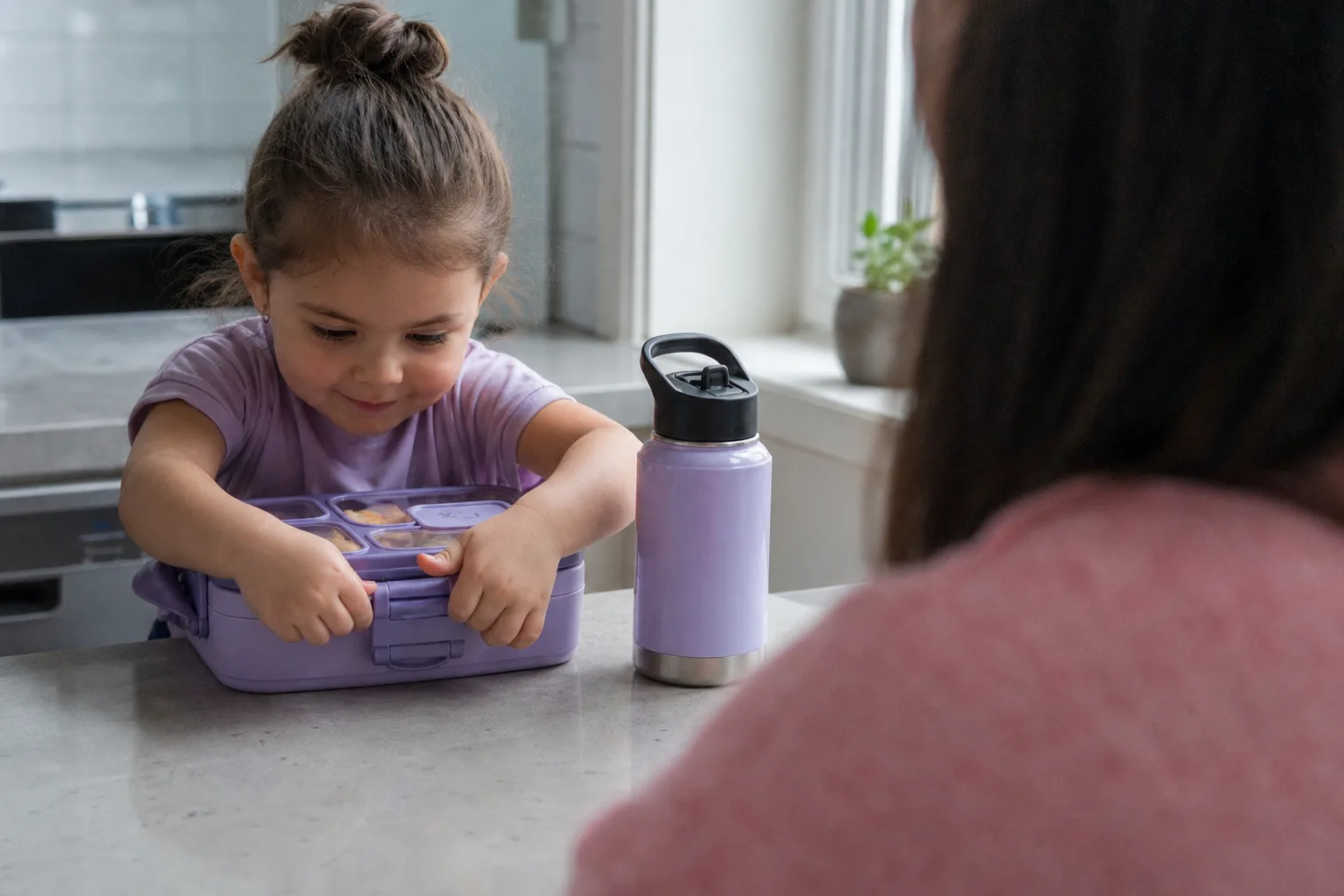
That matters for a 44 lb five-year-old. Paediatric guidance commonly keeps a loaded backpack within 10 to 20% of body weight, about 4.4 to 8.8 lb here, so lunch can consume much of the practical allowance.
- Pack the usual lunch, chill or preheat it as required, and fill the bottle to its normal level.
- With slightly damp hands, have the child open every latch, button and screw lid without coaching.
- Have the child eat or drink, reseal every part and return the items to the actual bag.
- Repeat the complete sequence three consecutive times, then let the child carry the bag through normal backpack movement.
Single front latches usually require fewer actions than two side latches. Screw jars need two-handed torque, while push-button straws reduce opening effort but add cleaning parts. Bottle bodies around 2.8 to 3.1 inches wide are common, so check that a small hand can lift the full bottle one-handed.
Match age-appropriate capacity to real bread, whole fruit and genuinely sealed foods
Choose the largest usable compartment first, then confirm the total capacity. These ranges are practical shopping bands, not nutritional prescriptions.
- Ages 3 to 5: lunch box around 19 to 25 fl oz, bottle around 12 to 15 fl oz when refills are available.
- Ages 5 to 8: lunch box around 25 to 41 fl oz, bottle around 15 to 20 fl oz.
- Ages 8 to 12 or larger appetites: lunch box around 34 to 51 fl oz, bottle around 20 to 25 fl oz if school rules, refills and carried weight allow.
Bring the child’s actual bread, roll or wrap when shopping. Five small half-cup wells can hold cut food yet leave no space for an intact sandwich. A well measuring 4.0 by 4.0 by 1.5 inches is very different from one measuring 6.7 by 4.5 by 2.0 inches. Also check vertical clearance for yogurt tubs, thick bread and whole fruit.
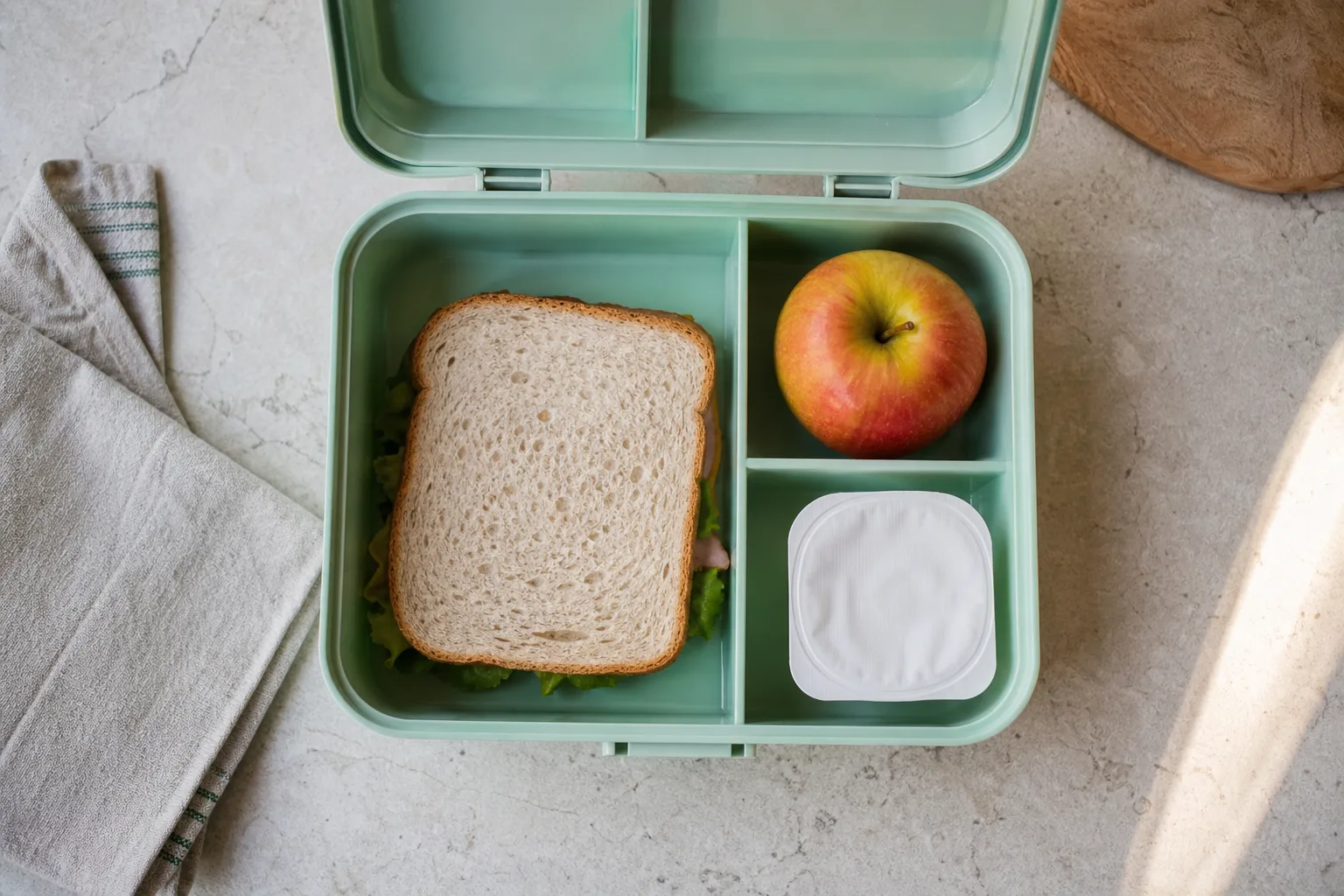
Read leak claims carefully. Individual silicone ridges can stop yogurt moving between wells, while a perimeter gasket can keep food inside yet allow migration across dividers. Removable dividers usually separate solids only. Free liquids such as soup often require a separately sealed container.
- Pack the planned yogurt, cut fruit or dressing without exceeding the stated fill line.
- Clean the sealing surfaces and close the box using only the force the child can reproduce.
- Place it on absorbent paper inside the lunch bag, then carry it upright and on its side.
- Check both the bag and the spaces between compartments. Never test soup in a section the maker excludes from liquid use.
Choose materials and drinking parts that your washing routine can keep mold-free
The best material is the one your household can wash, inspect and dry completely every day.
- Plastic is light, relatively inexpensive and sometimes transparent. It offers little insulation and can stain, scratch or distort if its care instructions are ignored.
- Single-wall stainless steel resists food staining and odor and can be very durable. It is heavier, opaque, unsuitable for microwaves and prohibited by some schools.
- Vacuum-insulated stainless steel suits warm food, hot weather and days without refills. It adds the most weight and often has component-specific hand-washing rules.
- Silicone works well for seals and edge protection. Gaskets must be removed where instructed, washed and dried before refitting.
- Glass is heavy, breakable and commonly banned. Skip it for a school backpack.
Sports caps, bite valves and covered straws can trap moisture and residue in dark channels. Choose a cap that fully disassembles and lets you see the drinking path. Remove the straw and gasket where designed, wash each piece and leave everything apart until completely dry.
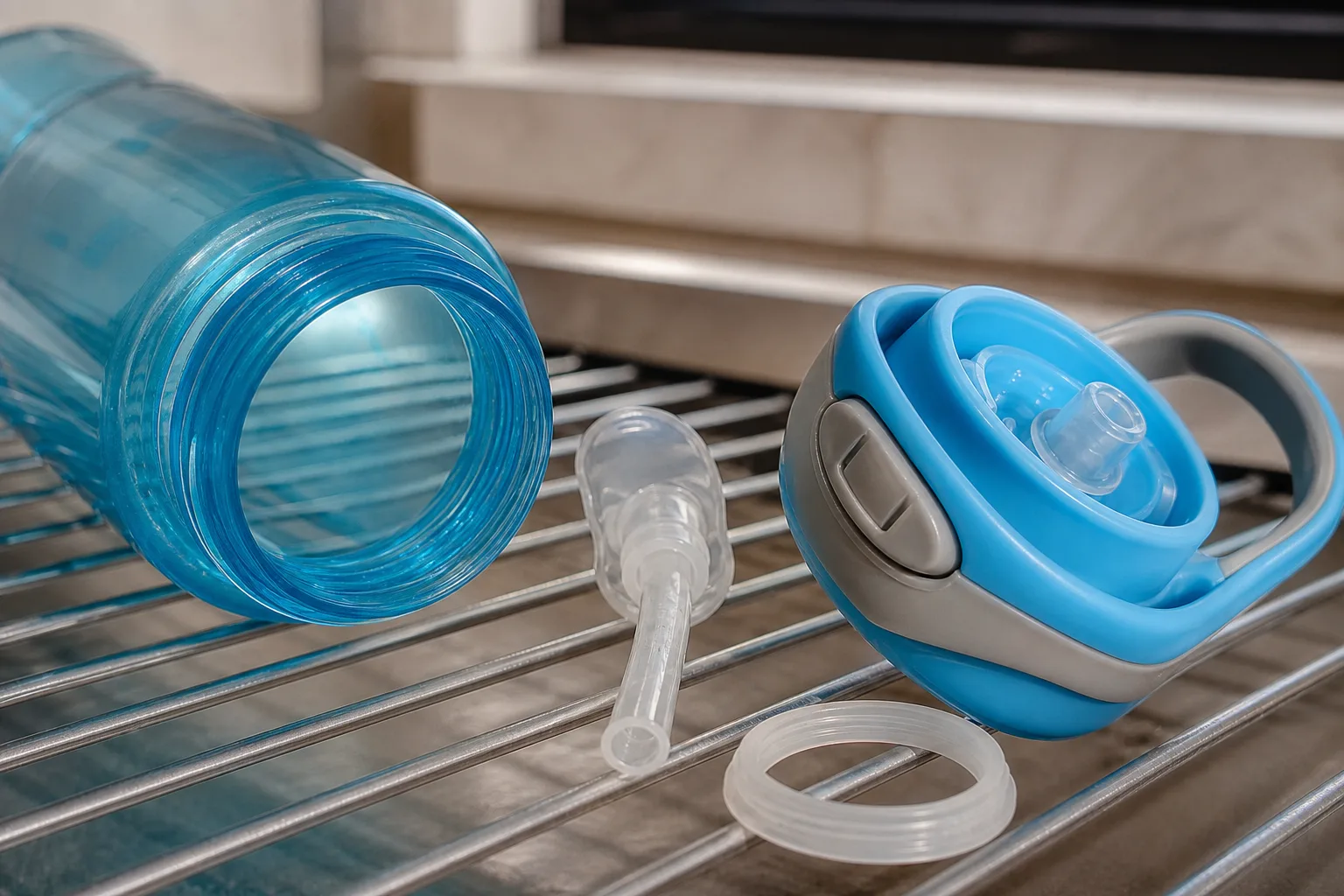
- Fully dishwasher-safe should cover every functional component under the stated instructions.
- Top-rack safe still requires disassembly and complete drying.
- Tray or lid only means the shell, insulated body or finish needs separate hand washing.
- Fixed valves that retain water after a cycle remain a poor choice for dishwasher-dependent households.
Check the price and availability of seals, straws, valves and trays before purchase. A modest replacement straw can save a sound bottle, though a replacement tray costing more than half the original box can be poor value.
Compare the best lunch-box and bottle setups by use case, weight and fair annual cost
For most younger students, a molded plastic bento and a refillable 12 to 20 fl oz bottle give the strongest balance of independence, weight and price.
| Setup | Best fit | Practical capacity | Weight and care | Fair price tier |
|---|---|---|---|---|
| Existing modular containers plus insulated bag | Dry lunches and children who manage several lids | Size each container around the actual meal | Usually light; pieces can go missing | No new purchase or entry |
| Molded plastic bento plus plastic bottle | Preschool and early elementary cold lunches | 19 to 41 fl oz box; 12 to 20 fl oz bottle | Light to medium; shell may need hand washing | Mid-range |
| Sandwich-format bento plus bottle | Intact sandwiches, wraps and larger main portions | About 25 to 34 fl oz box | Medium; fewer tiny wells to clean | Mid-range |
| Stainless bento plus insulated bottle | Durability, hot weather and schools allowing metal | Usually elementary-school capacities | Heavy; check dishwasher instructions | Premium |
| Food jar plus side container and bottle | Allowed warm lunches such as soup or pasta | Jar sized to the child’s normal portion | Bulky and torque-heavy; often hand washed | Premium |
Price checks from July 2026 put child-focused bentos at roughly $15 to $35, about two to four times the price of basic containers. Premium steel or hot-food systems commonly cost around $30 to $60, or one and a half to twice the mid-range level. That extra money can buy defined compartment seals, insulation, replaceable parts and stronger service support. Opening ease still requires the child test.
A cheap set replaced twice costs three purchase prices in one school year. A better set costing four times as much and lasting two years costs two entry prices per year. Paying more makes financial sense once it prevents repeat purchases and the parts that usually fail are replaceable.
Compare kids’ bento lunch boxes
Live prices from more than 20 shops, updated daily.
Avoid the September mistakes that cause leaks, trapped mold and midyear replacements
Six checks prevent most early failures before the labels come off.
- Don’t judge an empty display model. Add the expected food and water weight.
- Don’t treat leakproof as permission to pack soup. Check which compartments and food thicknesses the claim covers.
- Keep bread, fruit and yogurt below the seal line. Overfilling breaks lid-to-tray contact.
- Avoid caps with fixed, hidden valves when nobody will clean them by hand.
- Read dishwasher instructions component by component. A safe tray tells you nothing about the shell, hinge or insulated body.
- Ignore extra compartments that the child’s normal lunch won’t use. More wells add cleaning and can shrink the sandwich space.
FAQ: Leakproof claims, dishwasher care, bottle size and warm-lunch safety
Component-level instructions settle several questions that broad package claims leave open.
What should I do if the school refrigerates lunch boxes?
Place the lunch in the refrigerator with the insulated bag open so cold air can circulate. Close the bag again before the child carries it to lunch.
Can a bento tray go in the microwave?
Only use the exact component the manufacturer identifies as microwave-safe. Stainless boxes and vacuum food jars cannot go in a microwave, and a microwave-safe plastic tray does not make its outer shell safe.
Why can a food-jar lid feel tighter at lunchtime?
Temperature changes, food residue and overtightening can increase the effort needed. Test the packed jar after the normal waiting time and teach the child to stabilize the body on a flat surface before turning the lid.
Can an insulated children’s bottle carry milk, soup or hot chocolate?
Check the bottle instructions. Several common straw-bottle designs exclude hot, carbonated or perishable drinks. Insulation alone does not make a water bottle suitable for warm food or milk.
Are decorative magnets and detachable plugs safe for preschool children?
Follow the stated age rating. Some lunch-box magnets and sports-cap parts carry warnings for children under three. Remove damaged or loose components immediately.
The verdict: pack it, test it three times and buy only what the child can manage alone
For most preschool and early elementary children, choose a light molded bento with one easy latch, a sandwich-capable main well and seals you can remove and inspect. Pair it with a school-approved 12 to 20 fl oz bottle whose full body fits the child’s grip. Pack the real lunch, chill it, fill the bottle and require three independent cycles before committing.
This article was created using AI, following our team's editorial standards.