

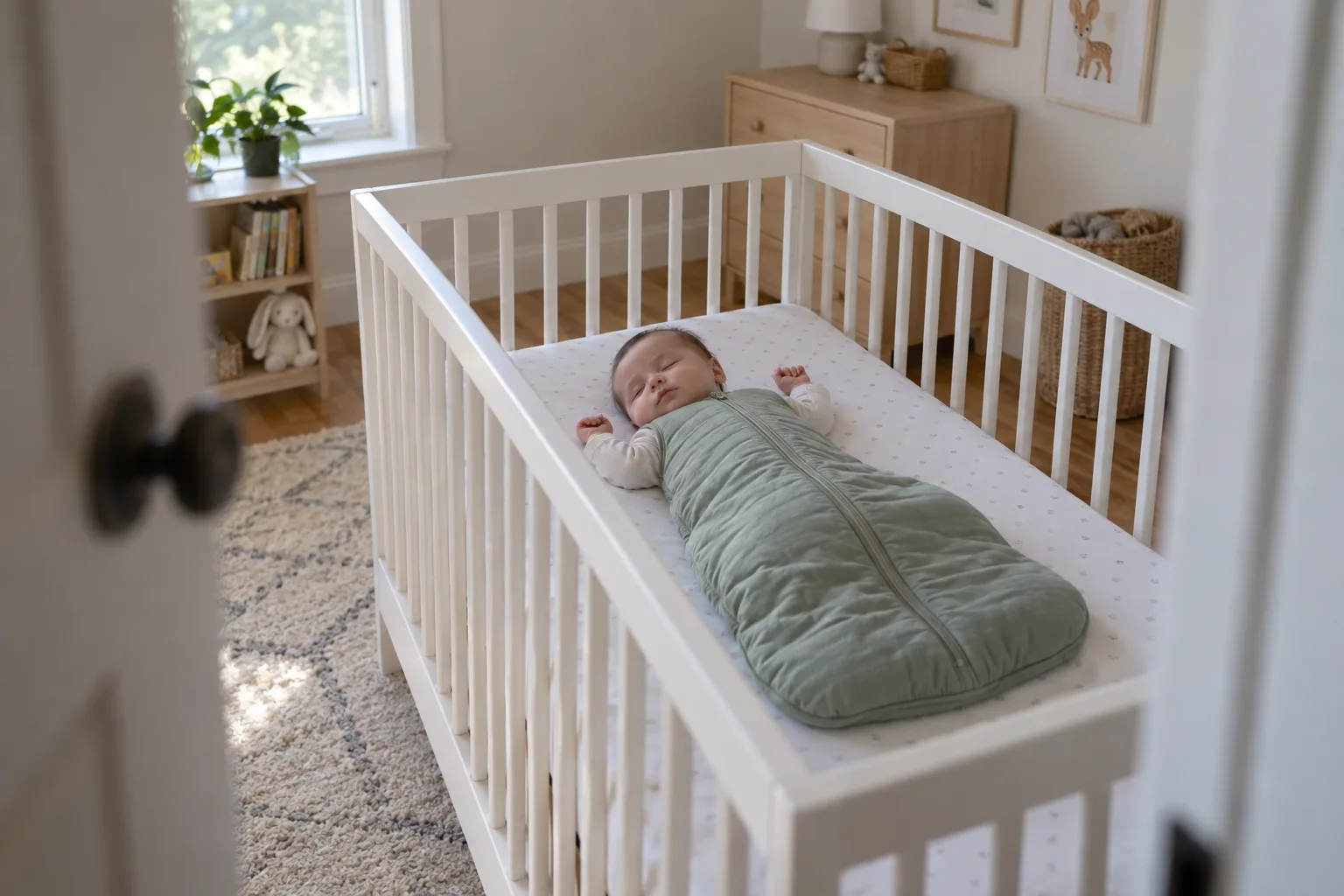
A 65°F bedroom points to a 2.5 TOG sleep sack as a starting point; at 72°F, look at 1 TOG instead. Check the particular sack’s clothing guide and your baby’s chest before deciding what goes underneath.
A sleep sack leaves safe-sleep rules unchanged
A sleep sack keeps a baby covered without loose bedding riding over their face. It suits families who want that coverage, but it cannot make an unsafe sleep space safe or prevent SIDS. If a sack you own still fits and suits the room, you needn’t buy a winter-labeled replacement.
- Put your baby down on their back on a firm, flat, non-inclined crib or bassinet mattress, with their head and face uncovered.
- Keep pillows, comforters, bumpers, toys, nests and other soft items out of the sleep space.
- Keep your baby’s separate crib or bassinet in the parents’ room for at least the first six months, as American Academy of Pediatrics (AAP) safe-sleep guidance recommends.
The overnight room temperature sets the TOG starting point
Measure where the baby sleeps with a room thermometer kept out of reach, and check whether the room changes overnight. TOG measures a sack’s insulation; it cannot tell you your baby’s final temperature. These ranges provide a shortlist. The particular sack’s dressing guide determines the next step.
| Sleep-room temperature | TOG starting point | What to check |
|---|---|---|
| Below 61°F | Some makers specify 3.5 TOG | Follow that sack’s exact clothing guide. If the room is markedly colder, especially for a newborn or vulnerable baby, address the room conditions and seek individual advice. |
| 61 to 68°F | 2.5 TOG is a common starting point | Check the maker’s underlayers. An extra onesie adds insulation. |
| 68 to 75°F | 1 TOG is a common starting point | Use lighter clothing underneath toward the warmer end, following the maker’s guide. |
| 75 to 81°F | 0.5 TOG is a common starting point | Some ranges offer 0.2 to 0.3 TOG. A baby may need little clothing underneath. |
| Above 81°F | No TOG recommendation for this temperature range | A lightweight bodysuit or just a diaper can be appropriate in very hot weather. Monitor the baby and room; a sack may be unnecessary. |
The 61 to 68°F sleep-room recommendation is useful guidance, rather than an exact biological cutoff. A heated bedroom can call for a light sack even when it’s freezing outdoors. No U.S. rule assigns 3.5 TOG to every room below 61°F.
Clothes underneath can make the chosen TOG too warm
Start with the clothing chart for the exact sack, then check your baby’s trunk. One maker pairs its 2.5 TOG sack with a sleeper at 61 to 68°F. For its 3.5 TOG sack, it specifies either a bodysuit or a sleeper at 57 to 61°F, then both below 57°F. Those combinations belong to those products; another sack can have different instructions.
- Feel the chest or back of the neck. Hands and feet commonly feel cooler and are a poor guide to adding a layer.
- If the chest or neck feels hot or sweaty, or hair is damp or skin flushed, remove a layer or use a lighter sack. Overheating is a safety concern.
- If the trunk feels cold, check the room and the maker’s chart, then adjust the clothing or sack. Check again if the room changes overnight.
A sack to grow into can let a baby slip inside
Choose within the maker’s weight and height limits, then fasten the sack on your baby. An age label such as “0 to 6 months” cannot establish a safe fit. The lower half should leave space for hips and knees to bend, while the neck and arm openings must stay secure.
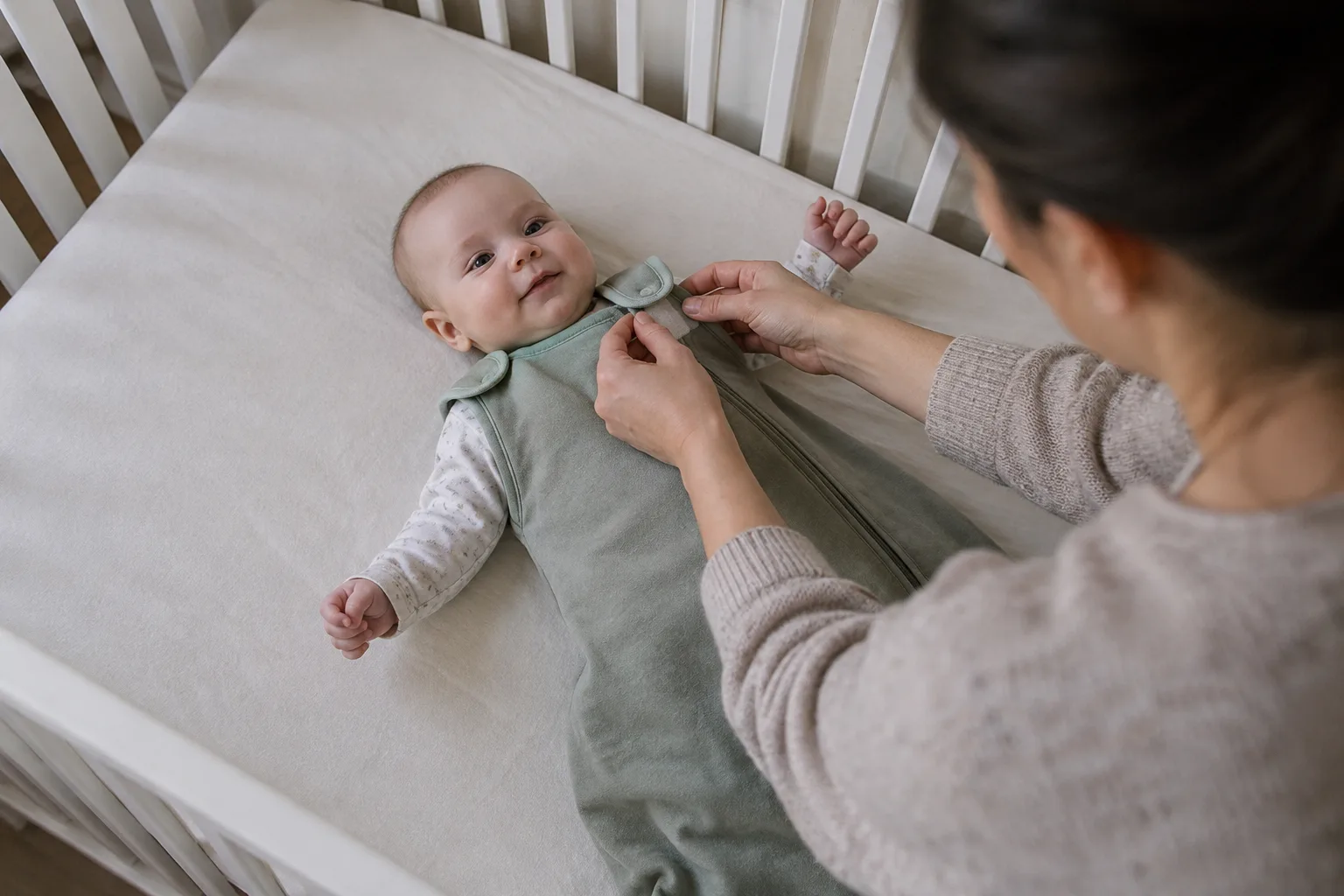
- Check that the baby’s head cannot pass through the fastened neck opening and that their arms cannot disappear into the sack.
- Reject hoods, loose ties, insecure decorations and weighted sacks. Leave the legs free to bend and move.
- Stop using an arms-in or body-compressing swaddle design as soon as the baby shows signs of trying to roll. An arms-free sack can continue if it fits.
Published minimums vary: one newborn sack starts at 7 lb, while guidance for premature babies says most sacks can be used from around 9 lb, subject to their instructions. For a premature, small or medically vulnerable baby, ask the hospital discharge team about fit and temperature needs before buying a larger sack to last longer.
Wash-day checks can catch a changing fit
Recheck the fastened openings after laundering and during use. A 2026 recall involved neck openings that could stretch enough to let a baby slip inside. An initially snug fit is no reason to stop checking.
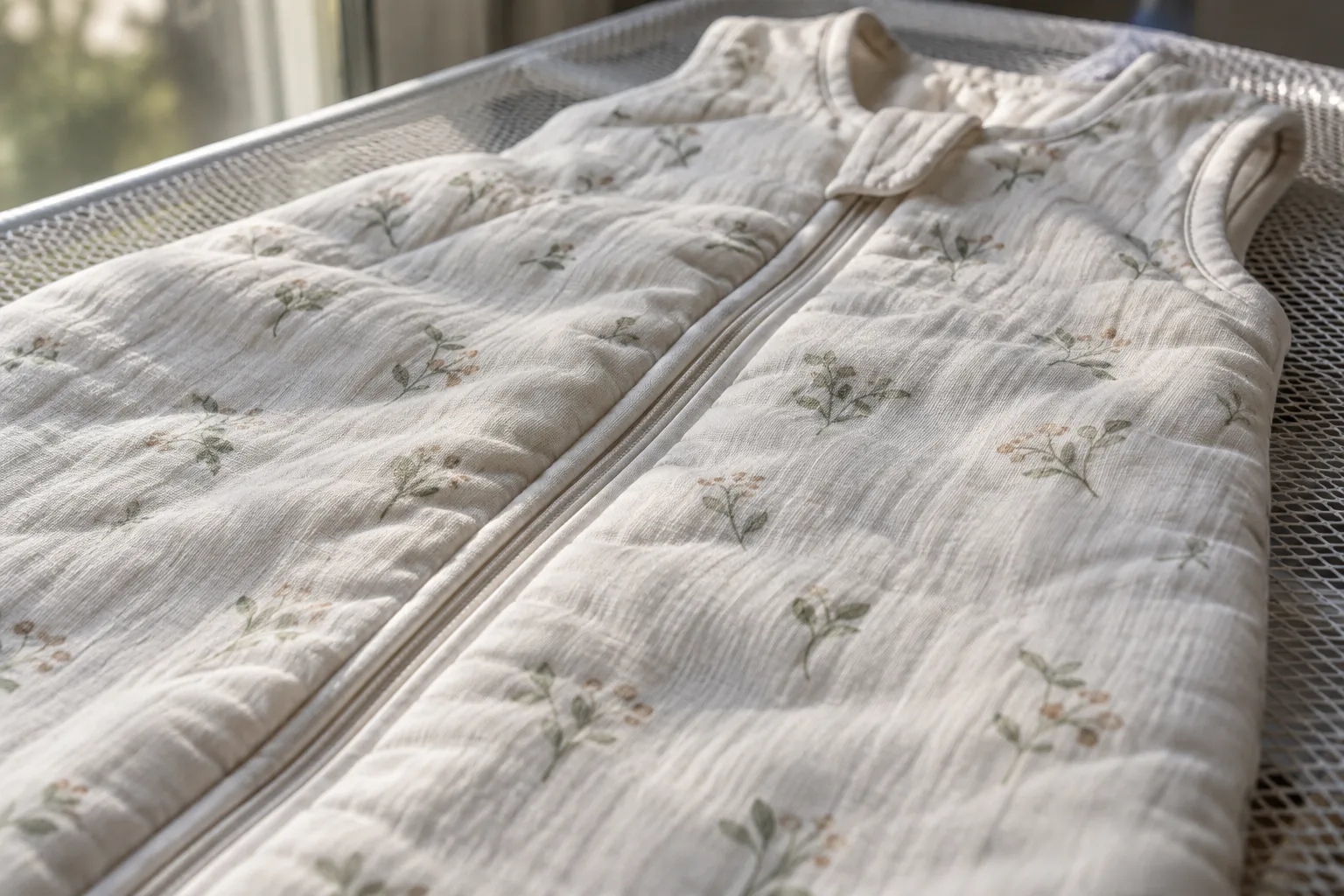
- Fasten the shoulders and zip. Check that closures stay shut, the zipper pull is secure, and stitching and filling remain contained. A bottom-opening zipper can ease diaper changes; a zipper guard keeps the fastening off skin.
- Read the care label before buying. Wash and drying instructions vary across cotton, filled and wool sacks, so choose a routine you can follow.
- Check the maker’s product-safety information and the U.S. Consumer Product Safety Commission (CPSC) recall database alongside the sack itself. A European EN 16781:2026 marking is not a U.S. safety approval; an older marking alone does not prove a sack is defective.
A steady room favors a conventional sack
For a crib room that stays near 65°F, start by comparing correctly sized, sleeveless 2.5 TOG sacks and their clothing guides. Choose a different design for a specific need:
- A convertible sack can serve a room with substantial temperature swings. Verify the TOG and dressing chart for each configuration, and secure every detachable part as instructed.
- A footed design can help an older mobile child move before or after bedtime. Check its neck fit and the maker’s crib-use instructions; stop using a crib sack if the child can climb out.
- Cotton, fleece, polyester-filled quilting and wool differ in feel and care. A fiber name, “breathable” claim or “four-season” label cannot replace the stated TOG and clothing guide.
Compare the price per correctly sized sack at the needed TOG, especially with multipacks. A second suitable sack helps while one is wet. If you find a discount, compare the same size, TOG, configuration and number of sacks against their usual purchasable price; there’s no reliable best month to wait for.
Compare baby sleep sacks
Live prices from more than 20 shops, updated daily.
Extra blankets and winter hats create hazards
If your baby’s trunk feels cold, use a suitable sack or a maker-approved underlayer and recheck their warmth. Never put a blanket or comforter over a sleep sack, and never stack sacks to improvise extra insulation.
- Keep hats and hoods off for indoor sleep, and remove outdoor hats and extra clothing when you come inside.
- Keep the crib away from radiators and leave hot-water bottles out of the sleep space.
- Keep the baby’s head and face uncovered as you adjust their clothing or sack.
Frequently asked questions
Does a printed TOG prove a sleep sack is safe?
No. A TOG label gives an insulation figure, not a safety approval. A targeted 2020 investigation found wide necks and inaccurate TOGs among sampled sacks. It is not a current market failure rate, but it is a reason to check the seller, construction, instructions and recalls.
Can my baby wear a crib sleep sack in a car seat?
Don’t put a bulky sack or insert between the baby and the fastened harness; it can compress in a crash and leave the straps loose. Use thin layers and, if needed, warmth over the harness while keeping the face clear. Move a sleeping baby to an appropriate flat sleep space when travel ends.
Can I use a blanket instead of buying a sleep sack?
AAP safe-sleep guidance recommends keeping loose blankets out of the sleep space. A wearable blanket or sleep sack can keep your baby covered without loose bedding. Follow the safe-sleep guidance in your market; never put a blanket over a sack.
How many sleep sacks should I buy?
One can be enough if it can be washed and dried before the next sleep. Two correctly fitting sacks make leaks or slow drying easier to handle; frequent leaks or spit-up may justify a third. Match any spare to the room temperatures you actually have.
Will a sleep sack prevent SIDS?
No product guarantees that. A sack’s practical benefit is keeping the baby covered without loose bedding that could reach the face. Back sleeping, a clear sleep space and avoiding overheating still matter.
How to choose
For most bedrooms that stay around 61 to 68°F, start with a correctly fitting, sleeveless 2.5 TOG sack. Use its own clothing guide, check your baby’s chest or neck, and change the combination if the room or your baby’s warmth changes. A reliably heated room may call for a lighter sack, even through winter.
This article was created using AI, following our team's editorial standards.

