


Fit one or two smart radiator heads about a month before dependable daily heating starts, then use the trial to prove valve fit, wireless range and boiler response. For most suitable homes, plan around 5 to 15% lower space-heating use, with savings coming from shorter heating periods in empty or already-warm rooms.
Who benefits from room-by-room control
The strongest candidates have wet radiator heating, control over their boiler and rooms used at clearly different times. A smart radiator thermostat replaces the removable head of a thermostatic radiator valve, senses nearby temperature and moves the existing valve pin to regulate water flow.
- Good fit: bedrooms used morning and evening, a weekday home office, occasional guest rooms or an upper floor left empty for much of the day.
- Useful where a hallway wall thermostat switches the boiler off while a north-facing bedroom remains cold, provided the chosen system lets that bedroom request heat.
- Weak fit: small open-plan homes, households heating every room to similar temperatures all day, and homes already managed carefully with mechanical valves and a good central schedule.
- Do not buy if you rent a home with communal heating you cannot control, cannot change the valve heads, or pay a fixed heating charge unrelated to use.
Budget on 5 to 15% savings
A realistic plan starts at 5 to 15% of space-heating energy, with the lower end applying to well-controlled homes. Independent test-house research found about 12% from effective zonal control, with modelled results around 10 to 14% and smaller gains in better-insulated homes.
| Starting point | Plausible space-heating reduction |
|---|---|
| Good schedules, stable occupancy, sensible mechanical valves | 0 to 5% |
| Several rooms heated unnecessarily each day | 5 to 15% |
| Long or irregular absences, strongly different room schedules | 10 to 20% |
| Manual controls, serious overheating, whole home heated continuously | 20 to 30% is possible, but unsafe as a budget assumption |
Map waste before shopping. A home office needed from 08:00 to 17:00 on weekdays and a guest room used twice a month offer clear setback hours. A living room occupied all day at a steady temperature offers much less.
Calculate payback as installed hardware cost divided by annual variable space-heating spend multiplied by the realistic saving rate. Add subscriptions and batteries. Exclude hot water, cooking, standing charges and unrelated electricity, because radiator zoning does not reduce them.
Make sure each room can request boiler heat
Choose an integrated boiler link if rooms need heat outside the central thermostat’s normal cycle. A basic smart head can open its radiator, but no hot water arrives if the hallway thermostat has already switched the boiler off.
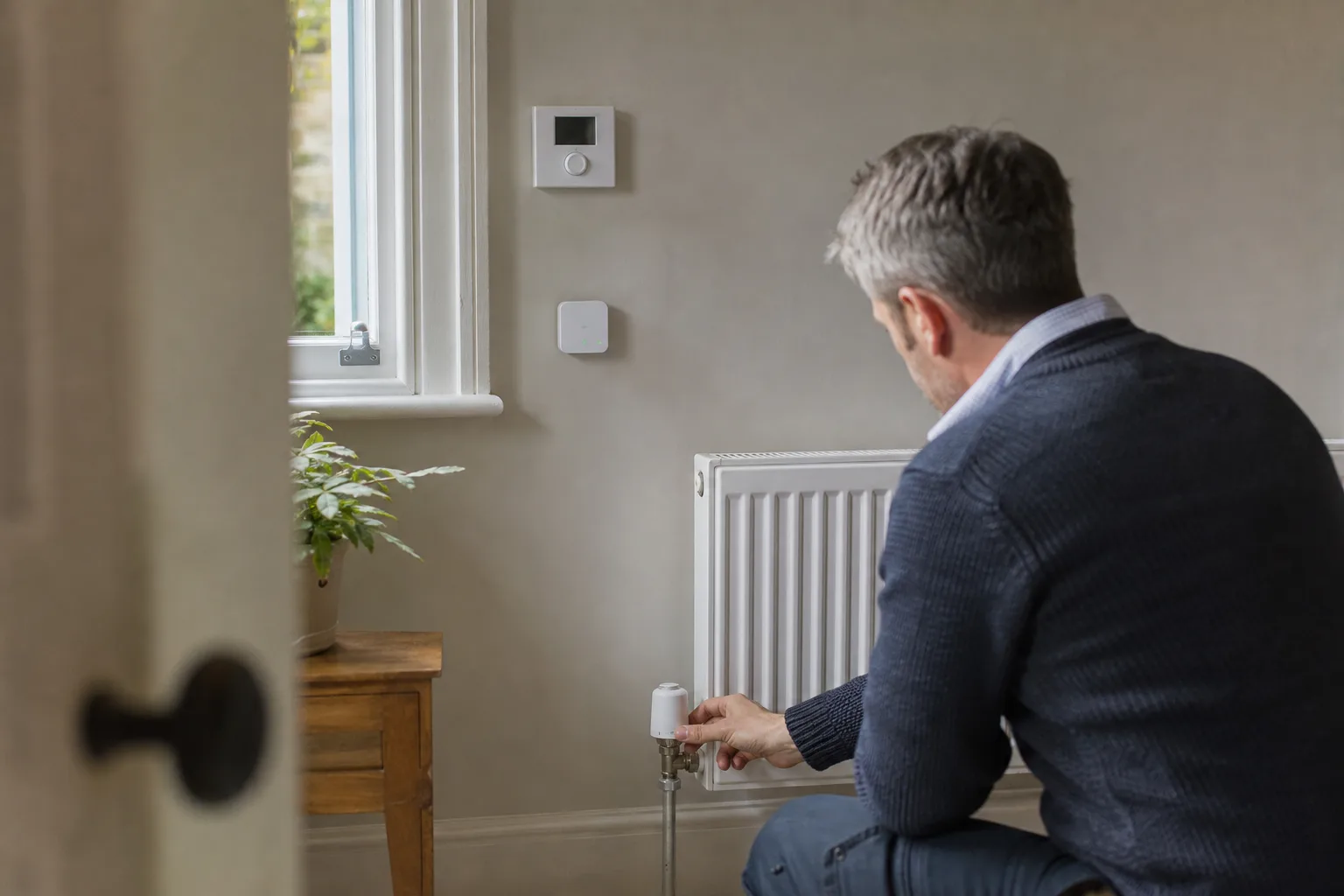
- Ask whether each room only limits available heat or can send a heat request.
- Check whether that function requires a wired thermostat, wireless receiver or separate boiler controller.
- Confirm whether the boiler uses a basic on/off relay or a supported modulating protocol such as OpenTherm.
- Ask how the system handles several rooms requesting different temperatures at once.
A smart head paired with the existing wall thermostat is adequate when room schedules overlap the boiler’s operating hours. For a bedroom needed at 06:30 while the central schedule starts at 07:30, use coordinated boiler control.
Check valve fit, clearance and temperature sensing
Inspect one representative radiator before ordering a full set. M30 × 1.5 mm is a common direct fit, although M28 × 1.5, M30 × 1.0, clip-on Danfoss fittings and several other designs are also in service.
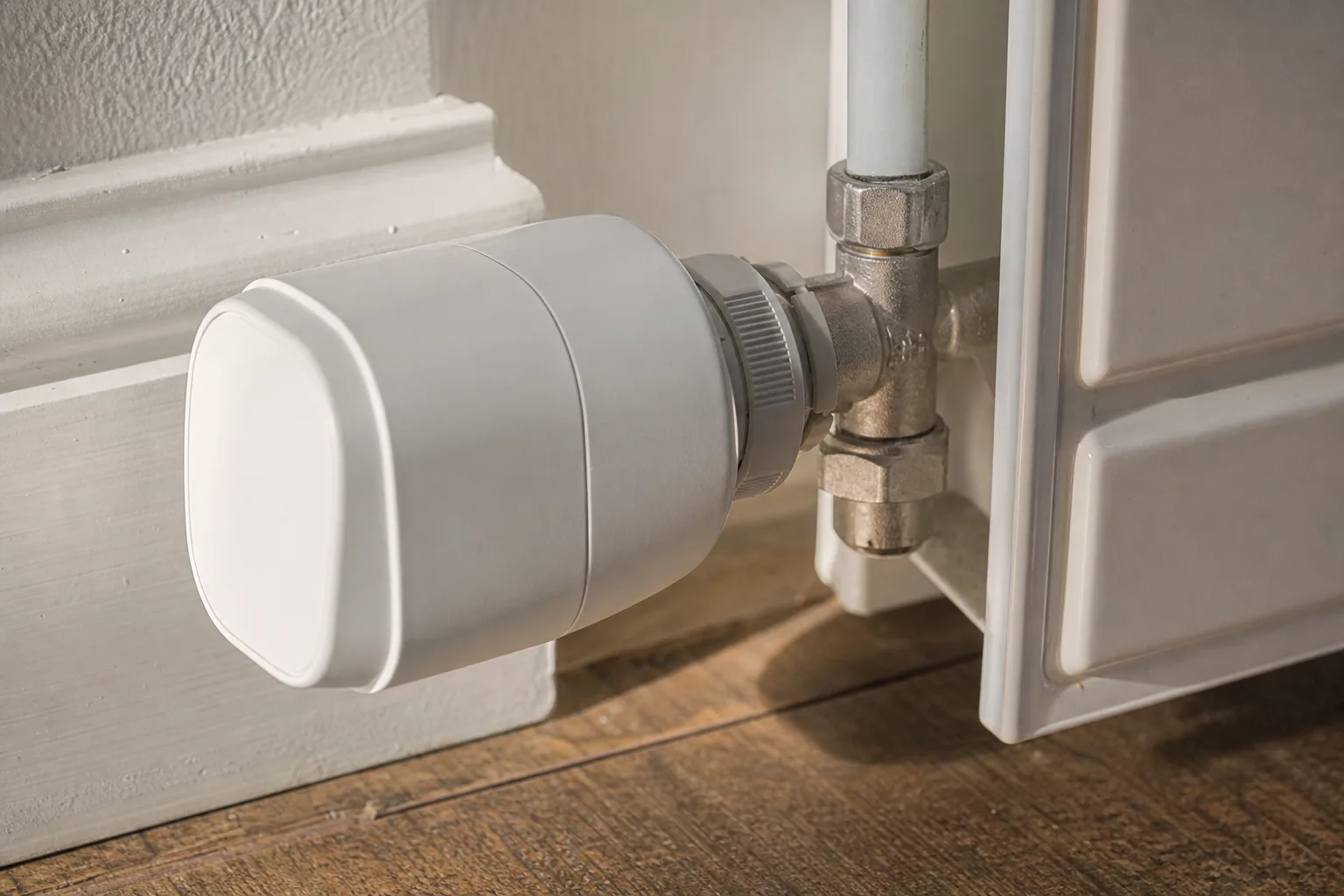
- An adapter can correct thread diameter, thread pitch, clip-on mounting or pin reach, sometimes with a pin extender.
- It cannot repair a seized, corroded or leaking valve, convert an unsuitable manual body, correct one-pipe hydraulics or make an RTL water-temperature valve compatible.
- Measure around walls, skirting, covers and furniture. Current smart heads are typically 51 to 57 mm wide and 78 to 90 mm long.
- Removing a conventional thermostatic head normally releases no water. Replacing the valve body requires plumbing work and may require draining or isolating the circuit.
The built-in sensor sits beside a hot radiator, often near a cold wall or trapped behind curtains. A temperature offset helps with a consistent error. Use a separate room sensor for covered radiators, large rooms, outside-wall installations or rooms with several radiators, placing it around occupied height away from sunlight and draughts.
Choose an ecosystem that survives winter
Prioritise local schedules, dependable radio coverage and manual control before app polish. Proprietary bridges often coordinate multiple heads and boiler demand well, although they tie future replacements to one product family.
- Matter-over-Thread can reuse a compatible Thread border router. Remote control still needs that router, and battery heads usually do not extend the mesh.
- Matter improves platform compatibility, but advanced schedules, external sensors, calibration, boiler demand and reports can remain inside the manufacturer’s app.
- Bluetooth or stand-alone heads can store a weekly schedule without a cloud account. They usually lack away-from-home changes and geofencing.
- Before the return period ends, disconnect the internet while leaving heating power on. Confirm schedules continue, physical controls work and the app clearly reports the outage.
Replaceable batteries typically last one to two years, with some claims reaching 2.5 years. Rechargeable packs may need annual charging, which can take roughly 2.5 hours. Weak radio signals, stiff valve pins and frequent motor movements shorten runtime.
Check the approved battery chemistry and the exact failure behaviour. Some exhausted heads remain open and heat whenever water circulates, while others retain their last request. Charge or replace batteries before each heating season in bedrooms, remote properties and rooms used by vulnerable occupants.
Compare the practical options
Choose a programmable valve for one to three predictable rooms, and integrated zoning for a larger home where several rooms must call for heat independently. A connected head attached to the old wall thermostat sits between those choices.
| Type | Best for | What the extra spend buys | Main limit |
|---|---|---|---|
| Mechanical TRV | One stable maximum temperature | No batteries or software required | No schedule or remote control |
| Programmable or Bluetooth valve | Predictable weekly routines | Timed comfort and setback periods, often for around half to two-thirds of a connected head’s regular price | Usually cannot start the boiler |
| Platform-based smart head | App schedules and remote changes | Remote access, automations and possible reuse of an existing home hub | Advanced functions may stay in the vendor app |
| Integrated hub and boiler zoning | Several rooms with different schedules | Coordinated room demand, sensors and boiler control | Highest hardware cost and strongest ecosystem lock-in |
Spend on functions that change heating hours
Independent schedules, reliable boiler demand, an external room sensor and locally stored operation deserve priority. Window contacts also outperform built-in open-window detection because they measure the window’s actual position.
- Built-in open-window detection infers ventilation from a rapid temperature change. It can miss tilted windows, mild-weather airing or windows far from the radiator.
- Automatic geofencing helps irregular households only when every relevant phone supplies reliable location data.
- Adaptive preheat mainly improves comfort by reaching the target temperature on time, and can increase heating duration.
- Voice control, decorative displays, humidity readings and detailed estimated savings graphs add convenience unless they cause a real schedule or temperature change.
Use September as a low-risk pilot
Install one or two representative heads roughly a month before daily heating becomes essential. In the Northern Hemisphere this usually means September. Elsewhere, use the equivalent pre-season month.
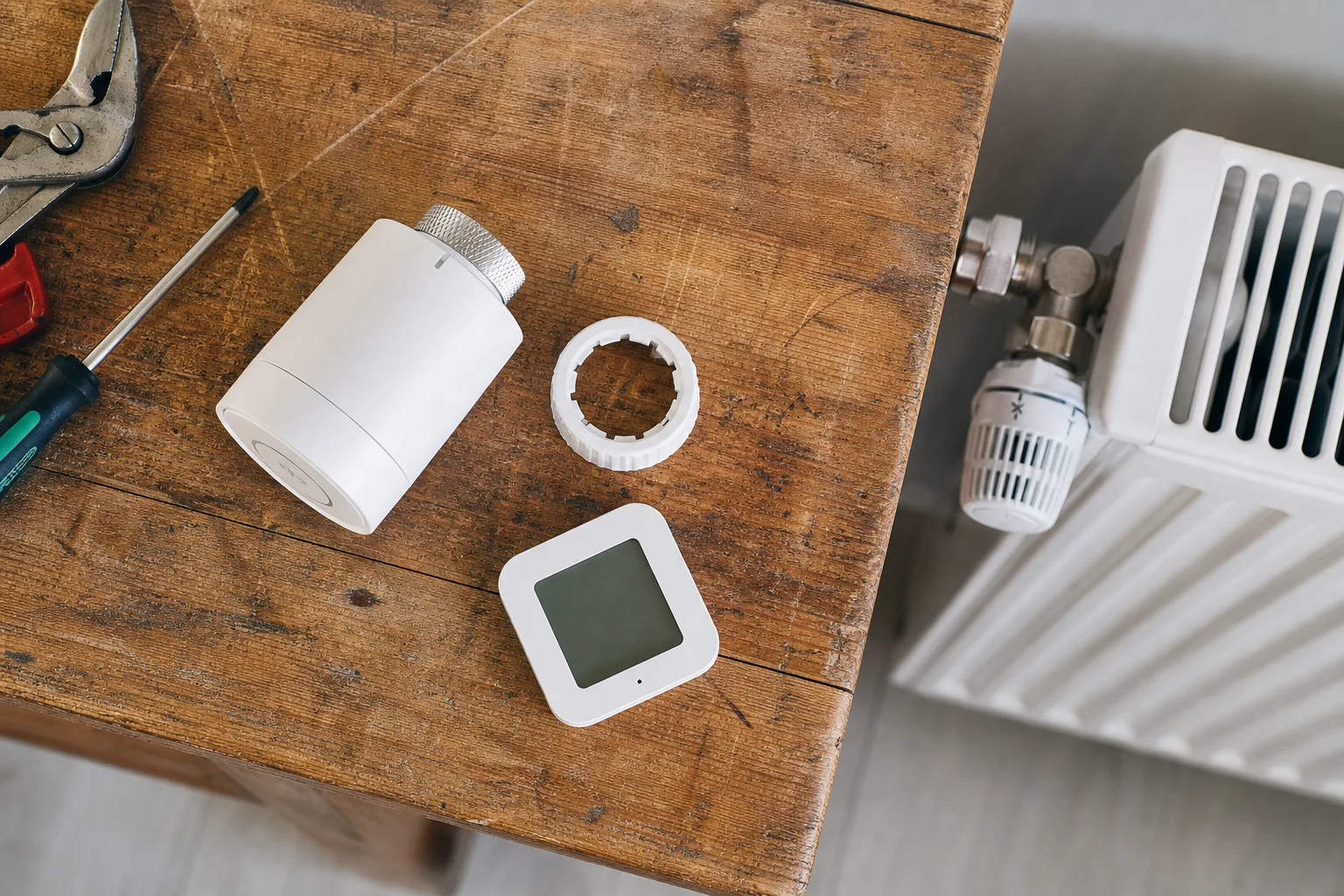
- Choose a difficult radiator and a high-waste room. Include an unusual valve, tight clearance, long wireless distance or a radiator behind a curtain.
- Fit the head and run calibration. Confirm the motor can move the pin without repeated errors, unusual strain or a loose adapter.
- Create a real weekly schedule. Check room temperature with a separate thermometer in the occupied part of the room, then adjust the offset or add a room sensor.
- Test boiler demand. Lower the central thermostat, request heat from the pilot room and verify whether the radiator warms as the product specification promises.
- Disconnect the internet and check local schedules, physical controls and alerts. Inspect battery status after several days of motor activity.
- Expand only to rooms with clear waste. Uncontrolled radiators left open will still heat whenever the boiler runs, so close or sensibly set their mechanical valves.
Smart radiator thermostat FAQ
A partial installation is usually the sensible starting point, provided the remaining radiators are set deliberately and the boiler can serve the chosen rooms.
Do I need a smart thermostat on every radiator?
No. Start with bedrooms, a home office, guest rooms and spaces warmed by sun or cooking. Check every uncontrolled radiator, since one left fully open can undermine the saving whenever the boiler runs.
How quickly does open-window detection react?
Built-in systems commonly wait several minutes for a sharp temperature drop, then pause heating for a fixed period such as 10 or 30 minutes. Slow ventilation and tilted windows are easy to miss. A separate contact sensor is the dependable choice.
Should the room with the wall thermostat have a smart valve?
With traditional controls, a radiator valve in that room can restrict heat before the wall thermostat is satisfied. An integrated zoning system can coordinate the room sensor, radiator and boiler, so follow that system’s design instructions.
Can a subscription affect basic operation?
Local schedules are often included, but automatic geofencing, advanced reports or automatic action after open-window detection can require payment. Compare the exact free feature list and check that cancellation leaves schedules and manual controls working.
Can renters use smart valves with communal heating?
Only with permission to change the heads, hot water available during the requested periods and charges linked to actual consumption. The valves can restrict radiator flow, but they normally cannot command the building’s central plant.
Compare smart radiator thermostats
Live prices from more than 20 shops, updated daily.
Verdict: prove the system before expanding
Test one or two high-waste rooms a month before heating season. Expand after the valves fit, temperatures read sensibly, schedules survive an internet outage and each required room can obtain boiler heat. If your routine is predictable, buy programmable heads instead. If the boiler or building controls are the real constraint, spend nothing on radiator electronics yet.
This article was created using AI, following our team's editorial standards.


