


Match the fixing to how the opening moves and how often you use it. Adhesive mesh suits a quiet window with a clean, continuous frame; a removable frame is stronger for a regularly tilted window; a magnetic curtain handles busy balcony traffic; retractable or pleated systems earn their place where accurate tracks and a clear parked opening justify the harder installation.
Usage frequency selects the fixing
A quiet window places little strain on adhesive tape, but repeated opening, removal and passage expose weak corners fast. Start with the daily routine, then check whether the frame can support the suitable fixing.
- Choose cut-to-size adhesive hook-and-loop mesh for a lightly used, inward-opening window with a smooth, dry mounting face. It is shallow and inexpensive, and the mesh can often be detached for washing.
- Choose a removable tension or clip frame for a European tilt-turn window used every day. The exterior frame stays in place as the sash tilts inward, provided its brackets fit the rebate and clear shutters, rain guards and drainage details.
- Choose a magnetic curtain for a balcony door crossed repeatedly with laundry, meals or watering cans. It offers hands-free passage, although its perimeter attachment is commonly adhesive.
- Choose a retractable or pleated screen for frequent use, wide openings or a cleaner view when the screen is parked. This choice needs more mounting space, straighter geometry and often screws.
- Skip these retrofit products if a hung, sliding or patio opening already has a purpose-built screen channel. A correctly sized replacement framed screen will usually use that geometry more effectively.

Each fixing moves the weak point
Every design can seal well when its vulnerable point is controlled. The practical differences appear at corners, seams, thresholds and moving tracks.
| Type | Best use | Where gaps start | Daily passage | Removal and cleaning | Main compatibility check |
|---|---|---|---|---|---|
| Adhesive hook-and-loop mesh | Lightly used window | Lifted tape, interrupted corners or mesh pulled too tight | Poor for a main doorway | Detach mesh if allowed; washing instructions vary by product | Smooth bonding face clear of seals, drainage slots and sash contact |
| Removable tension or clip frame | Tilt-turn or other screened window used regularly | Wrong bracket depth, distorted frame or missing brush contact | No walk-through function | Lift out intact, wipe or gently rinse, then store flat | Rebate depth, bearing lip, shutters, drip guards and outside clearance |
| Magnetic door curtain | Frequently used balcony or patio door | Uneven centre seam, floor drag or peeling side tape | Best low-cost hands-free choice | Usually detaches for washing; follow the exact care label | Flat face around opening, correct finished size and clear threshold |
| Spring retractable screen | Regular use with a clear parked opening | Dirty or unsupported tracks, skewed frame or wind displacement | Requires deliberate closing | Vacuum tracks, wash gently and dry before retracting | Cassette space, square opening and level guide support |
| Pleated side-stack screen | Wide or busy opening needing gentle movement | Sloping sill, dirty guide or uneven latch contact | Stays where placed, but does not close behind the user | Keep guides clear and dry mesh before stacking | Stable low guide, side-cassette room and handle clearance |
Three-point measurements expose bad geometry
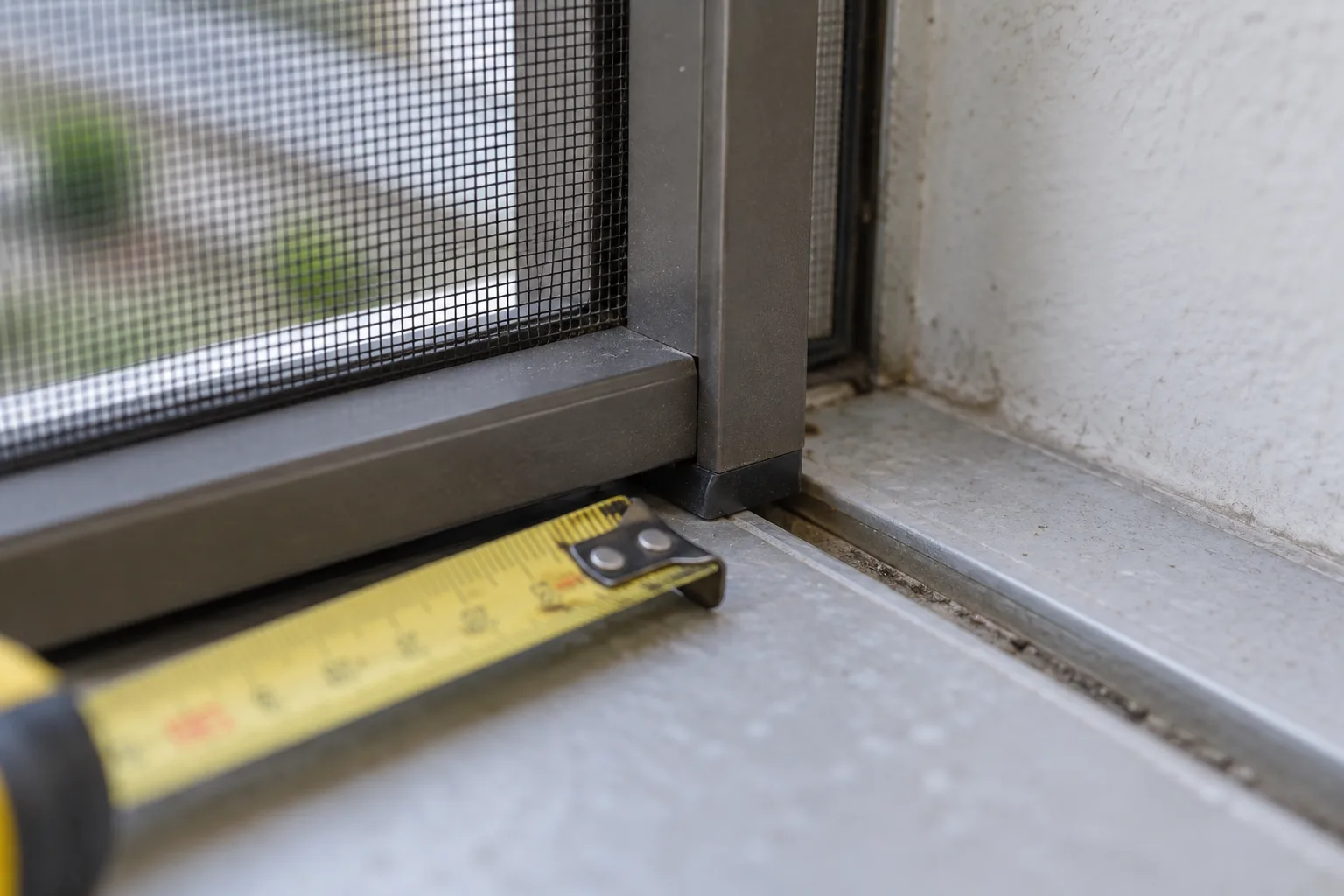
Measure the proposed mounting plane at the top, middle and bottom, then use the narrowest width. Repeat for height, because nominal door size and glass size reveal little about the space available to a screen.
- Photograph the opening from both sides, including hinges, handles, shutters, closers, drainage channels and the sill.
- Record the smallest clear width and height. Measure the flat mounting face and frame depth separately.
- Check both diagonals or use a square for retractable and pleated products. A rectangular kit cannot correct a badly skewed opening.
- Support the full bottom guide. A sloping sill, drainage groove or old track may need a manufacturer-approved platform or shim.
- Dry-fit before cutting or bonding. Operate the window, door, shutter and blind ten times, then inspect the lowest 300 mm for drag or daylight gaps.
Window operation determines the mounting side
The screen belongs on the side that stays clear of the moving sash or door. Trace the full movement of the handle, hinges and opening leaf before choosing an inside or outside installation.
- European tilt-turn window: the sash tilts inward for ventilation and swings inward in turn mode. An exterior tension frame can remain fitted, assuming its clips and brush seal clear any roller shutter and rain guard.
- Single-hung, double-hung or sliding window: look first for an exterior screen channel. A half screen can cover one operating area; a full screen is used where both areas need coverage.
- Outward-opening casement or awning window: place the screen indoors so the sash can move outside. Preserve access to the crank, lock and handle.
- Hinged balcony or French door: install the screen on the side opposite the door swing. Check the handle projection, closer arm and threshold before committing to adhesive or tracks.
- Sliding patio door: inspect the parallel track before shopping for a retrofit. A conventional sliding screen is preferable where the original track remains usable.
A tight-looking gap can still be usable, but only the product drawing settles it. One current open-and-close adhesive window panel requires a 3.5 mm gap between frame and sash. Other systems use different brackets and bearing areas.
Magnetic curtains prioritise easy passage
A magnetic curtain makes sense when a balcony door sees ten or twenty trips on a warm day. The centre can close behind someone carrying a laundry basket, so the screen spends less time standing open.
Its seal depends on hanging geometry. The top must be level, the two panels must hang evenly, and the hem must clear the sill. A small twist near the floor can hold the seam open even if the curtain has many magnets.
- Confirm the exact finished size. Some current curtains cannot be trimmed, and excess length can drag across the threshold.
- Check for a broad, flat attachment face around the opening. Dust, silicone residue and textured render weaken adhesive edges.
- Keep the centre line clear of the door handle. Test repeated passages and watch whether the bottom magnets meet without help.
- Read the care label. One current tesa magnetic curtain specifies hand washing at 30°C, but that instruction cannot be assumed for every product.

Retractable screens punish uneven tracks
A retractable or pleated screen works best on a square opening with a stable, level guide. Dirt, unsupported track sections and a sloping sill can produce sticking, corner gaps or mesh leaving the guide.
The higher tier pays for a cassette, controlled edge guides and a doorway that clears when the mesh is parked. Spring rollers take little storage space but require deliberate closing and can retract abruptly. Pleated screens move with lower force and can remain partly open, though their bottom guides still need clean support.
- Verify cassette, side-profile and guide space from the exact section drawing. A current measuring guide suggests about 25 by 25 mm of mounting face for selected models only.
- Vacuum debris from tracks. Clean mesh with mild soapy water and allow it to dry before retracting or stacking.
- Avoid pressure washers, harsh chemicals and oily lubricants. Use only the dry or silicone lubricant specified by the manufacturer.
- Park flexible mesh during strong wind and when it is unused. Tracks do not turn it into a wind barrier.
- Check alteration rules before ordering. Many systems use screws; clamp-mounted and adhesive-track versions are product-specific exceptions.
No-drill fixings can still mark frames
No-drill describes the fastener, not the condition of the frame after removal. Adhesive can leave residue or lift weak paint, and clamp brackets can rub finishes or compress soft seals.
Current adhesive instructions commonly require a smooth, dry, grease-free surface. Clean with a little alcohol or the specified cleaner, avoid silicone-containing products, and let the surface dry fully. Apply tape continuously, butt joins neatly and press every corner. Keep flexible mesh flat with light tension so the corners carry less peel force.
- Check the exact product sheet for approved surfaces and removal claims. uPVC, coated aluminium, varnished timber, bare wood and painted trim behave differently.
- Review the tenancy agreement and obtain written approval where screws, permanent adhesive or modifications are involved.
- Recheck adhesive after several warm days. If the same corner lifts again, change the fixing instead of adding household glue.
- For seasonal storage, a one-piece removable frame is easiest to lift out. Adhesive mesh may detach while its tape remains on the window, and replacement tape can become a continuing cost.
FAQ
Can I cut a magnetic door curtain to the nearest size?
Only if the exact product instructions allow it. Some current magnetic curtains are sewn to a finished size and specifically exclude trimming. Cutting can damage edge binding or disturb the centre alignment.
Does a higher magnet count guarantee a closed seam?
No. Magnet count is secondary to a level top edge, equal panel lengths, free movement at the hem and continuous side attachment. Inspect those details first.
Should I spray a sticky retractable track with general-purpose oil?
Avoid oily lubricants because they collect dirt and can hinder the guides. Vacuum and wipe the track first, then use the manufacturer-specified dry or silicone lubricant only if required.
Is dark mesh harder to see through?
Fine black or anthracite mesh often looks less conspicuous than white mesh because it produces less visible glare. Colour cannot compensate for a coarse weave, torn mesh or a poor perimeter seal.
Will a tension frame fit a tilt-turn window with a rain guard?
Compatibility depends on the bracket depth, bearing lip and obstruction. Some current telescopic products explicitly exclude windows with rain guards, so compare the profile drawing with the actual frame.
Verdict
For a lightly used window, buy adhesive hook-and-loop mesh only after confirming a clean, continuous bonding face. For a frequently tilted tilt-turn window, favour a removable tension or clip frame with compatible rebate depth and shutter clearance. For the common rented-flat problem of a busy balcony door, a correctly sized magnetic curtain is the practical first buy. Move to retractable or pleated construction when the opening is square, track support is sound, alteration rules allow the fixing and clearing the doorway is worth the extra fitting work.
Compare magnetic door curtains
Live prices from more than 20 shops, updated daily.
This article was created using AI, following our team's editorial standards.


