


Check the room’s overnight temperature before buying. Choose a compressor for heated space around 15 to 22°C, choose a desiccant below about 10°C, and demand model-specific performance data for the uncertain band between them.
A heated room takes a compressor, a cold one desiccant
The difficult band is 10 to 15°C, where a large modern compressor can remain economical while a desiccant usually removes water faster. Compare extraction and watts at 10°C and 60% relative humidity before deciding.
| Criterion | Compressor | Desiccant | Better choice |
|---|---|---|---|
| Heated room, 15 to 22°C | Efficient and effective | Effective, with higher power use | Compressor |
| Cold enclosed room, below 10°C | Extraction falls and defrost interrupts drying | Flatter cold-weather performance | Desiccant |
| Electricity per litre | Lowest in heated rooms | Higher at typical domestic temperatures | Compressor |
| Bedroom noise | Quiet models reach about 35 to 40 dB(A) | Low modes overlap, high modes often reach 46 to 50 dB(A) | Quiet compressor in a heated bedroom |
| Heat output | Modest outlet temperature rise | Much warmer outlet air | Desiccant when heat helps |
| Carrying upstairs | Usually 10 to 15 kg | Usually 6 to 9 kg | Desiccant |
| Unattended operation | Large tanks and pump options are common | Usually smaller tanks, gravity drainage available | Compressor for permanent installation |
The litre rating on the box is measured at 30 degrees
Published extraction at 20°C and 60% RH, followed by 10°C and 60% RH, is far more useful than the maximum on the box.
- A compressor draws air across a refrigerated evaporator coil. Water condenses when that coil sits below the air’s dew point, then the air crosses a warm condenser and returns to the room.
- As the room approaches 10°C, the evaporator moves closer to freezing. Frost restricts airflow and triggers defrost cycles, slowing or pausing extraction.
- A desiccant passes air through a moisture-attracting rotating wheel. A heater regenerates the wheel, and the released water is collected in the tank or drain.
- The desiccant avoids an icing evaporator, so its cold-weather curve is much flatter. Temperature, humidity and power setting still affect its output.
| Technology and condition | Extraction | Power |
|---|---|---|
| 12 L-class compressor at 30°C, 80% RH | 11.99 L/day | 182 W |
| 12 L-class compressor at 20°C, 60% RH | 5.40 L/day | 136 W |
| 12 L-class compressor at 10°C, 60% RH | 1.97 L/day | 111 W |
| 20 L-class compressor at 20°C, 60% RH | 8.5 L/day | 216 W |
| 20 L-class compressor at 10°C, 60% RH | 3.4 L/day | 180 W |
| Desiccant on medium at 20°C, 60% RH | 5.40 L/day | 437 W |
| Desiccant on medium at 10°C, 60% RH | 5.23 L/day | 443 W |
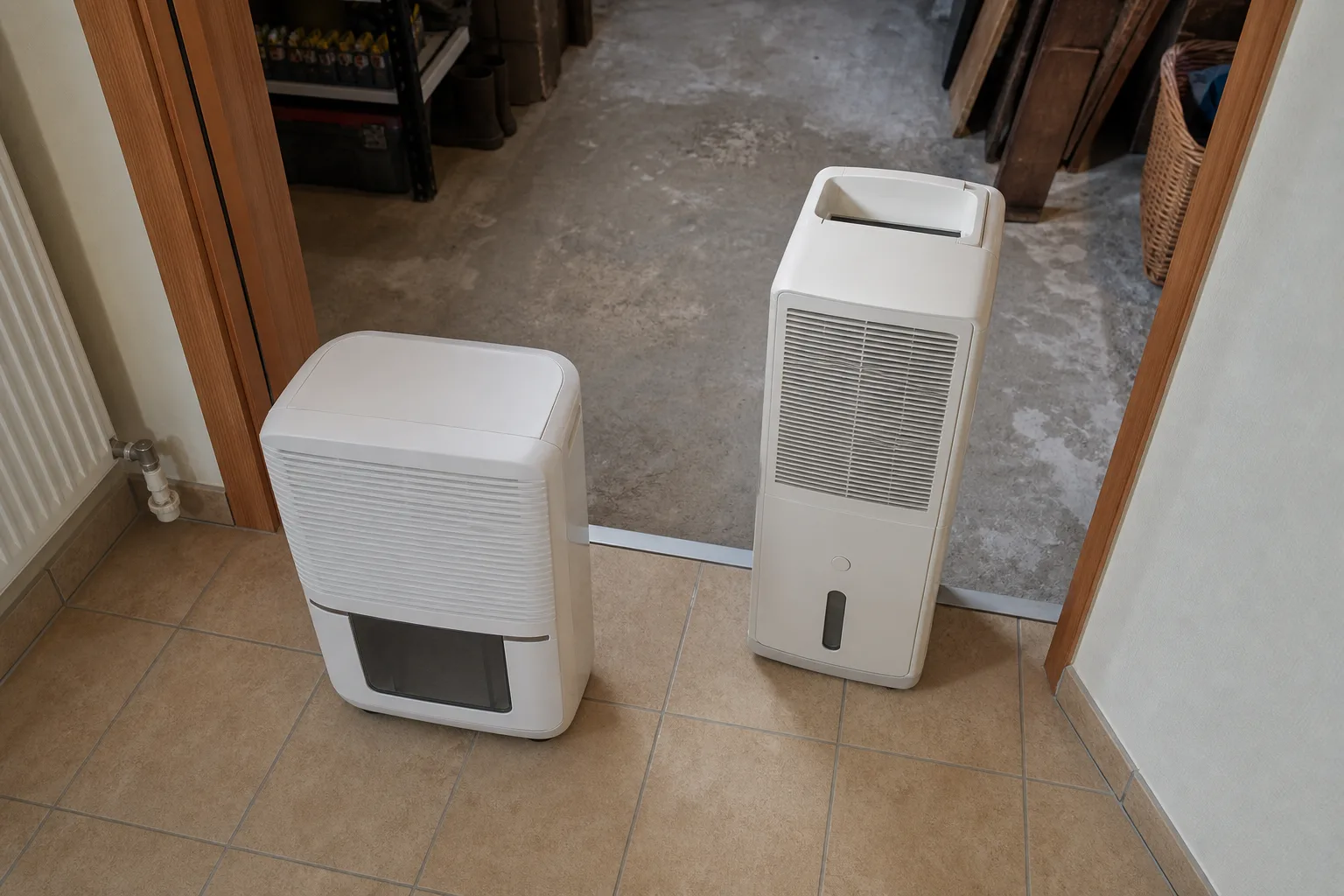
The 12 L compressor example delivers 45% of its headline figure at 20°C and 16% at 10°C. European compressor claims often use 30°C and 80% RH, while desiccant ratings commonly use 20°C and 60% RH. Other markets can use cooler test conditions, so litres per day only compare cleanly when temperature and humidity match.
- Find extraction at 20°C and 60% RH.
- For cold-room use, find extraction at 10°C and 60% RH.
- Check watts at both conditions.
- Treat a maximum figure without supporting tables as unverifiable for winter use.
A compressor uses far less power per litre
A compressor normally removes each litre with far less electricity in a heated room. Cost per hour hides this advantage because a weak cold compressor can run cheaply while collecting very little.
| Worked example | Electricity per litre | Great Britain reference | EU reference | US reference |
|---|---|---|---|---|
| Compressor at 20°C | About 0.60 to 0.61 kWh | About 16p | About €0.17 to €0.18 | About $0.11 |
| Compressor at 10°C | About 1.27 to 1.35 kWh | About 33p to 35p | About €0.37 to €0.39 | About $0.23 to $0.25 |
| Desiccant at 20°C | About 1.94 kWh | About 51p | About €0.56 | About $0.36 |
| Desiccant at 10°C | About 2.03 kWh | About 53p | About €0.59 | About $0.37 |
These worked product examples use reference household rates available by August 2026: 26.11p/kWh in Great Britain for July to September 2026, €0.2896/kWh for the EU average in the second half of 2025, and $0.1844/kWh for the US average in May 2026. Multiply the kWh per litre by your local unit rate. Real costs rise as humidity falls, filters clog or doors keep opening.
Both technologies warm the room. Compressor outlet air can be around 1 to 2°C warmer than the inlet, while some domestic desiccants produce a 10 to 12°C outlet rise. These figures describe the air leaving the machine, rather than a guaranteed change across the room.
That paid electrical heat is useful beside winter laundry or in a cold utility room, conservatory, garage or boat. In an already heated bedroom or a warm basement, it adds discomfort and can increase cooling demand.
In a heated bedroom the quiet compressor wins
A quiet compressor is usually the better bedroom compromise when the room stays heated, especially if its fan stops after reaching the humidity target.
- Quiet small compressors are commonly rated around 35 to 40 dB(A) at 1 m. Large models often sit around 38 to 44 dB(A), depending on fan speed.
- Desiccants can reach 34 to 40 dB(A) on their lowest setting, but medium and laundry modes frequently rise to 46 to 50 dB(A).
- Compressor sound includes fan noise, hum and cycling. Desiccant sound is more airflow-heavy.
- Check what night mode changes. Some modes only dim lights and mute alerts, while useful ones also reduce fan or heater speed.
For a sensitive sleeper, run the unit with the bedroom door closed before bedtime, then let the humidistat maintain the result elsewhere if practical. Manufacturer noise figures use different test rooms, so compare settings within the same product range carefully.
Desiccant is the one you can carry upstairs
Choose by the route the machine must travel and by how often someone can empty it.
- Small compressors weigh roughly 10 to 11 kg, large compressors around 15 kg, and desiccants about 6 to 9 kg. Castors help across one floor, while a sub-9 kg unit is materially easier to carry upstairs.
- Typical tanks hold 2.5 to 2.6 L on small compressors, 4.8 to 6 L on large compressors and 2 to 3 L on desiccants. A machine collecting 5 L daily fills a 2.5 L tank about twice a day.
- Tank size changes emptying frequency, not extraction. Full-tank shut-off prevents a spill but also pauses drying.
- Gravity drainage needs a continuously downhill, unkinked hose and a lower drain. Choose a built-in or compatible condensate pump if water must rise to a sink.
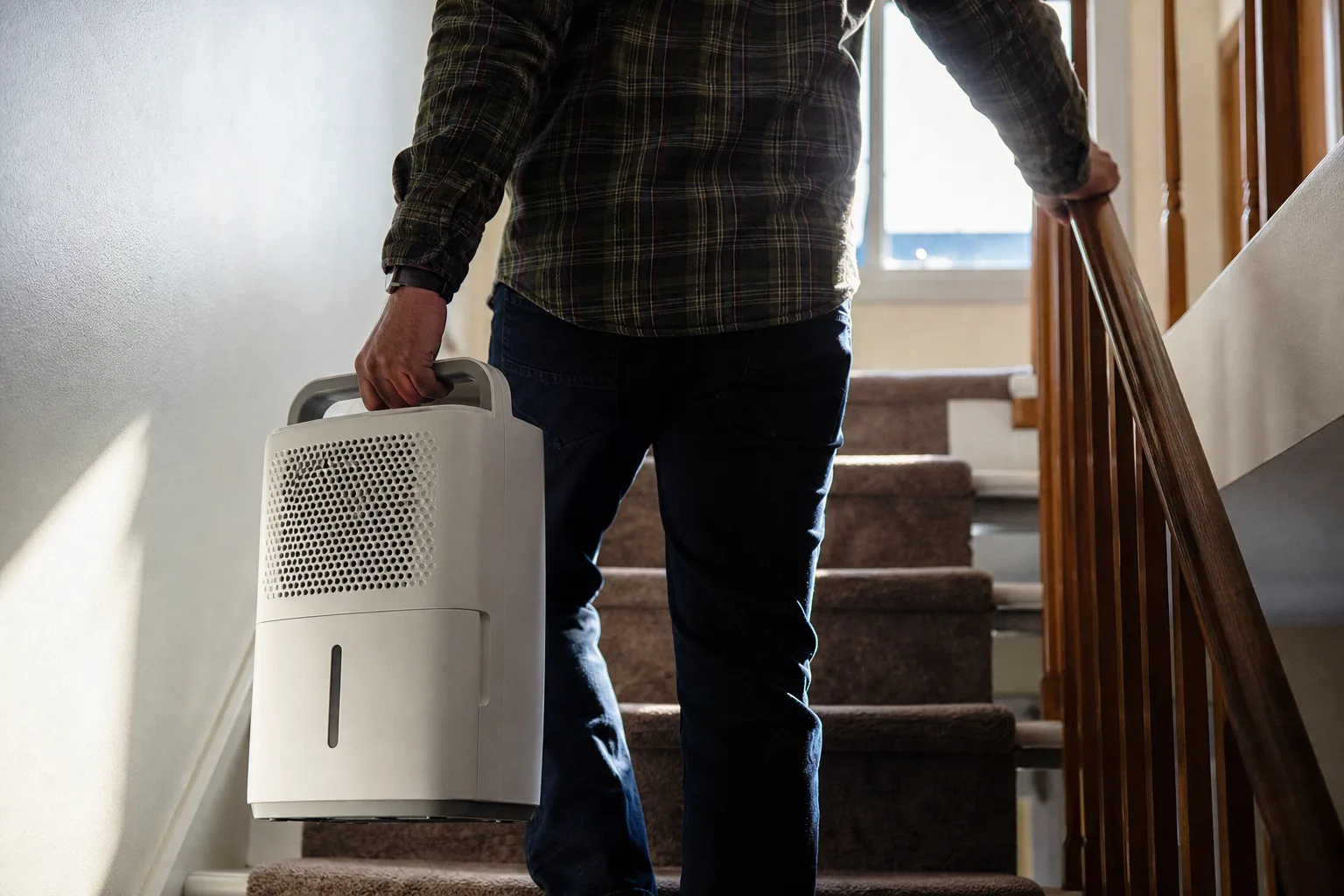
Empty the tank before carrying the appliance. If a compressor has been tilted, follow its manual’s settling instructions before restarting it.
Desiccant earns its cost in cold rooms
A desiccant earns its higher energy use where speed, low-temperature operation or easy carrying matters more than minimum cost per litre.
- Below 10°C: choose it for an enclosed cold utility room, garage, boat, caravan or genuinely cold home.
- Fast laundry drying: choose it when its warm airflow is welcome and use it intermittently rather than around the clock.
- Between 10 and 15°C: compare a 20 to 25 L compressor with the desiccant at 10°C and 60% RH. A large compressor can remain cheaper per litre, while the desiccant usually finishes faster.
At 10°C, the worked desiccant extracts about 2.7 times as much water as the small compressor example. Its cost per litre is roughly 1.5 to 1.6 times that of the compressor examples. The premium buys speed, fewer defrost interruptions and substantial heat.
Fix the moisture source before buying anything
A machine is the wrong purchase if fresh moisture keeps entering faster than a domestic appliance can remove it.
- Poor ventilation habits: use kitchen and bathroom extractors during steam production and afterwards, keep permanent vents clear, close the room door while extracting, and avoid drying clothes on radiators. Ventilate briefly first, then close exterior windows while the dehumidifier runs. Cold outside air can carry less water even when its RH looks high.
- A leaky unheated space: a frequently opened shed or draughty garage can make the unit process replacement outdoor air indefinitely. Improve air sealing, ventilation or storage conditions first. A reasonably sealed cold store containing valuable items remains a valid desiccant use.
- A building fault: investigate patches that worsen after rain, staining below gutters or pipes, damp ceilings, damaged plaster around windows, or low-level tide marks and salts. Use an independent building-pathology-led inspection. A handheld moisture reading alone cannot diagnose the cause.
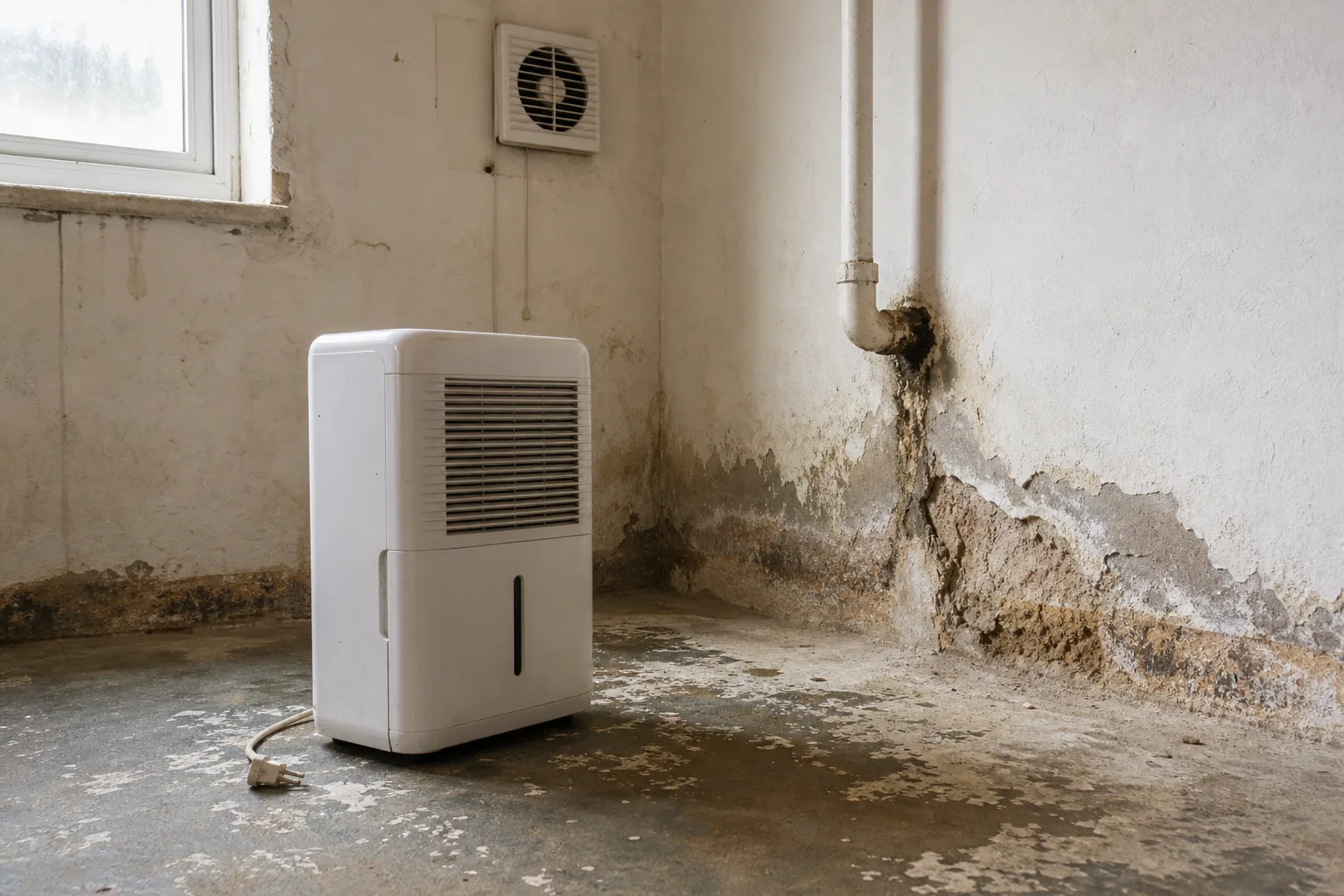
A domestic dehumidifier can speed drying after a fault has been repaired. Saturated plaster, concrete or timber after major flooding needs commercial drying equipment.
Common dehumidifier questions
These checks prevent several common setup and specification mistakes.
If a compressor operates down to 5°C, will it work well there?
The operating range only confirms that the machine is designed to run there. It gives no useful extraction or efficiency guarantee. Ask for litres per day and watts at 10°C, then expect weaker performance as the room gets colder.
What humidity should I set?
Around 50 to 55% RH is practical for most homes, with the main aim of staying below 60% and preventing condensation. Chasing 40% increases run time. Very cold wall surfaces can still condense at an acceptable central-room reading.
Can one unit dry a whole home?
It can manage a modest load when placed centrally with internal doors open and clear airflow. Closed bedrooms and isolated cold corners receive little benefit, so move the unit between rooms or use another extraction point.
Does a full tank prove that the home has severe damp?
No. A new unit can initially collect moisture from furnishings and building materials, while a laundry load creates a large temporary spike. Watch whether collection and RH settle over several days.
Does laundry mode save electricity?
Usually it prioritises high airflow and continuous extraction. It can finish drying sooner, but it is rarely the lowest-power setting.
Compare compressor dehumidifiers
Live prices from more than 20 shops, updated daily.
Most heated homes should buy a compressor
Most heated households should buy a compressor because it controls condensation and laundry moisture with substantially lower electricity use per litre.
- Choose a quiet 6 to 12 L-class compressor for a heated flat or small house, routine window condensation and modest laundry.
- Choose a 20 to 25 L-class compressor for a larger heated home, frequent indoor laundry or rooms around 10 to 15°C, provided you can manage a cabinet weighing about 15 kg.
- Choose a 7 to 8 L-class desiccant for an enclosed space that stays below 10°C, for frequent stair carrying, or where fast drying and warm outlet air justify the higher energy bill.
- Buy neither until you have corrected poor extraction, uncontrolled outdoor air or an active building fault.
Measure the coldest room, compare extraction and watts at that temperature, then check low-mode noise and drainage. Those four facts are more useful than the headline litres-per-day claim.
This article was created using AI, following our team's editorial standards.


