


Start with your water and your manual: if your machine has a documented descale routine and a compatible descaler, this is a careful 45 to 90 minute home job. If it is a warranty-controlled machine, a dual boiler with no descale mode, or a heat-exchanger prosumer machine with no tank-descale procedure, book service.
Start with the safety check: should this machine be descaled at home?
Descaling is acid work, not a generic cleaning cycle. It dissolves mineral deposits inside hot-water paths, while backflush tablets and coffee cleaners remove oils from the group and basket.
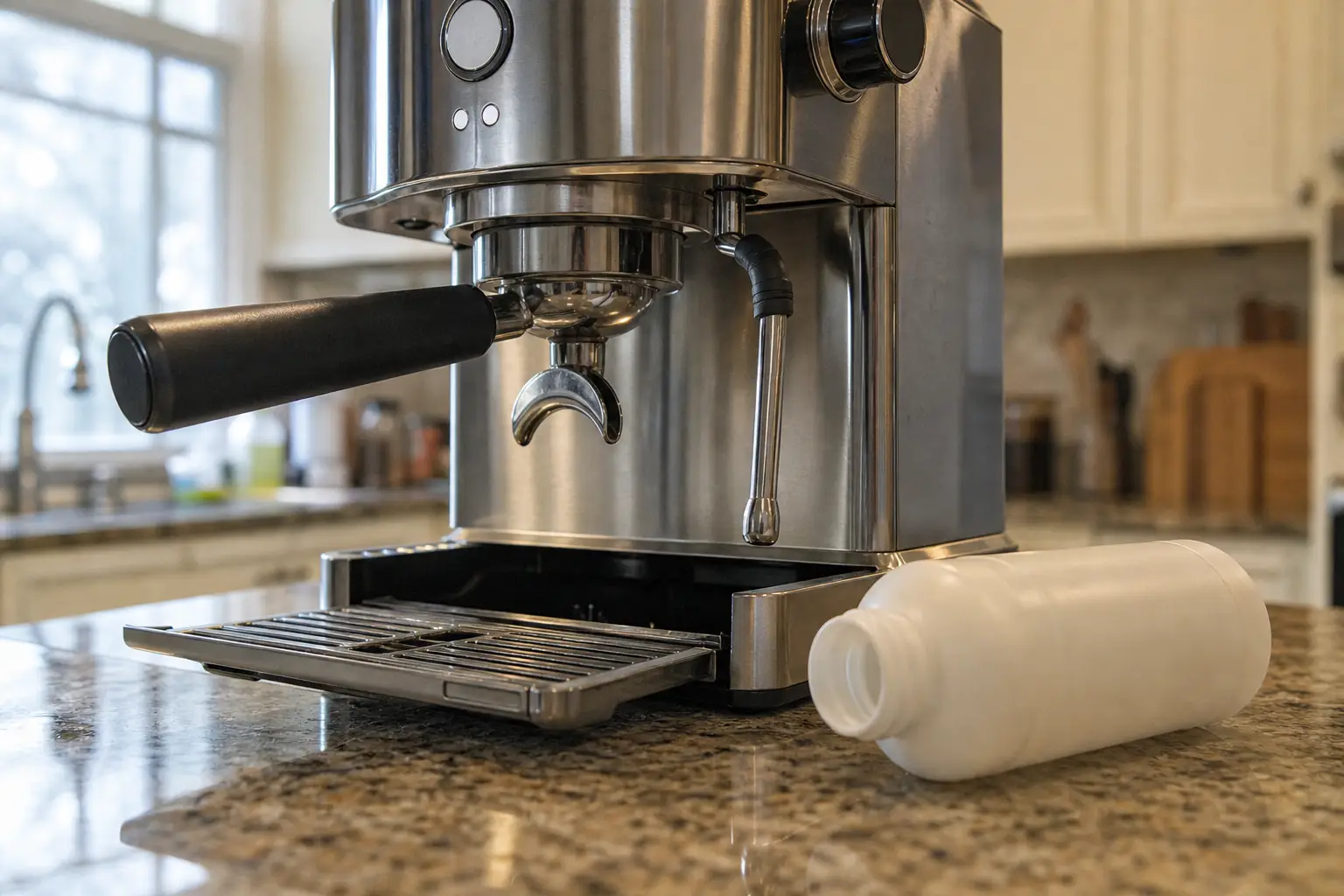
- Use the manufacturer product or support route if the machine is new, under warranty, or the manual says authorised service only.
- Send dual boilers to service if there is no descale mode, no boiler drain instruction, or no clear rinse procedure for both boilers.
- Avoid routine tank descaling on heat-exchanger or E61 prosumer machines unless the maker gives a procedure. Loosened scale can block tiny restrictors, valves or gauges.
- Stop and call service for no-flow machines, near-no-flow machines, leaks, electrical trips, overheating, error codes, or an unknown used machine with heavy scale.
Confirm scale is due with flow, heat, steam and taste checks
Scale is the likely target only after you rule out the easy faults that imitate it. A 9 bar machine with a choked basket or a loose water tank can look like a scaled machine for five minutes, then work normally after cleaning.
- Descale alert: follow it after checking the machine’s water-hardness setting. On some machines, a solid clean or descale light means descaling, while a flashing light means a separate backflush or cleaning cycle.
- Flow test: remove the portafilter and run water from the group. Weak pulsing, sputtering or a sharp drop from normal flow points to scale or a blockage if the tank is full and seated.
- Steam and hot water: weak steam or no hot water can come from scale, a blocked steam tip, an empty tank or an unprimed pump. Clean the tip before blaming the boiler.
- Temperature: hard-water build-up can reduce brew temperature. Cold cups, an unheated portafilter and a low temperature setting can do the same.
- Taste: sour, flat, weak or inconsistent shots can follow poor flow and low heat. Stale beans, grinder drift, wrong dose and channeling are more common day-to-day causes, so do the flow check first.
Choose the right acid for your boiler, warranty and water path
The safest descaler is the one your machine maker specifies, especially for aluminium boilers, automatic descale programmes and warranty claims. If the manual allows a universal espresso descaler, choose by acid type, dilution and material compatibility rather than by the strongest label.
| Descaler type | Where it fits | Main caution |
|---|---|---|
| Manufacturer solution | Best first choice for warranty machines, aluminium parts, super-automatics and machines with a programmed descale cycle. | Costs can be higher per descale, but compatibility is clearer. |
| Lactic acid liquid | Common in branded espresso descalers and a sound general option when the manual allows it. | Still an irritant. Use the stated dose. |
| Citric acid or citric blend | Widely used in powders and liquids. Some manufacturer products combine citric with other acids. | Ingredient alone is not enough. Strong DIY mixes can be the problem. |
| Sulfamic acid espresso descaler | Fast specialist products exist for coffee machines across many brands. | Use espresso-specific products, not bathroom or kettle descaler. |
| Vinegar or acetic acid | Best avoided for espresso machines. | Some manuals ban it. It can be hard to rinse and can leave odour and aftertaste. |
Aluminium boilers need the strictest line: use the named descaler or one explicitly approved for that model. Stainless-steel boilers and thermoblocks are usually more tolerant, but the manual still controls dilution and rinse volume. Copper and brass heat-exchanger machines need extra caution because dissolved chunks can travel into small passages.
Compare espresso machine descalers
Live prices from more than 20 shops, updated daily.
Gather the kit and set aside 45 to 90 minutes for a controlled acid job
This is a low-skill job if the machine has instructions, but it needs uninterrupted time. Most mistakes happen because the solution is mixed too strong, the water filter is left in, or the rinse is rushed.
- Approved espresso-machine descaler.
- Fresh rinse water, preferably the same treated water you normally use if it is machine-approved.
- A 1 to 2 L container for the group, steam wand and hot-water outlet.
- Towels, and gloves if you splash liquids easily or handle powder.
- The manual or support page open before you start.
- Optional water-hardness strip or drop kit for setting the next interval.
Prepare the machine so descaler reaches the right places safely
Good preparation makes the acid reach every scaled path while keeping it out of parts that should not see it. The machine is ready only when the tank, tray, filter and containers are set before the first pump run.
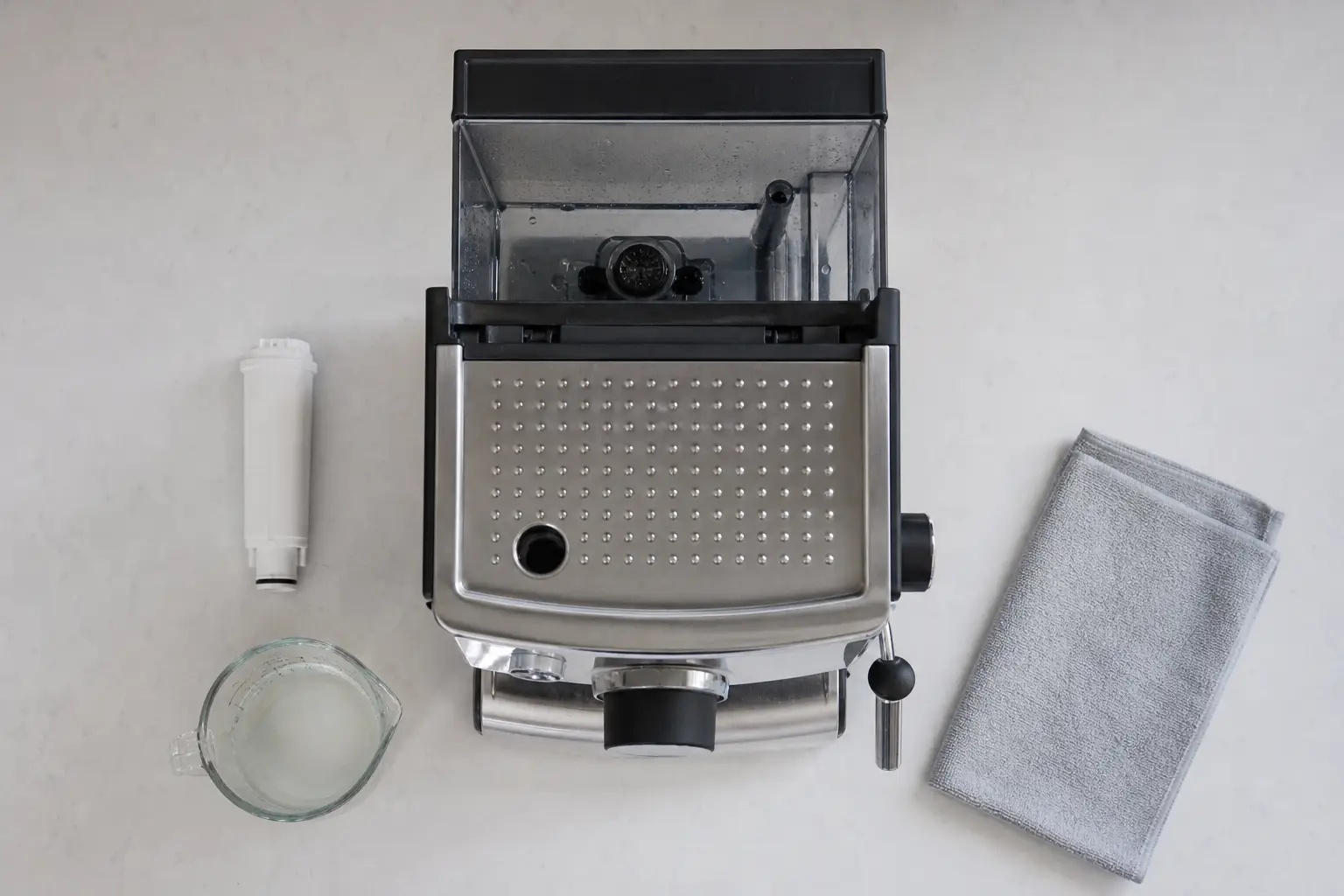
- Read the manual and identify the machine type. If it is dual boiler, heat exchanger, plumbed-in, or silent on descaling, stop and check service guidance.
- Cool the machine if the manual says so. Acid plus unnecessary heat raises splash and handling risk.
- Remove the tank water filter or softener cartridge unless the manual tells you to keep it installed.
- Empty the drip tray and water tank. Clean the basket holes, shower screen and steam tip so coffee oil or milk residue does not confuse the result.
- Mix the descaler exactly as directed. Dissolve powder or tablets fully before they enter the tank. Do not make a stronger mix for a badly scaled machine.
- Place the container so it catches the group, steam wand and hot-water outlet. Keep towels nearby for splashes.
Run the descale solution through the group, steam and hot-water circuits
The acid has to pass through every circuit that heats or dispenses water. Follow your model’s programme if it has one, because many machines run group, steam and hot-water stages in a set order.
- Start the descale mode if present and let it advance through each stage. Do not reset the warning early.
- For a manual single-boiler semi-automatic, alternate solution through the group and the steam or hot-water path in short runs. If the manual calls for pauses, use those pauses rather than leaving acid in the boiler for hours.
- Keep the pump intake covered. Stop before the tank runs dry unless the programme tells you otherwise.
- Watch the waste liquid. Cloudiness or small flakes can be normal on a scaled machine. If flow suddenly gets worse, stop. A loosened fragment may have blocked a valve or restrictor.
- Keep all dispensed liquid away from cups you drink from until the full rinse is complete.
Flush until neutral, then verify flow, steam pressure and taste
Rinsing is the part home users underdo. A machine can look finished while acid remains in the steam boiler, wand or hot-water line.
- Remove the tank, wash it, and refill with fresh water. Do not top up leftover descaler.
- Flush every path that saw acid: group head, steam wand and hot-water outlet.
- Use the manual’s full rinse volume. Some consumer machines rinse with a full 2 L tank, while some single-boiler routines use several tanks. If smell remains, run another tank.
- Dispense hot water from each path into a clean cup and smell it. It should have no sour acid note and no vinegar-like odour.
- Repeat the no-portafilter flow test. Better flow at the group and stronger steam suggest scale was part of the problem.
- Pull a shot only after water tastes neutral. Use the same beans, dose and grind as before, or you will not learn much from the comparison.
Set your next descale interval from water hardness, not guesswork
Water hardness decides how fast scale returns. Use the machine’s test strip, a local water report, or a GH/KH-style drop kit, then set the machine’s hardness level correctly if it has one.
| Hardness as mg/L CaCO₃ | Practical interval if the manual gives none | Rule to use |
|---|---|---|
| 0 to 60, soft | When prompted, or inspect and flush every 6 to 12 months. | Soft water still needs filter changes and occasional checks. |
| 61 to 120, moderately hard | Every 3 to 6 months. | A sensible default for many tank machines. |
| 121 to 180, hard | Every 2 to 3 months. | Consider better machine-approved water treatment. |
| >180, very hard | Monthly to every 2 months only if the manual permits it. | Do not use frequent acid as your main defence. Improve the water first. |
Tank filters reduce scale, but they do not cancel descaling. Replace them on the schedule in the manual, and sooner in hard-water areas if the maker says so. Avoid distilled, demineralised or ultra-low-mineral water unless the machine maker approves it, because some machines rely on mineral content for operation and coffee taste.
FAQ and final safe-descaling checklist
Can I descale straight after backflushing?
Yes, if the machine manual allows both tasks, but rinse between them and keep the chemicals separate. Backflush cleaner and descaler do different jobs and should not meet in the machine.
Can I use lemon juice instead of descaler?
Do not improvise with lemon juice, especially on aluminium boilers. Espresso descalers are sold with a known acid type and dilution; kitchen acids give you less control.
Why is my shot still sour after descaling?
If flow, steam and rinse water are normal, go back to espresso setup. Sour shots often come from grind, dose, stale beans, channeling or low brew temperature settings rather than remaining scale.
What if the descale warning will not clear?
Run the full programmed rinse exactly as the machine requests. Many alerts clear only after the machine measures the complete cycle, not after the tank looks empty.
Should I run a second descale if flow is still weak?
No immediate second acid run if flow worsened, flakes keep appearing, or the pump sounds strained. Rinse fully and arrange service, because a loosened deposit may now be blocking a small passage.
- Manual checked and machine type suitable for home descaling.
- Correct descaler chosen for boiler material, warranty and descale mode.
- Filter removed, tray emptied, surfaces protected and container placed.
- Solution mixed to the stated dilution.
- Group, steam and hot-water paths descaled and rinsed.
- Water smells neutral, flow is improved, steam is normal and the alert is cleared only after the rinse.
Final verdict
A proper espresso-machine descale starts with water hardness and machine design. Use the approved acid, run it through every relevant circuit, rinse far longer than feels necessary, and stop before forcing acid through a blocked or unsupported machine. That approach protects the pump, valves, boiler and the next coffee you drink.
This article was created using AI, following our team's editorial standards.


