


Before you compare 30L and 40L models, count the hottest unrefrigerated hours between your home fridge and the next real fridge. Short, shaded trips can run on ice; hot parking, overnight food and raw meat push you toward a compressor, while thermoelectrics are best for powered driving and drinks.
Litres come second: decide whether you need ice assistance or real refrigeration
The first choice is the cooling method, then the size. A 40L label tells you what fits, but it says little about whether chicken, yoghurt or leftovers stay cold enough through a July traffic jam.
- Choose a soft or basic passive box if you carry sealed drinks, fruit, sandwiches or picnic food for a few hours and you can use frozen bottles or gel packs.
- Choose a better hard passive box for family day trips, barbecue food and camping weekends where you can pre-chill hard, pack plenty of ice and keep openings low.
- Choose a thermoelectric box if it will sit in an air-conditioned cabin and stay plugged in most of the time. Treat it as assisted cooling for drinks and pre-chilled snacks.
- Choose a compressor cool box for long drives, hot parking, 24 to 72 hour camping, raw meat, dairy, baby food or any trip where ice access is uncertain.
- Do not buy a big powered cooler for a two-hour beach run with drinks and whole fruit. A small insulated bag or the cooler you already own is enough.
The food-safety test: count hot hours and keep perishables at ≤5°C
Perishable food should stay at 5°C or below, with 4°C (40°F) used in stricter consumer guidance. High-risk foods include raw or cooked meat, fish, dairy, eggs, cut fruit and vegetables, cooked rice or pasta, leftovers and ready-to-eat chilled meals.
- Put a fridge or appliance thermometer in the box. It is the cheapest upgrade and gives you a real answer.
- Pre-chill the box, food and drinks. Passive and thermoelectric boxes are poor at pulling warm food down to fridge temperature.
- Keep raw meat and fish in sealed, leakproof containers and physically separate from ready-to-eat food.
- Open the food cooler as little as possible. For camping, use a second drinks cooler because drinks get grabbed all day.
- Do not rely on an ordinary cool box for temperature-sensitive medicines unless the medicine instructions and verified cooler temperatures match.
A simple timeline shows the risk. If you pack yoghurt and marinated chicken at 08:00, drive four hours, stop for lunch in a 33°C car park and reach a campsite fridge at 15:00, that is seven hours away from proper refrigeration. A passive box needs enough ice and a thermometer to prove the job; a thermoelectric in a hot boot is the wrong tool.
Passive vs thermoelectric vs compressor: the practical comparison table
Each cooler type solves a different summer problem, and the weak point matters more than the brochure capacity.
| Type | What it buys | Best fit | Main risk | Useful size cue |
|---|---|---|---|---|
| Passive ice box | Insulation plus ice, gel packs or frozen bottles. No power and little to fail. | Picnics, beach days, supermarket runs, weekends with ice access. | Safe only while enough cold mass keeps food at ≤5°C. Lab-style ice-retention claims are not food-safety guarantees. | 10 to 25L for day trips; 35 to 60L for camping, remembering ice takes space. |
| Thermoelectric cool box | A Peltier module and fan, often cooling about 18 to 25°C below ambient. | Powered driving, drinks, snacks and pre-chilled food in an air-conditioned cabin. | In 35°C air, a 20°C drop can still leave the box around 15°C, too warm for perishables. | Commonly 20 to 40L; check fan noise, plug quality and AC adaptor. |
| Compressor cool box | A real refrigeration system with a settable thermostat, usually for 12/24V DC and mains AC. | Hot stops, long drives, campervans, camping weekends and food that must stay fridge-cold. | Needs power, ventilation and battery planning. Warm food still needs pull-down time. | 25 to 45L suits many road trips; 35 to 75L for touring or family camping. |
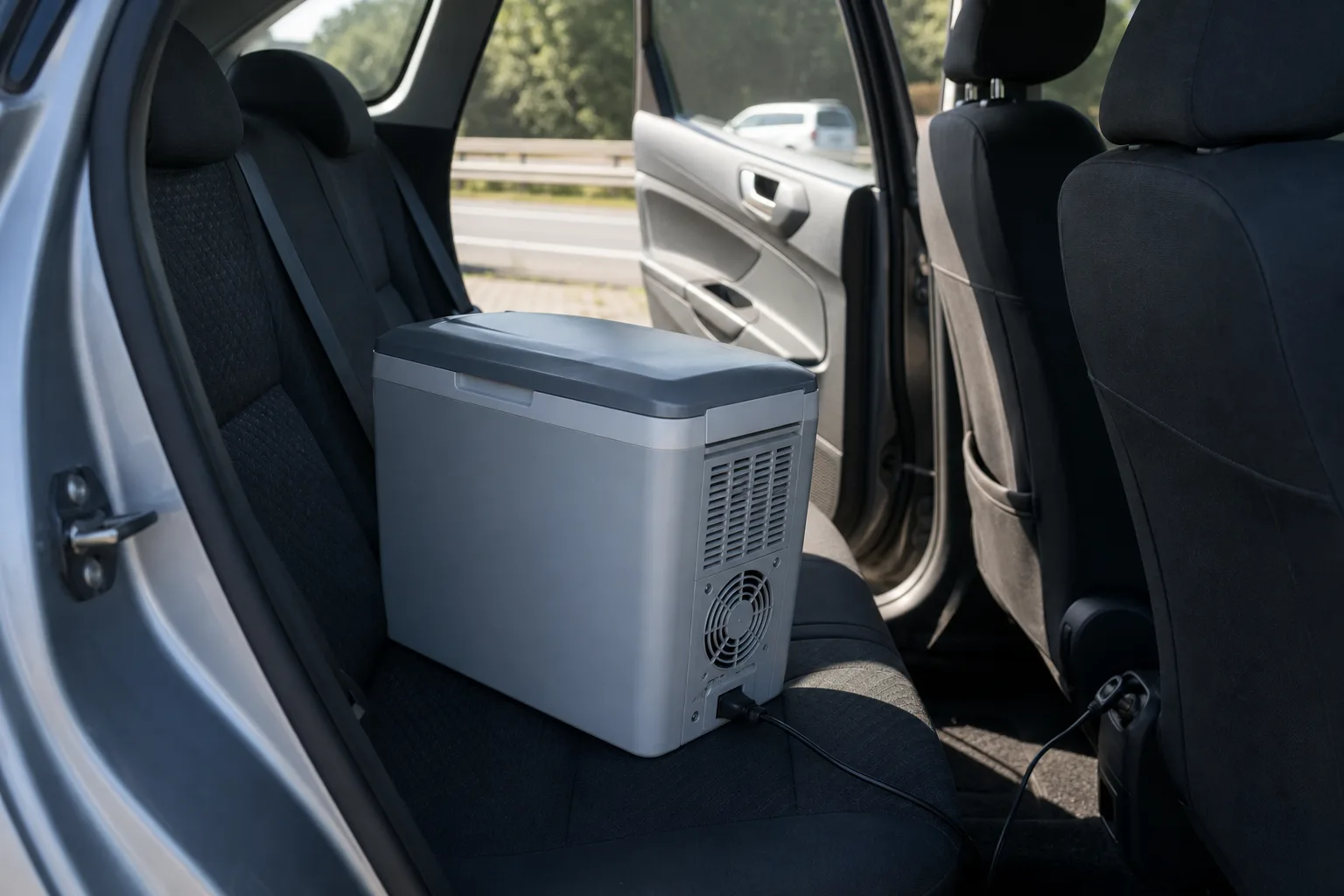
Be careful with hybrid models. Some cool differently on car power than on mains power, so ask which technology works from 12V before assuming fridge-like performance on the road.
Pick usable capacity, not label capacity: ice volume, food layout and loaded weight
Buy the litres you can actually use after ice, containers and lifting weight are included. For US-labelled coolers, 1 US quart is about 0.95L, so 45qt is roughly 43L.
- 5 to 10L: lunch, solo snacks or a very small medicine carrier only if separately temperature-verified.
- 10 to 20L: two-person picnic or day trip, easy to carry.
- 20 to 35L: family day trip, compact car boot and many thermoelectric models.
- 35 to 50L: tight weekend food for 2 to 4 people, and a useful compressor range for road trips.
- 50 to 75L: family camping, fishing or multi-day travel. Plan wheels, a trolley or a two-person lift.
- 75L plus: groups, boats and vehicle-based touring rather than casual day use.
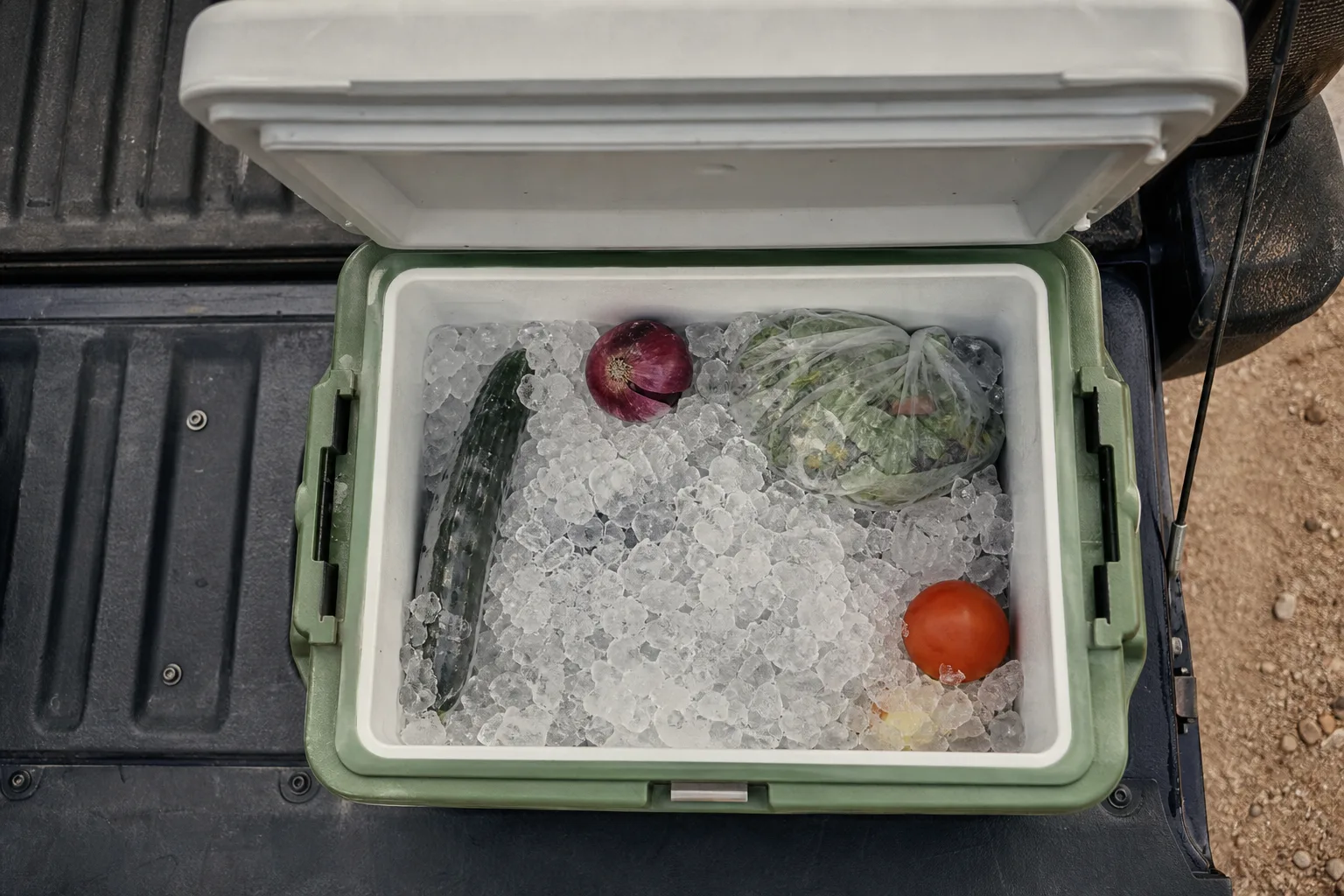
For longest passive performance, major cooler brands commonly advise about 2:1 ice-to-contents. That leaves only about one-third of the internal volume for food and drink. A 40 to 50L passive box with food and 10 to 20kg of ice can become awkward fast, while compressor boxes in the 25 to 55L range can weigh roughly 13 to 22kg empty before you add food.
Match type and size to the trip: day trips, camping weekends and long drives
Trip length decides how much safety margin you need.
- Day trip, picnic or beach, 3 to 8 hot hours: use a 10 to 25L soft or basic hard passive box for drinks and lower-risk food. For meat, dairy or cut fruit, add plenty of frozen mass and a thermometer, and keep it shaded.
- Family road trip, same-day travel with uncertain stops: a 25 to 45L compressor is the safer general choice if you carry perishables through hot parking. A well-iced passive box works on a budget if you can refill ice.
- Camping weekend, 24 to 72 hours: use a 35 to 60L high-performance passive box with block ice, cubes, strict packing and fewer openings, or a 35 to 55L compressor if you have mains, a leisure battery or a power station.
- Long drives, touring and hot climates, 2 days plus: choose a compressor around 35 to 75L with low-voltage protection and an independent thermometer. Dual-zone is useful for frozen food; otherwise single-zone is simpler.
Plan power and parking before you buy: car sockets, battery drain and ventilation
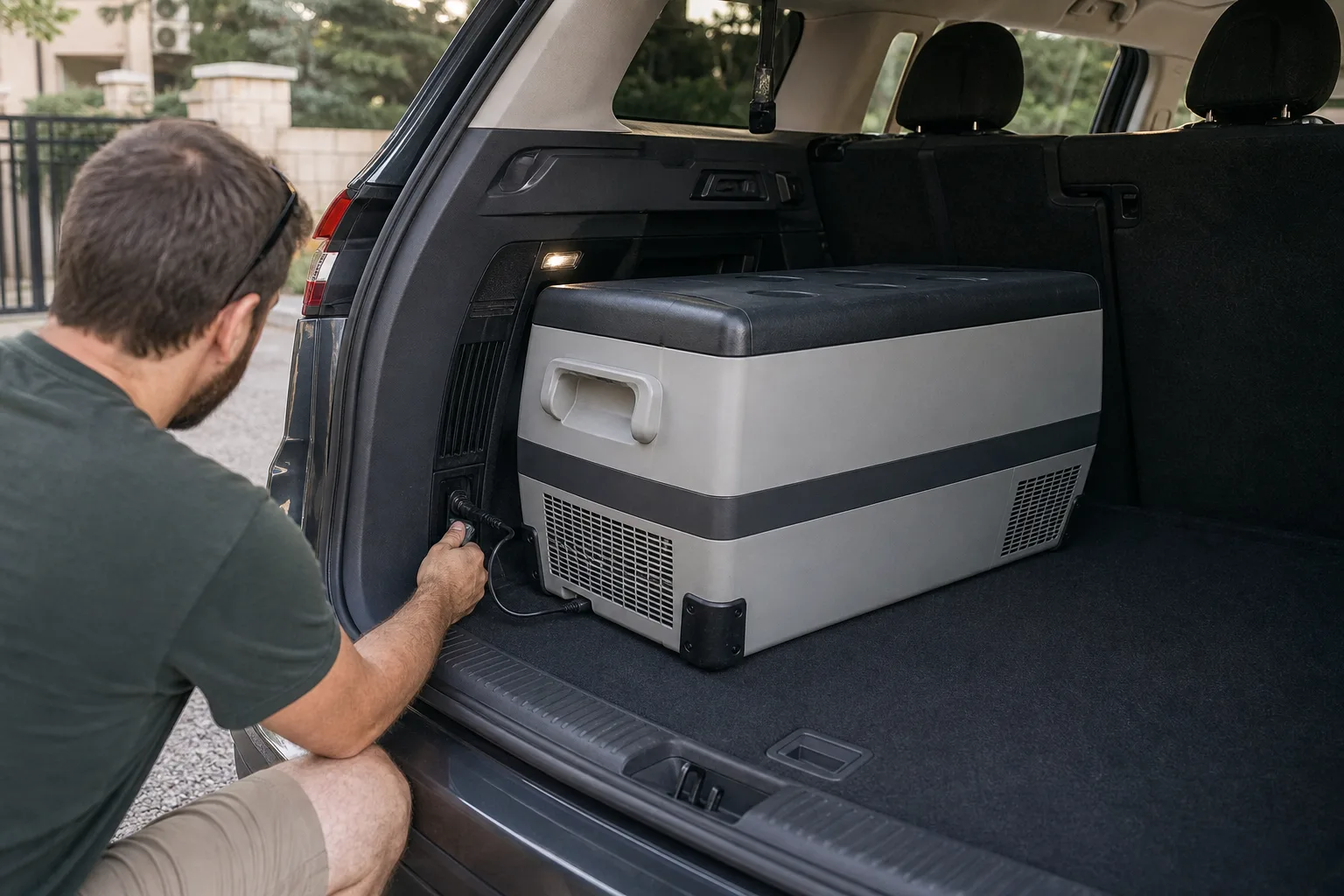
An electric cool box only helps if the power source lasts through the parked parts of the journey. Check the socket, cable route and ventilation before you fill the basket.
- Check whether the 12V socket stays live when the ignition is off. Many vehicles switch it off.
- Check the socket rating. Vehicle accessory sockets are often fused around 10 to 20A, and a 60W thermoelectric draws roughly 5A at 12V.
- Expect thermoelectrics to draw continuously. Typical examples around 48 to 60W use about 1.15 to 1.44kWh per day before losses.
- Compressors draw more at peaks but cycle. Use the manufacturer’s average W, Ah per hour or Ah per day figure for battery planning.
- Use this runtime estimate: usable battery Wh divided by average cooler W equals approximate hours.
- Use high or medium battery-protection settings on a starter battery. Reserve low settings for a dedicated auxiliary battery.
- Avoid thin extensions, loose plugs and blocked vents. Voltage drop can trigger low-voltage alarms, and poor airflow makes any electric cooler work harder.
Where the extra money goes: insulation, thermostat control, durability and service support
The price jump buys different things depending on the cooling method. As of mid-2026, local taxes and retailers vary, but the tiers are useful.
- Soft or basic passive 5 to 30L: around 10 to 60.
- Mid hard passive 20 to 60L: around 50 to 150.
- High-performance or rotomolded passive 30 to 60L: around 180 to 400 plus.
- Thermoelectric 20 to 40L: around 80 to 250.
- Budget compressor 15 to 35L: around 180 to 400; mainstream 35 to 60L: around 400 to 800; premium large or dual-zone: around 800 to 1,300 plus.
In passive coolers, paying more buys thicker insulation, a better lid seal, tougher hinges and latches, improved drains, stronger handles and often rotomolded durability. In thermoelectrics, it usually buys quieter fans, better insulation and AC/DC convenience around the same below-ambient cooling limit. In compressors, it buys the costly parts that change the job: a refrigeration system, thermostat control, power electronics, adjustable battery protection, better insulation, lower noise, baskets, service support and warranty cover.
App control, lights and “antibacterial” linings should not drive the purchase. Temperature stability, cleanability, plug quality, vent design and repair support matter more, especially once the cooler costs as much as a small appliance.
Common mistakes and FAQs: warm food, flat batteries, meltwater, dry ice and “40L enough?”
Most cool-box failures come from warm starts, too many openings, weak power plans and assuming the label volume is all usable space.
Is 40L enough for a weekend?
For a compressor, 40L can work for 2 to 4 people if meals are planned tightly. For a passive box packed for long retention, lay out the food first, then add ice volume; the ice can take most of the space.
Can I put warm leftovers straight into a cool box?
No. Cool food safely first, refrigerate it, then pack it cold. A passive or thermoelectric cooler is mainly a holding tool, and even a compressor needs time to pull down a warm load.
Should I drain meltwater?
Cold meltwater helps temperature more than warm air, so leave it if all food is sealed and the water is clean. Drain it if packaging leaks, raw-food containers fail or the water becomes dirty.
Can I leave an electric cooler running from the car overnight?
Do not plan on a starter battery unless the cooler has battery protection and you accept that it may switch off. Use a leisure battery, power station or mains hookup for planned overnight running.
Can I use dry ice in a cool box?
Only if the manufacturer allows it. Dry ice is about -78.5°C, can cause cold burns, can freeze food solid and releases CO₂, so use gloves, ventilation and never seal the box airtight.
Compare compressor cool boxes
Live prices from more than 20 shops, updated daily.
Verdict: choose the cheapest box that safely covers your hottest unrefrigerated hours
For a picnic with drinks and a few sandwiches, keep it simple: a small passive box, frozen bottles and shade. For a summer road trip carrying meat, dairy or leftovers through hot stops, a 25 to 45L compressor is the sensible upgrade because it gives you a set temperature instead of hoping the weather, ice and parking all cooperate. Thermoelectric coolers sit in the middle: handy for plugged-in, air-conditioned driving, but a weak choice for food safety once the surrounding air gets hot.
This article was created using AI, following our team's editorial standards.


