


Use autumn to find out how much starting reserve your battery has left. Cold slows lead-acid chemistry and makes the engine harder to crank, so charge and test any battery that is around three years old, regularly undercharged or already showing symptoms.
Before you begin: allow 20 minutes and follow the no-spark rules
A visual inspection and resting-voltage check are basic jobs, but the battery deserves care. Cleaning takes longer, and a workshop test requires a separate visit.
- Gather the vehicle manual, a cheap digital multimeter, safety glasses and chemical-resistant gloves.
- For light corrosion, add a disposable nylon or terminal brush, baking soda, clean water and cloths.
- Park on level ground in a ventilated place. Apply the parking brake, switch off the ignition and accessories, and let the engine cool.
- Remove rings, watches and necklaces. Identify the positive and negative terminals before touching the battery.
Stage 1: Spot lost reserve and check the battery’s age
Changes from the car’s usual starting behaviour are more useful than one isolated symptom. Review what has happened during late-summer and early-autumn driving.
- Listen during starting. Slower cranking, a longer delay before the engine fires, clicking or buzzing can indicate weak output, poor terminal contact or a starter fault.
- Watch the lights and powered equipment. Dimming at idle or slow windows deserves investigation. Dimming while driving can also indicate alternator, belt, cable or earth problems.
- Notice whether start-stop has quietly stopped operating. Low charge can trigger this, although temperature, engine warm-up, demisting and heavy heating or cooling demand can do the same.
- Check the invoice, service history or installation label for age. Typical battery life is about three to five years. Arrange a pre-winter test from around three years old, sooner if symptoms or repeated discharge exist.
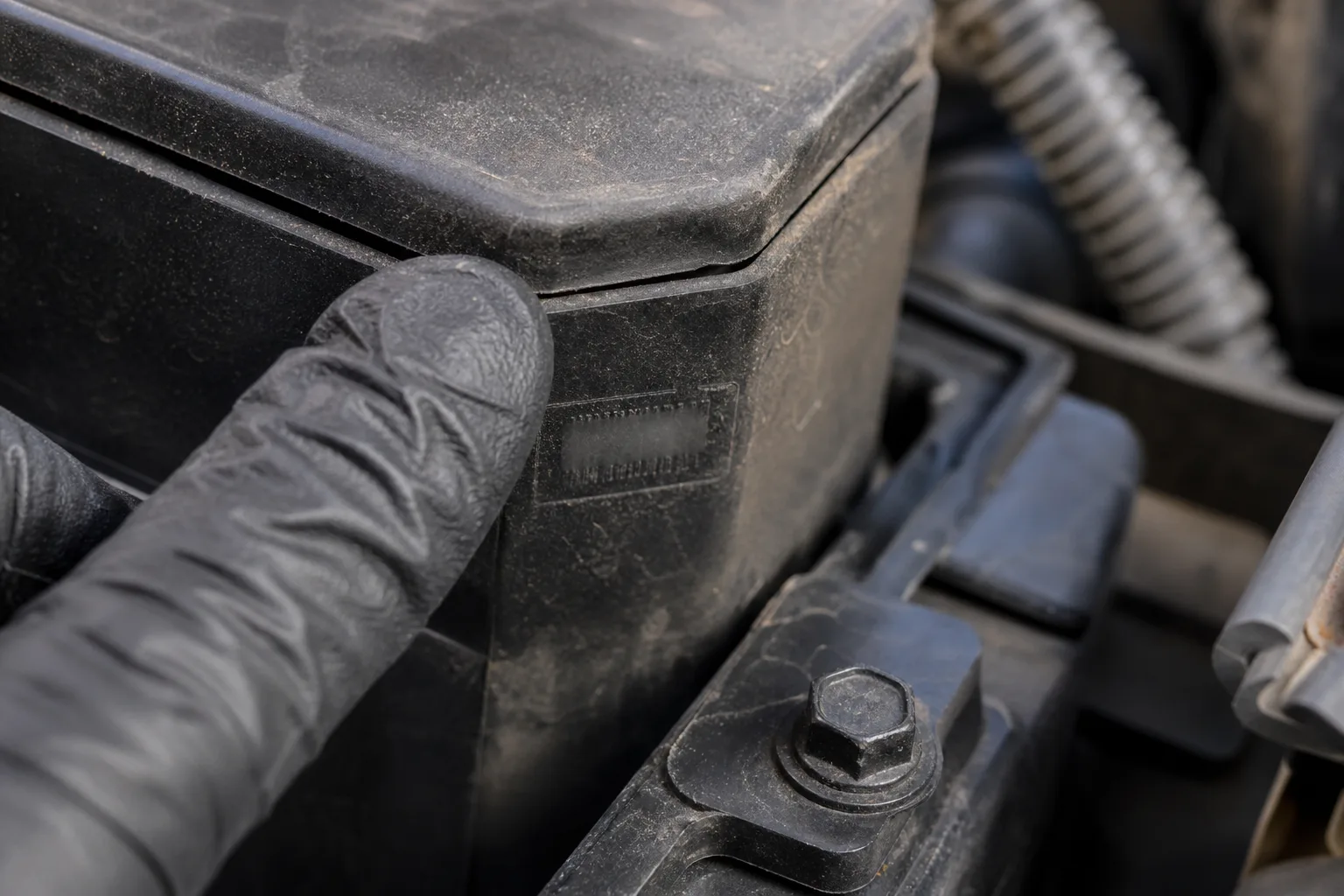
If service records are missing, look for a sticker, engraving or stamped code on the top, side or case edge. Formats vary by maker and can show production, shipment or activation dates. Use the manufacturer’s decoder for the complete code.
Stage 2: Inspect the mounting, cables and clamps
A secure, clean connection lets the starter use the battery’s available power. Loose mounting also exposes the battery to life-shortening vibration.
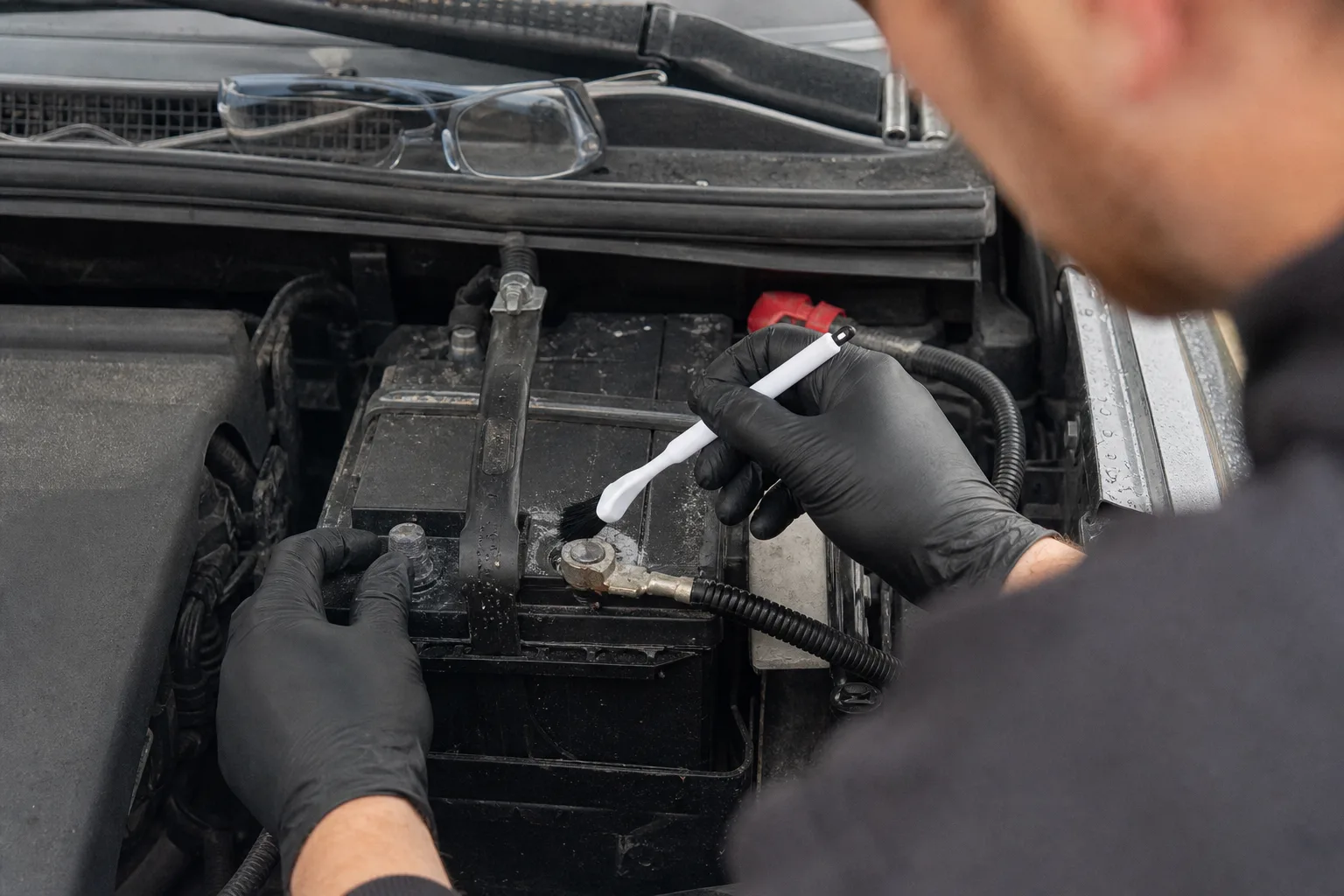
- Check the hold-down. The battery must stay fixed in its tray. Inspect cable insulation, crimped joints and earth straps for damage.
- Try each clamp gently by hand. It should not rotate. Avoid overtightening because battery posts are soft.
- Look for white, blue or green crust. Light surface corrosion can be cleaned. Thinned clamps, damaged cables, leaking seals or eaten-away posts need professional attention.
- Read the manual before disconnecting because some cars lose settings or require relearning. Put on glasses and gloves, then disconnect negative first and positive second.
- Keep the detached positive cable covered and clear of body metal. Mix about one part baking soda with five parts water, or use terminal neutralizer, and scrub with a disposable brush.
- Keep liquid and debris out of vents and filler openings. Wipe away residue, use minimal clean water where needed, then dry the parts thoroughly.
- Reconnect positive first and negative last. Secure the clamps, refit the hold-down, heat shield and covers, and apply terminal-protection spray if desired.
Stage 3: Measure resting voltage and judge the charge level
A multimeter gives a useful state-of-charge snapshot. It cannot measure remaining capacity or confirm that the battery will survive a cold start.
- Let the car stand unused for several hours or overnight. Switch off lights, ventilation, heated screens and other accessories.
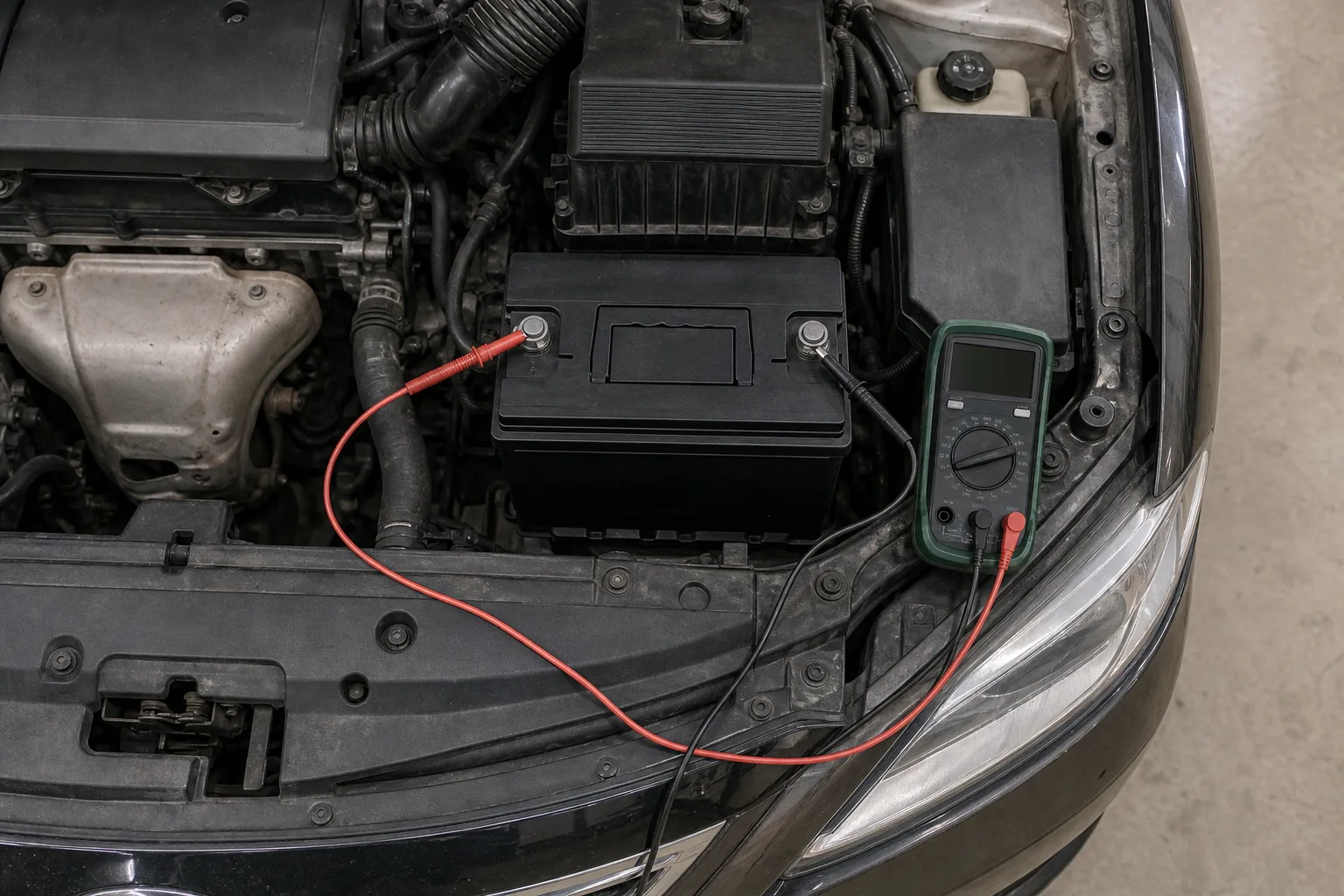
- Set the meter to DC volts on a range above 15 V, unless it is auto-ranging. Touch red to positive and black to negative.
- Measure directly on the posts first. A reading from the clamps can hide resistance between a post and its clamp.
- After recent driving or charging, switch the headlights on for about one minute, switch them off and let the voltage settle before measuring.
| Resting voltage at about 20 to 27°C | Working interpretation |
|---|---|
| 12.6 to 12.8 V | Fully or nearly fully charged |
| About 12.4 to 12.5 V | Around three-quarters charged; recharge before winter |
| About 12.2 to 12.3 V | Around half charged and significantly undercharged |
| Below 12.0 V | Heavily discharged |
| Around 10.5 V | Possible shorted cell or severe discharge; seek professional testing |
Charts vary by a few tenths with temperature, chemistry and preparation, so one hundredth of a volt never decides pass or fail. A battery can show 12.6 V and still collapse under starter load. Modern alternator output also varies deliberately, which makes one generic running-voltage rule unreliable for diagnosis.
Stage 4: Get a workshop health and charging-system test
A professional, chemistry-appropriate test is the dependable way to separate low charge from declining battery health.
- Ask for the battery, starter and charging system to be checked. The report should cover charge, health and measured starting capability against the battery’s cold-cranking rating.
- Workshops may use a controlled load test or a validated conductance tester for flooded, EFB or AGM batteries. Both assess performance under conditions a resting-voltage reading cannot reproduce.
- If the battery is deeply discharged, charge it fully, remove surface charge and retest. A low state of charge can otherwise produce an inconclusive result or false failure.
- Replace: the result says replace, bad cell or failed starting capability. Damage, swelling or leakage also requires replacement.
- Recharge and retest: the battery is undercharged but tests healthy, especially after standing, short journeys or a one-off mistake such as leaving lights on.
- Diagnose the car: a fully charged battery goes flat within days, corrosion quickly returns, lights dim while driving or the charging warning lamp appears.
- Replace before winter: a four to five-year-old battery combines slow cranking with a marginal result. Another jump start is a poor plan where reliable transport matters.
A jump start supplies enough temporary current to run the engine. It leaves the battery’s charge, internal damage and cause of discharge unresolved. Charge and test the battery after any unexplained jump.
Prevent another weak battery with better charging habits
A battery lasts longer when starts are followed by enough charging time and parked periods do not leave it partly discharged.
- Trips under about 15 minutes can finish before the alternator replaces the energy used to start, especially with lights, heating, demisting and heated seats running.
- One uninterrupted journey longer than 30 minutes each week is a useful rule of thumb for a lightly used car, though it cannot guarantee recovery of a deeply discharged battery.
- Idling on the driveway is a poor charging method. Alternator output can be limited while vehicle loads, exhaust and security risks remain.
- Parked cars still power alarms, clocks, keyless receivers and control modules. Dashcams, trackers, OBD devices and a nearby key fob can increase drain.
- A car may become difficult to start after roughly four weeks to two months of standing, depending on battery condition and standby load. Failure after only a few days calls for diagnosis.
A smart charger restores a depleted battery and then changes to maintenance mode. A fixed-output trickle charger can overcharge during indefinite connection, while charger repair or rejuvenation claims cannot overcome a bad cell or physical damage.
- About 1 to 2 A: suited to maintaining a healthy battery during long storage; slow for recovering a flat full-size car battery.
- About 4 to 8 A: the practical combined charger and maintainer range for many passenger-car batteries.
- About 10 to 12 A: faster for larger batteries, provided the charger’s capacity range matches the battery.
- Look for explicit support for the required flooded, EFB or AGM chemistry, automatic maintenance, temperature compensation, reverse-polarity protection and recognised electrical-safety approval for your market.
Compare smart battery chargers
Live prices from more than 20 shops, updated daily.
Avoid damage and know when to stop
Stop the DIY check as soon as the battery or vehicle shows signs that cleaning and voltage measurement are no longer safe or useful.
- Never open an AGM or sealed maintenance-free battery. Add water or acid only where the battery and vehicle maker provide an explicit service procedure.
- Use the charging and jump points in the vehicle manual. Many cars specify a remote positive post and chassis earth point.
- Do not fit an ordinary flooded battery to a vehicle requiring EFB or AGM. Replacement must also match dimensions, terminal position, hold-down, venting, Ah and CCA requirements.
- Check whether replacement requires battery-management registration, coding or relearning. A workshop needs to handle this if you lack the correct scan tool.
- Stop for a swollen, cracked, leaking, unusually hot or apparently frozen case, or for hissing, steam or a rotten-egg smell.
- Stop where corrosion has damaged a post, clamp, cable or hold-down, or where the battery is inaccessible under trim, connected to a vent tube or specified for professional replacement.
- Arrange diagnosis for repeated flat batteries, a charging warning lamp or lights that dim while driving. Possible causes include the alternator, belt, cables, earths or parasitic drain.
- If acid reaches skin or eyes, flush immediately with plenty of clean water and obtain medical assistance. Never apply baking soda to the body.
Autumn car-battery FAQ
These details resolve common uncertainties after the basic inspection.
Does a battery date code show when it was installed?
Often it does not. A code can record production, shipment, charging or activation. The purchase invoice or installation label gives the clearest time in service.
Will the alternator fully recharge a jump-started battery?
A ten-minute commute is unlikely to recover a significantly discharged battery. Use a compatible mains charger, then arrange testing if the cause of discharge is unclear.
Can an AGM or EFB start-stop battery use any 12 V charger?
No. The charger must explicitly support the battery chemistry and connect through the points specified by the vehicle maker, especially where a battery-management sensor is fitted.
Can a charger’s repair mode save an old battery?
Charging can recover a battery that is merely discharged, and some modes attempt to address limited sulfation. No charger repairs a bad cell, leaking case, shed plate material or major internal deterioration.
Your pre-frost decision
Keep a battery that starts normally, holds charge and passes a professional health test. Fully charge and retest an undercharged battery after short trips or standing. Replace a damaged or failed battery immediately, and replace an older marginal one before winter if slow cranking has already appeared. That decision costs less disruption than discovering the same weakness on a frosty morning.
This article was created using AI, following our team's editorial standards.


