

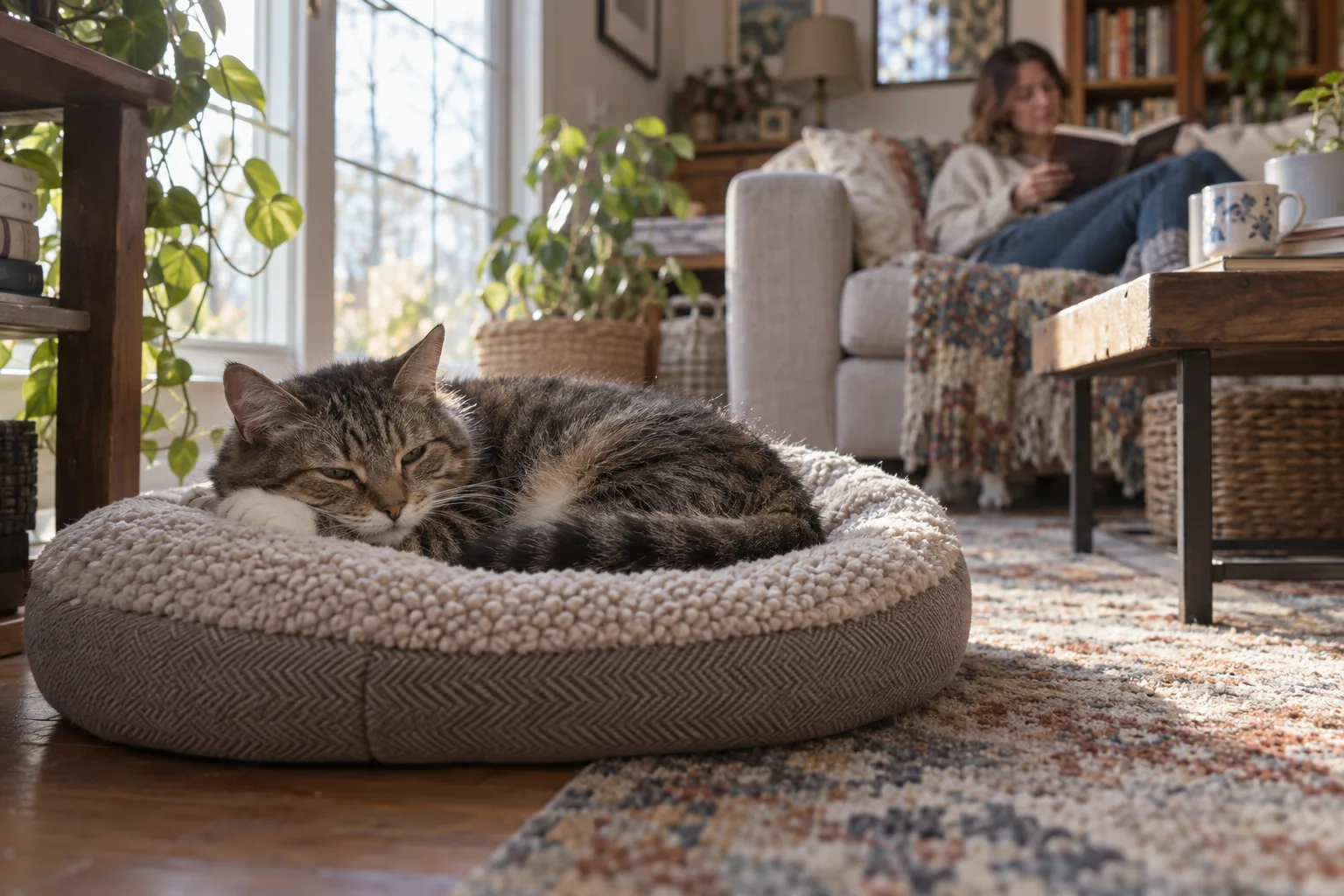
If your older dog hesitates at a bolster or your cat has stopped jumping into its bed, start with a low, supportive place to sleep. A reflective mat can help a mobile pet that seeks warmth indoors; powered heat belongs on the shortlist only if the pet can leave it unaided for an unheated spot.
Easy entry starts with a movement check
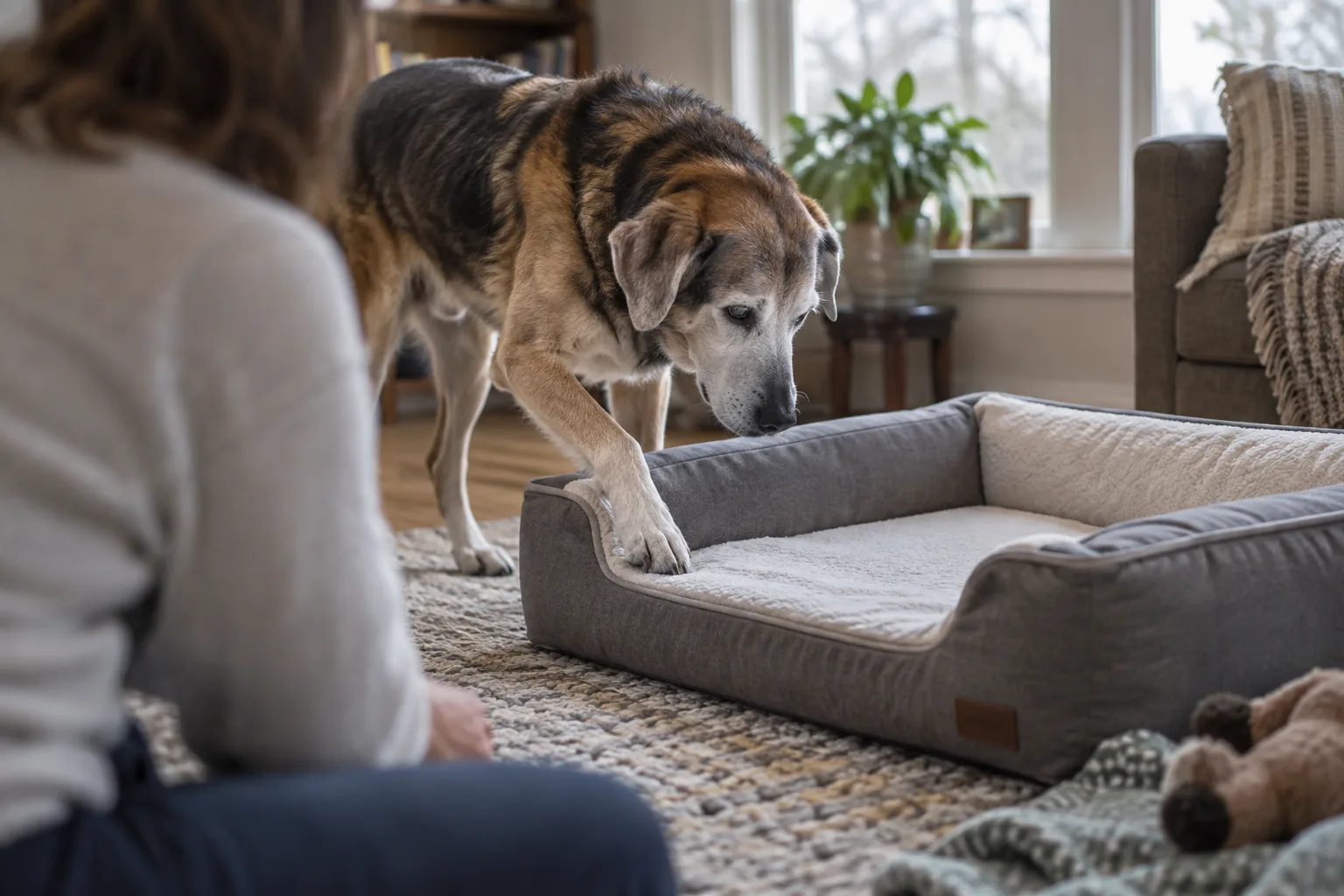
Watch your pet enter its current bed and rise after a nap before comparing replacements. A comfortable bed in an accessible, draft-free spot may need only a washable warm cover, with no new bed required.
- Check the approach: a high front, deep nest or tall mattress can make the first step difficult. There is no universal safe entry height; judge it against your pet's movement.
- Check the exit: watch whether the pet can stand without sinking into the filling. On a smooth floor, use a secure nonslip base or an adjacent rug.
- Check the sleeping space: measure your dog lying fully on its side, then compare that length with the space inside the bolsters. If the dog occupies 37 inches, an advertised 39-inch outer length alone doesn't establish a fit. A cat needs room to turn and settle in its preferred position.
| Pet or situation | Shortlist | Main limitation |
|---|---|---|
| Stiff dog struggling to rise | Low-entry supportive foam mattress | Soft filling can sink under a heavy dog |
| Older cat with reduced jumping | Padded, low-sided bed | A high-sided cave can block access |
| Mobile indoor cold-seeker | Reflective self-warming mat over adequate padding | It produces no heat of its own |
| Mobile pet still cold despite adequate bedding | Pet-specific thermostatic heated bed | It requires supervision and an unheated escape space |
| Pet needing support and occasional warmth | Supportive mattress with an approved warmer | The insert and its covering must suit that bed |
| Pet using a sheltered outdoor space | Dry shelter, then an outdoor-rated pad if needed | A heated pad cannot provide weather protection |
Bedding is a comfort aid, not arthritis treatment. Persistent stiffness, trouble rising or changed behaviour warrants a veterinary assessment. In cats, missed jumps, reduced grooming and toileting outside the litter tray can be signs that something is wrong.
Stiff dogs need stable, low-entry foam
A flat foam mattress gives a stiff dog a clear route on and off while leaving room to stretch. This is the strongest starting point for a heavy dog or one that struggles to stand. Its weakness is that an impressive foam label tells you little about support under your dog's weight.
- Press where shoulders and hips will rest. Reject foam that compresses to the floor; check its rebound and any stated weight limit. Thickness alone won't tell you whether it will hold up.
- Choose a washable cover and a separate waterproof barrier over the foam if accidents happen. A washable cover doesn't mean the foam core can go in the machine.
- If your dog likes a headrest, a three-sided bolster leaves an open approach. Skip a deep, soft nest if the dog has to struggle to stand in it.
Older cats need low sides and padding
Put a well-padded, low-sided bed in a favourite spot your cat can reach without jumping. That preserves a familiar resting place while removing a climb. The trade-off is less enclosed warmth than a tall-sided cave, so add a suitable liner or warm cover if the room is cool.
A warm radiator perch or elevated hammock loses its appeal if the cat can no longer get onto it. Check that the bed stays put as the cat steps in and has enough space for its usual curled or stretched sleeping position.
Reflective mats suit mobile indoor cold-seekers
Try a reflective mat for a mobile cat or small, thin-coated dog that seeks warmer places in a cool indoor room. It returns some of the pet's own heat and uses no operating electricity. Its weakness is thin cushioning: place it over an already suitable bed if the pet needs joint support.
A reflective mat cannot generate heat or reliably warm a cold, wet animal. Some liners rustle, so check that your pet will settle on one before treating it as a useful upgrade. In shop filters, confirm that a product called “self-heating” is the cord-free type you intend to buy.
Powered heat requires an easy escape
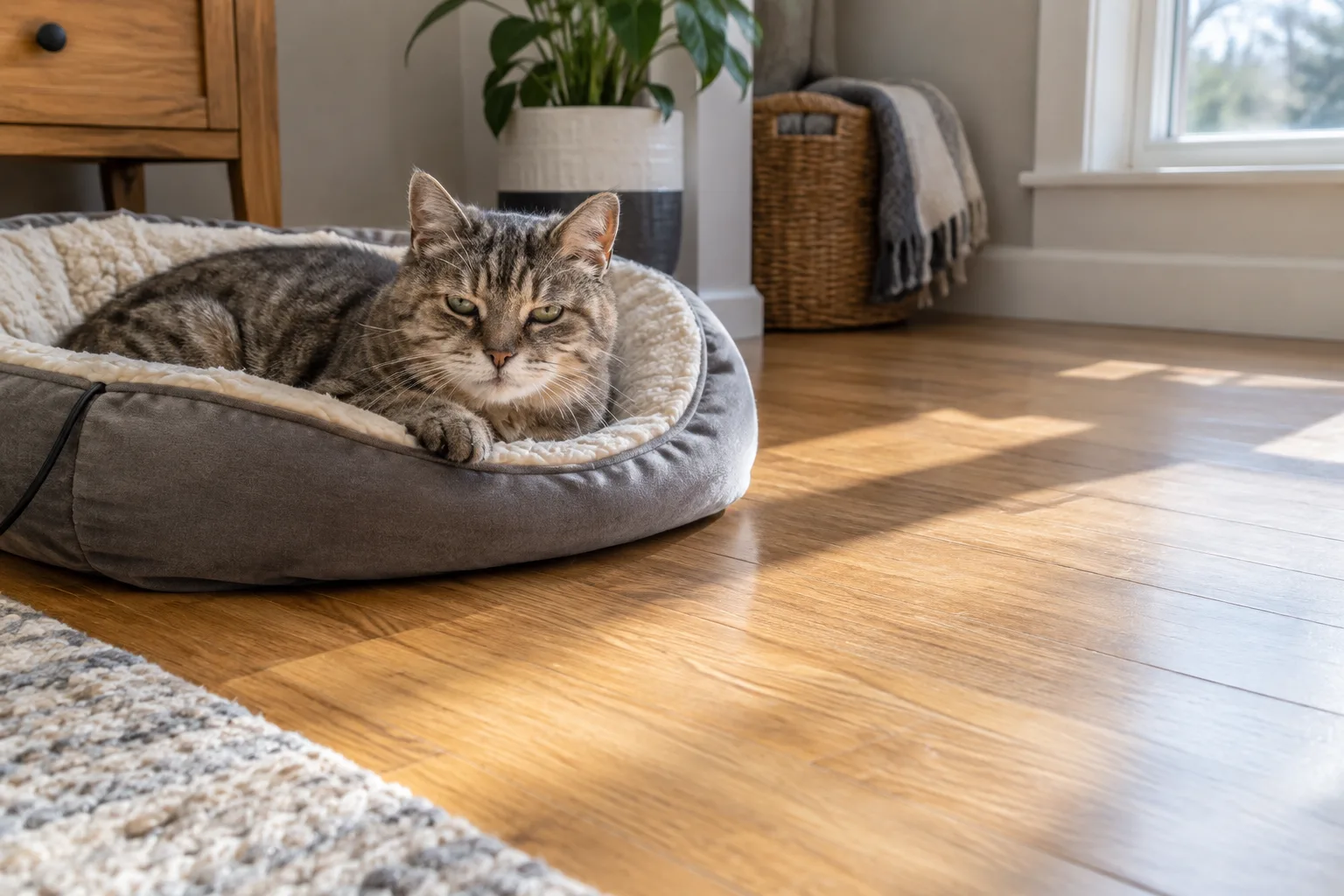
A pet-specific thermostatic indoor bed provides active warmth for a mobile pet that remains cold despite adequate bedding, provided someone can monitor its use. Its weakness is the added safety work: the pet needs a reachable unheated place, and the electrical parts need regular checks.
- Compare the heated area's dimensions with the bed's usable space. A small insert can warm only part of a much larger mattress; arrange a separate unheated resting spot the pet can reach easily.
- Read the manual for the intended bed, covering and heat controls. “Warms when occupied” does not necessarily mean the unit switches off when empty. A timer, low wattage or protected cord alone cannot establish safe contact.
- Check the product label for compatibility with a standard 120 V household outlet, and look for clear safety information and, where available, a third-party electrical safety mark such as UL Listed or ETL Listed. A product marked for 230 V cannot be made suitable for a 120 V supply with a plug adapter alone.
- Inspect the cord, plug, cover and heater for damage or dampness. Unplug electrical parts before removing or washing them, and follow the product's exact cover instructions.
Dry shelter comes before outdoor heating
For an animal using a sheltered outdoor space, provide a dry, protected shelter first and bring a vulnerable older pet indoors where possible. If powered heat is still needed, choose a product explicitly rated for that location and install it according to its instructions.
Keep unheated floor space available and check that the pet can move onto it. Outdoor-rated pads may have wipe-clean shells and protected cords, but they aren't a solution for a pet that chews electrical parts. An indoor plug-in bed or reflective mat cannot take the place of weather protection.
Combined beds must work with heat off
If a pet needs support every day and extra warmth occasionally, judge the unheated mattress first. It should remain stable, padded and easy to leave when the warmer is unplugged. Use only a bed warmer approved by its maker for that position and layering; don't improvise with an exposed pad on top of foam.
Claims such as “orthopaedic” and “therapeutic heat” don't establish arthritis relief. Independent home-use work on seven beds recorded owner impressions of comfort and cleaning, without measuring long-term medical outcomes or proving one bed type treats arthritis better.
The higher price buys active warmth
A basic reflective liner is usually an entry-tier add-on; a washable supportive mattress or small indoor heated bed moves up the spend, while large premium foam builds cost more again. Prices vary sharply with size and market. The extra cost of a powered bed buys generated warmth and electrical controls; assess its mattress separately for support.
For running cost, multiply watts by hours used, divide by 1,000, then multiply by your local price per kWh. At continuous rated power for 30 days, a 6 W warmer uses about 4.32 kWh and a 60 W pad about 43.2 kWh; eight hours a day makes each figure one-third as large. Actual use can differ as a thermostat cycles, and a higher-wattage outdoor pad has a different job from an indoor bed.
Compare orthopedic pet beds
Live prices from more than 20 shops, updated daily.
Frequently asked questions
Why does a heated bed barely feel warm when empty?
Some thermostatic designs give modest warmth until covered by an occupying pet. Follow that product's specified test method rather than judging by hand. One maker specifies a pillow for about 20 minutes during a test, then requires its removal; never leave a test pillow on an outdoor pad.
Can I use a microwaveable heat disc instead?
It offers temporary, local warmth without a cord, but its warmth fades and the concentrated heat needs the specified cover or bedding barrier. Follow the maker's heating instructions and let it cool completely before reheating. Ask a vet before using one for a frail pet or one unable to react to discomfort.
Can I leave an electric pet bed on overnight?
Choose an ordinary bed for overnight sleep, especially for a senior pet. A manufacturer's continuous-operation claim doesn't establish that sleeping unsupervised on the heater suits your animal. Never confine a pet with a pad that removes its choice of an unheated space.
Does certified foam prove a bed helps arthritis?
No. A foam certification can cover specified properties of the foam itself. It doesn't certify the finished bed as an arthritis treatment, so compare access, fit and support and take signs of pain to a vet.
Should I wait for a winter bed sale?
Don't delay if your pet currently struggles with its bed. Seasonal promotions occur, but their depth varies by item. Compare the same bed, size and seller with a price you've observed before the sale, including delivery and returns; a percentage off a list price alone says little.
How to choose
For a stiff dog, buy a supportive low-entry mattress that holds its weight. For an older cat, start with padding in an accessible favourite spot. Add a reflective liner for a mobile indoor cold-seeker; choose powered heat only for a pet that can leave it freely and has an unheated place to rest.
This article was created using AI, following our team's editorial standards.


