


A tick around 1/32 inch wide can disappear in a dark or dense coat, so a glance at the dog on the doorstep won’t clear it. After walks in the woods, rough pasture, brush or tall grass, allow about five minutes for a fingertip sweep, seven hidden-zone checks and prompt removal with a two-size hook or fine-point tweezers. This matters during the smaller late-summer-to-fall activity peak seen in many parts of the United States, although local patterns vary.
Set up a five-minute post-walk check: good light, gloves and one cheap removal tool
Keep the setup basic and ready near the leash, because searching for equipment leaves an attached tick feeding for longer.
- Time: around five minutes for a calm, short-coated dog. Allow longer for dense fur or removal.
- Difficulty: easy when the dog stands calmly. Use treats and a second person for a restless dog. Stop if handling creates a bite risk.
- Have ready: gloves, bright light, a two-size slotted tick hook or clean fine-point tweezers, and a sealed bag or container.
- Before checking: remove the collar and harness completely. Ticks hide under straps and buckles.
Compare tick removal hooks
Live prices from more than 20 shops, updated daily.
Sweep from muzzle to tail by touch, not sight, to find tiny ticks hidden by the coat
Use the same route after every exposed walk, pressing your fingertips gently against the skin to find unfamiliar bumps.
- Start at the muzzle and move over the head and neck.
- Feel the chest, shoulders, back, flanks and belly, then cover each leg.
- Part or reverse the fur whenever you feel a bump. Bright light and a comb help expose the skin on long or dark coats.
- Look for legs before treating a bump as a tick. Skin tags and nipples can be mistaken for engorged ticks.
- Continue to the tail, then repeat any area where your fingers lost contact with the skin.
Check the seven zones most often missed: ears, eyelids, collar, armpits, toes, groin and tail
The whole-body sweep finds exposed ticks, while these warm, folded areas need a deliberate second pass.
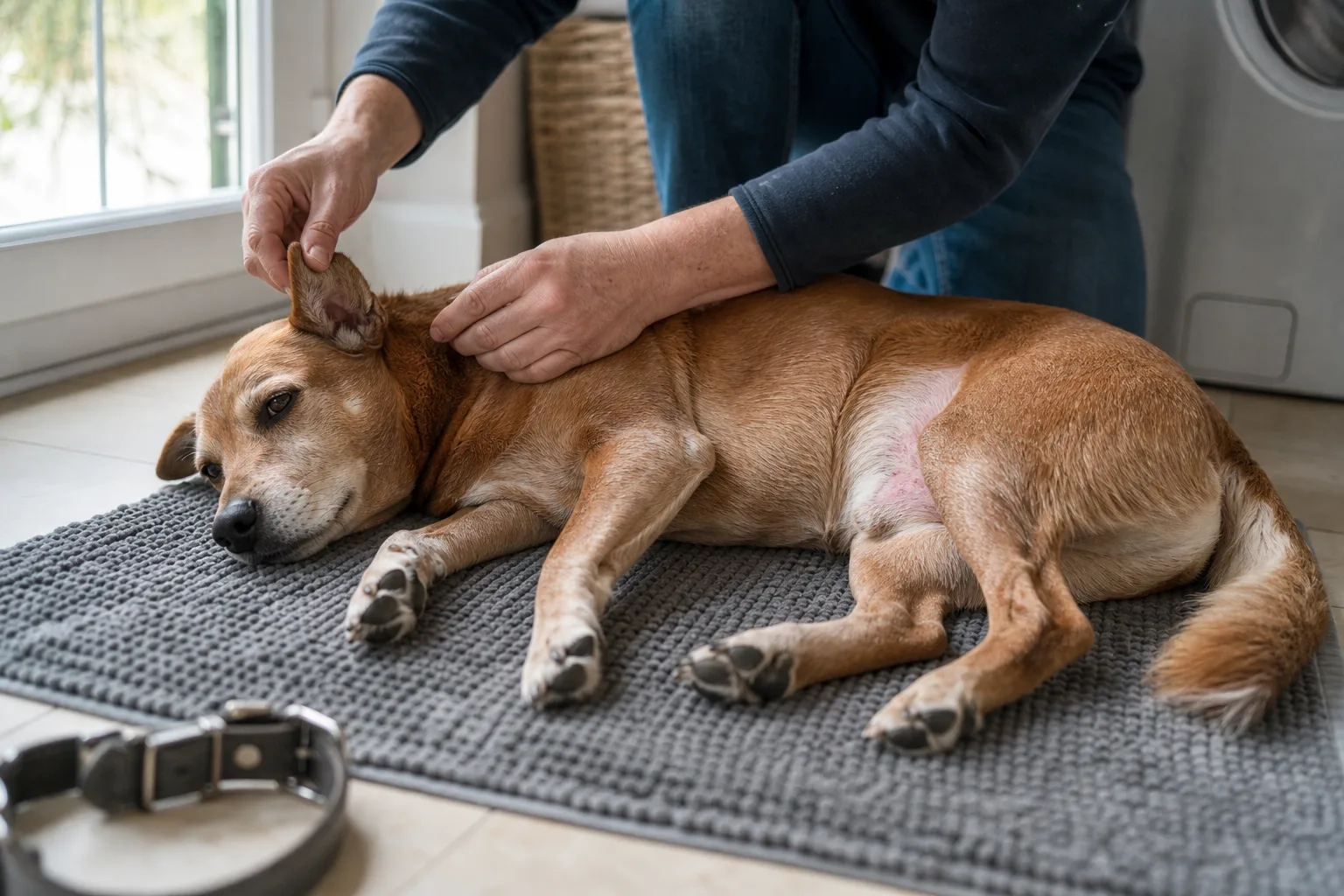
- Ears: inspect both surfaces, folds at the base and the visible canal entrance. Do not probe into the ear canal.
- Eyelids: examine around each eye. A tiny tick can resemble dried discharge or a skin tag. Use a vet for one attached at the lid margin.
- Under the collar: check the whole neck after removing the collar, plus skin covered by harness straps.
- Armpits: feel high where each front leg joins the chest.
- Between the toes: spread every toe and inspect above, below and around the pads.
- Groin: check between the back legs, across the inner thighs and over nearby skin.
- Tail: inspect the base, underside and surrounding skin.
Finish by looking for loose ticks crawling through the coat. Check your clothing and skin too, since a dog can carry an unattached tick indoors.
Remove the tick safely: rotate a slotted hook or pull tweezers straight up
The tool determines the motion: a purpose-designed hook rotates according to its instructions, while fine-point tweezers use steady upward traction.
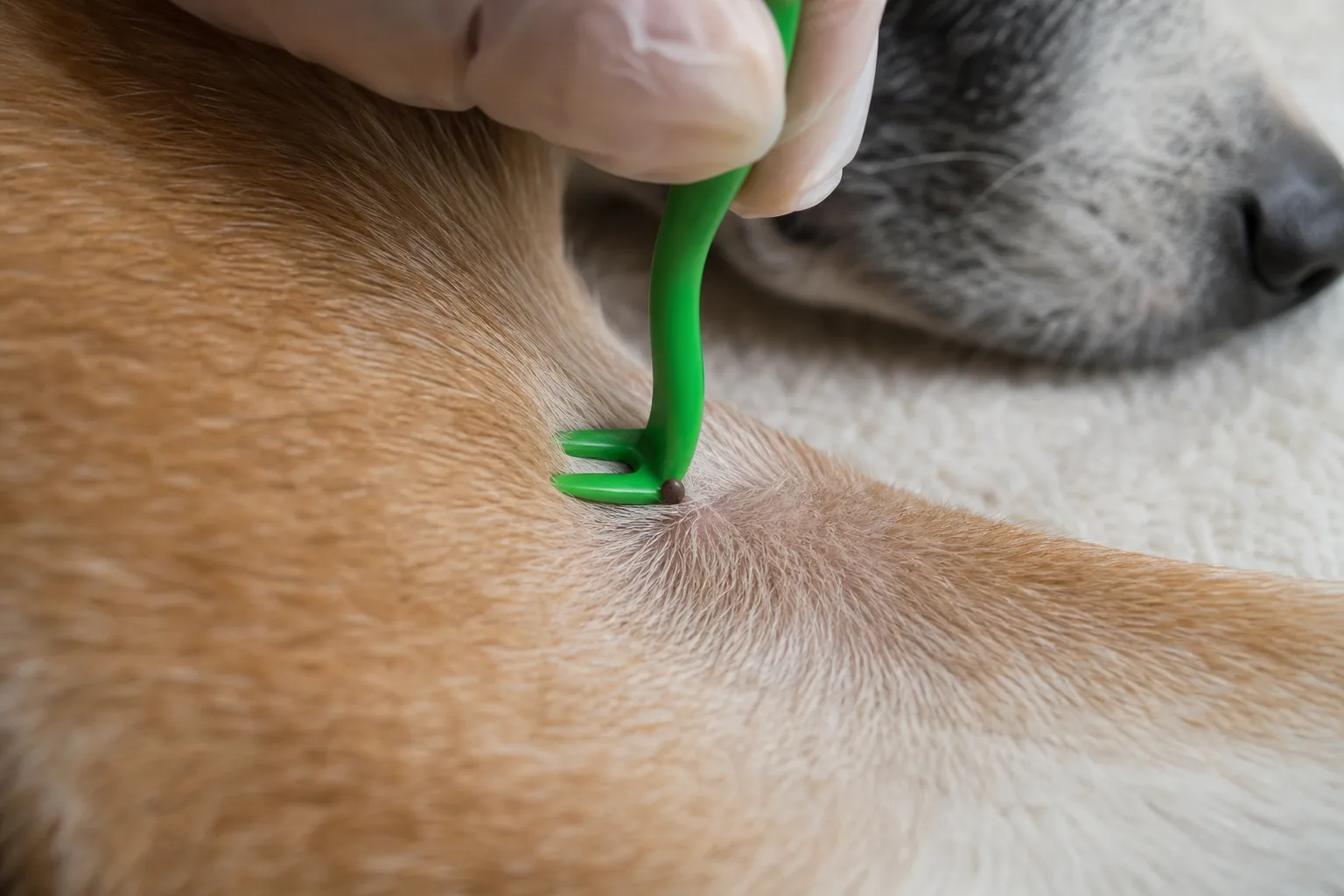
| Tool | Correct motion | Best suited to |
|---|---|---|
| Two-size slotted hook | Slide beneath the tick at skin level, then rotate as the tool instructions specify | An easy default for furry or curved areas and ticks of different sizes |
| Fine-point tweezers | Grip at skin level and pull straight upward with slow, even pressure | Very small or flat ticks, provided the handler has a steady grip |
Using a slotted tick hook
A correctly sized slot should pass beneath the tick without trapping its swollen abdomen.
- Part the coat until you can see the attachment point.
- Choose the hook size that fits closely around the narrow head and mouthpart area.
- Approach from the side and slide the slot beneath the tick until the hook rests against the skin.
- Keep the hook low and rotate it in one direction exactly as its instructions specify. Do not squeeze or yank.
- Continue until the tick releases, then lift it away.
Using fine-point tweezers
True fine points can reach the attachment area without compressing the tick’s body.
- Part the fur and place the tips as close to the skin as possible.
- Grip the tick at its head and mouthpart end. Avoid the large gray or swollen abdomen.
- Pull straight upward with slow, steady and even pressure.
- Keep the tweezers aligned. Do not jerk, rotate or twist them.
- If a fragment remains and does not lift easily with clean tweezers, stop digging.
Clean, record and recheck, then monitor the bite and your dog for several weeks
Once the tick is out, clean the site and create a record that will be useful if the dog becomes ill later.
- Put the tick in a sealed bag or container. Do not crush it with bare fingers.
- Clean the bite area and tool with soap and water or a veterinary-safe skin cleanser, then wash your hands.
- Record the date and likely exposure location. Take a clear photograph or retain the tick if travel or an unusual species could matter.
- Repeat the entire body check. Finding one attached tick does not rule out another.
Check the attachment site daily
A small speck can settle without intervention, but worsening inflammation needs veterinary advice.
- Increasing redness, heat, swelling or pain
- Discharge, pus or an open sore
- Persistent licking or scratching
- A growing lump or obvious retained material
Watch the whole dog for days to several weeks
Tick-borne illness does not always appear the next morning, and many exposed dogs never develop clinical disease.
- Lethargy, weakness, fever, reduced appetite or weight loss
- Limping, stiffness, swollen joints or lameness that moves between legs
- Pale or yellow gums, unexplained bruising or nosebleeds
- Dark, red or rust-colored urine
- Vomiting, diarrhea, increased thirst or increased urination
- Wobbliness, tremors, seizures, paralysis or altered behavior
Arrange same-day assessment for collapse, breathing difficulty, inability to stand, severe wobbliness, seizures, paralysis, pale or yellow gums, dark urine, significant bleeding or rapid deterioration. Fever, appetite loss, lethargy or lameness after tick exposure also warrants a prompt appointment.
Avoid oil, glue, burning and bad twisting advice, and know when to stop and call a vet
Home remedies delay mechanical removal and can irritate the tick or injure the dog.
- Oil, butter, petroleum jelly and nail varnish do not produce prompt detachment and can increase salivation or reflux.
- Glue can stick coat to skin while giving no control over the mouthparts.
- Matches and heated needles can burn the dog.
- Alcohol belongs in aftercare for cleaning. Pouring it onto an attached tick delays removal.
- Twisting is tool-specific. Rotate only a slotted hook designed for that action; ordinary tweezers pull straight upward.
- A fast yank raises the chance of tearing the body away from the mouthparts.
- Repeated digging for a dark speck creates a larger wound. Clean and monitor the area.
Move beyond DIY when handling or location makes removal unsafe
Ask a vet to handle ticks in delicate sites, heavy infestations or situations where safe restraint is impossible.
- The dog might bite or cannot be held calmly
- The object could be a nipple, skin tag or growth
- The tick sits in the ear canal or on the eyelid margin
- Numerous ticks are attached, especially on a puppy, small dog or debilitated animal
- Removal has repeatedly failed or the dog is already unwell
FAQ: preventives, retained mouthparts, tick testing and household risk
Why is a tick attached when my dog uses a preventive?
Products work differently. Some repel ticks, while others kill them after attachment. Keep checking after walks because no EPA-registered product is 100% effective. Product choice depends on the dog’s age, weight, health, travel and local tick risks, so ask a vet. Dog-only pyrethroid products, particularly permethrin formulations, can cause severe or fatal poisoning in cats.
Can retained mouthparts keep transmitting disease?
Once the tick’s body is gone, retained fragments cannot continue actively transmitting disease. They can still irritate the skin. Leave a stubborn fragment alone, keep the site clean and contact a vet if redness, pain, heat or discharge develops.
Should I have the tick or my dog tested immediately?
Tick testing does not diagnose the dog and can miss exposure from another unseen tick. An immediate blood test can also be too early, and a later positive antibody result can show exposure without proving active illness. A vet should decide whether symptoms and travel history justify testing.
Can I catch Lyme disease directly from my dog?
No. The household risk comes from an unattached tick carried indoors that later bites a person or another animal. Check the dog, your clothing and your own skin after exposed walks.
My preventive killed the tick, but it is still attached. Can I leave it?
Remove it mechanically and monitor the site. Dead ticks can remain attached for a period, and leaving one in place makes the bite harder to assess.
The repeatable late-summer routine: feel, check seven spots, remove promptly
Make the order automatic: remove collar and harness, sweep from muzzle to tail with your fingertips, inspect all seven hidden zones, then remove any tick with the correct motion for your tool. A basic two-size hook is enough for most owners. Keep it by the leash and use the money saved on elaborate kits elsewhere.
This article was created using AI, following our team's editorial standards.