

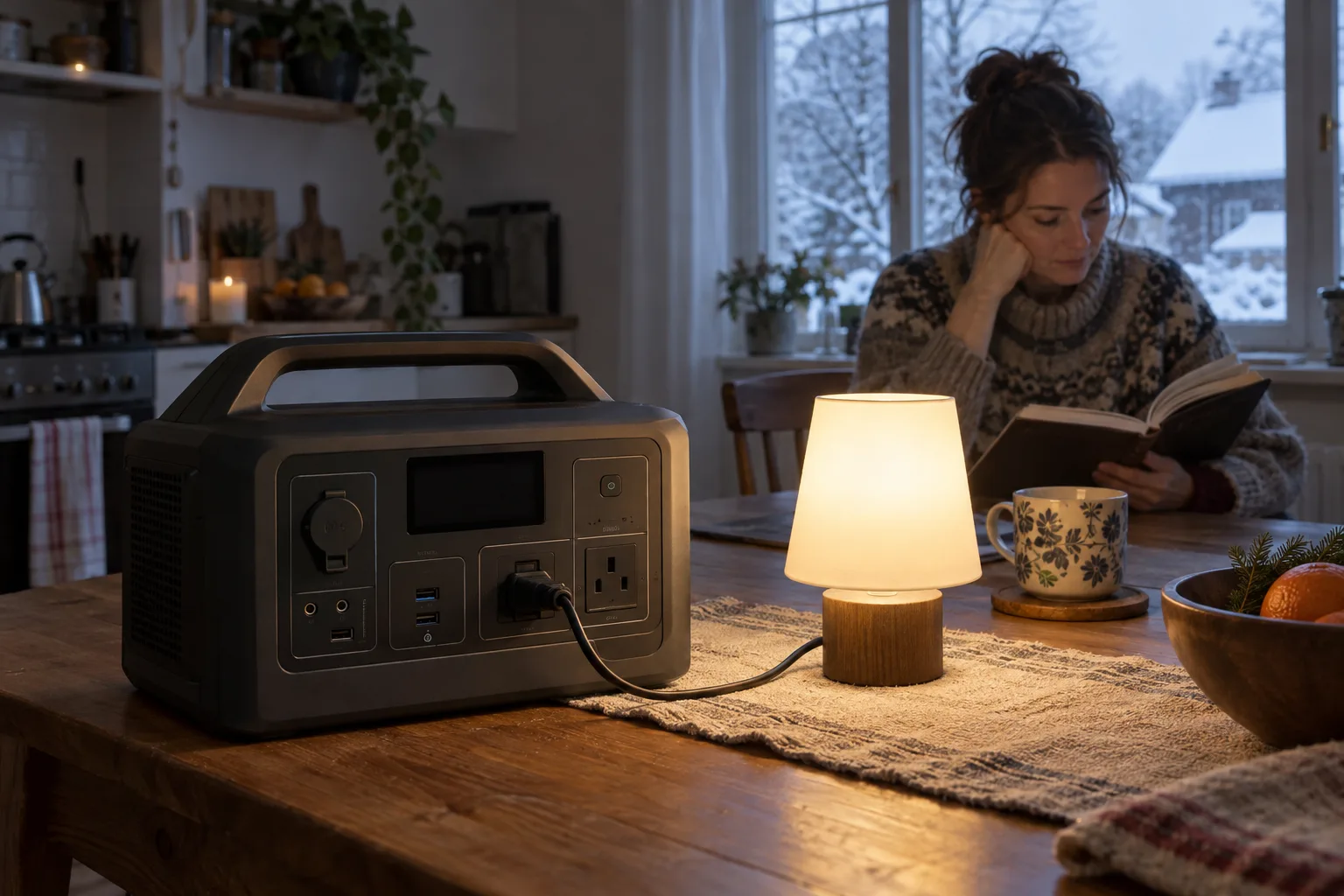
The power goes out and you look at the fridge. Keep its door shut: US food-safety guidance says an unopened fridge stays safely cold for about four hours. For a short cut, that may leave your battery free for the phone and a light.
A four-hour cut may call for a bank, not fridge backup
If the plan is a phone and a USB light, a large power bank is the lighter, simpler purchase. It can charge a suitable laptop too. A power station earns its place when ordinary household plugs must work for longer, especially if you hope to run a fridge. If your phones are already charged and the cut ends while the fridge remains safely cold, you may need no new battery at all.
The usable energy is smaller than the label suggests
Watts (W) tell you what a battery can power at once; watt-hours (Wh) tell you roughly how long. A 20,000 mAh bank holds about 74 Wh using a typical 3.7 V cell-voltage calculation. Allowing for conversion leaves roughly 52 to 59 Wh through USB. In an independent test of eight stations, usable capacity averaged 10 to 15% below the stated figure. The station estimates here use 85% of nameplate Wh, including for sizes outside that test. They’re planning figures: battery age, temperature and the output you use can change them.
| Example load | 20,000 mAh bank | 250 Wh station | 1 kWh station | 2 kWh station | What it means |
|---|---|---|---|---|---|
| One 5 W USB light | About 10 to 12 hours | Longer via USB | Many tens of hours via USB | More reserve | A bank covers the short cut |
| 10 W router | About 5 to 6 hours with compatible DC | About 21 hours before heavy AC idle losses | Up to about 85 hours before heavy AC idle losses | More energy, but check AC idle draw | Compatibility decides whether a bank works |
| Router and two lights, 30 W together | About 2.5 to 3 hours if all use USB or DC | About 7 hours | About 28 hours | About 57 hours | A station covers the longer cut |
| Fridge labelled 360 kWh per year | No ordinary USB solution | Compressor may fail to start | About 21 hours if it starts | About 41 hours if it starts | Check starting output first |
| 1,500 W space heater | No | Usually exceeds AC output | About 34 minutes if output is sufficient | About 68 minutes if output is sufficient | Neither is an overnight heat plan |
Those loads are examples, not ratings for your appliances. The bank’s router-and-lights figure also assumes all three can use its ports; ordinary AC bulbs cannot. Divide usable Wh by average load W for a starting estimate, then check the power needed at the same time. Small loads running from a station’s AC sockets may finish much sooner than the table suggests.
A router can make an AC inverter the biggest load
For the short-cut household, the tempting next step is keeping Wi-Fi on. A compatible USB or DC connection avoids running a station’s AC inverter solely for a small router. Some tested stations used as much as 30 W with AC enabled, against the table’s 10 W router. If a particular station adds 15 W to the 30 W router-and-lights setup, the 1 kWh estimate falls from about 28 to 19 hours. That’s an illustration of idle draw, not a loss to add again to every capacity figure.
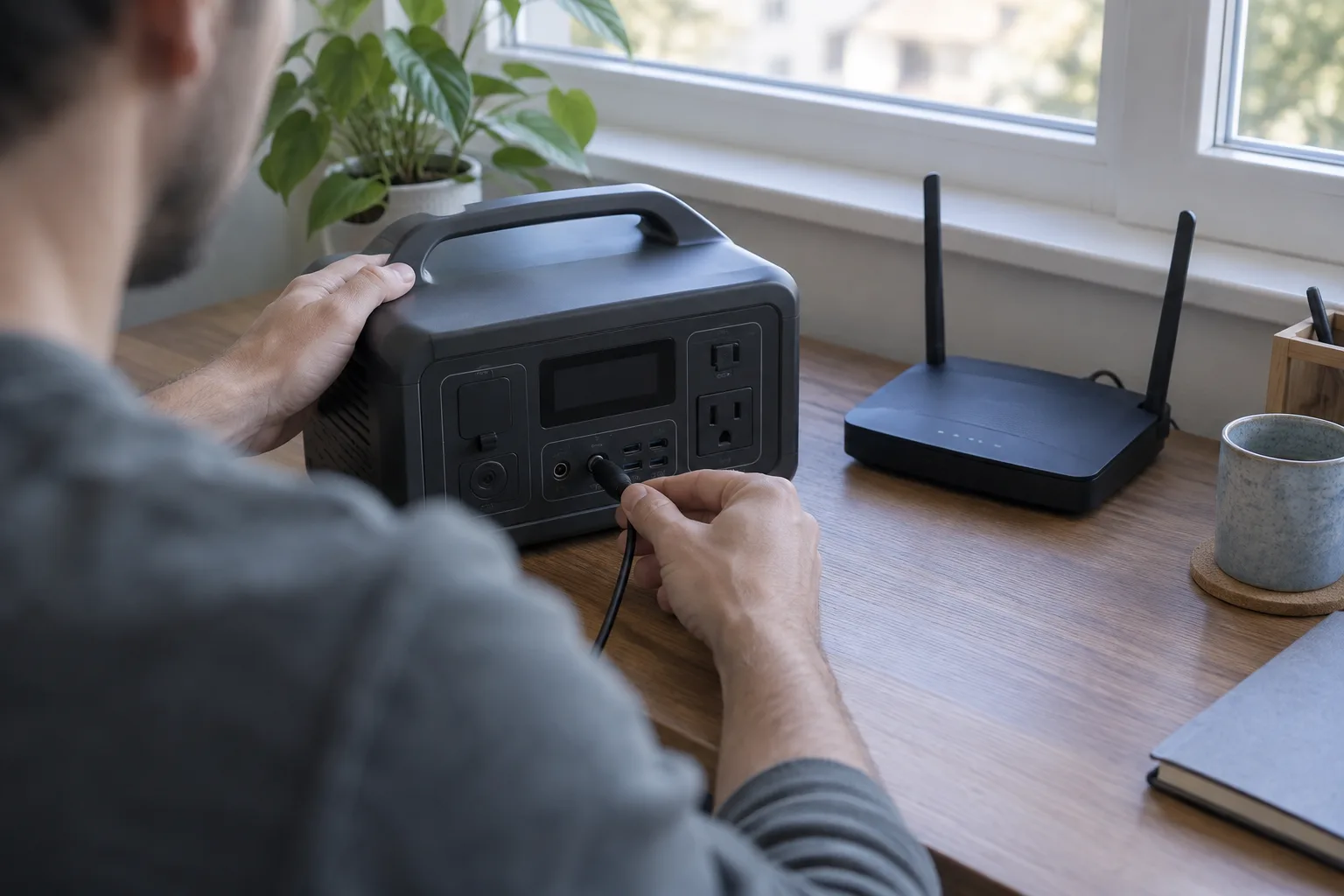
Match the router’s voltage, connector and polarity to the battery output; a generic USB-to-barrel cable proves none of those. A separate modem or fibre box needs power too, and the provider’s network may fail upstream. If one box needs an AC plug, the bank’s five to six hours no longer describes the whole connection. Even the 10 W assumption needs checking: one BT router lists 14.10 W in operation.
A fridge must start before its estimated hours matter
The longer-cut household has a different question. A fridge labelled 360 kWh per year averages about 41 W over a day, giving the table’s optimistic 21 hours from 850 usable Wh in a 1 kWh station. Its compressor draws more while running and briefly needs much more to start. One conservative sizing example allows 700 W running plus another 2,200 W at startup, about 2,900 W for that example’s start. That isn’t a rating for every fridge.
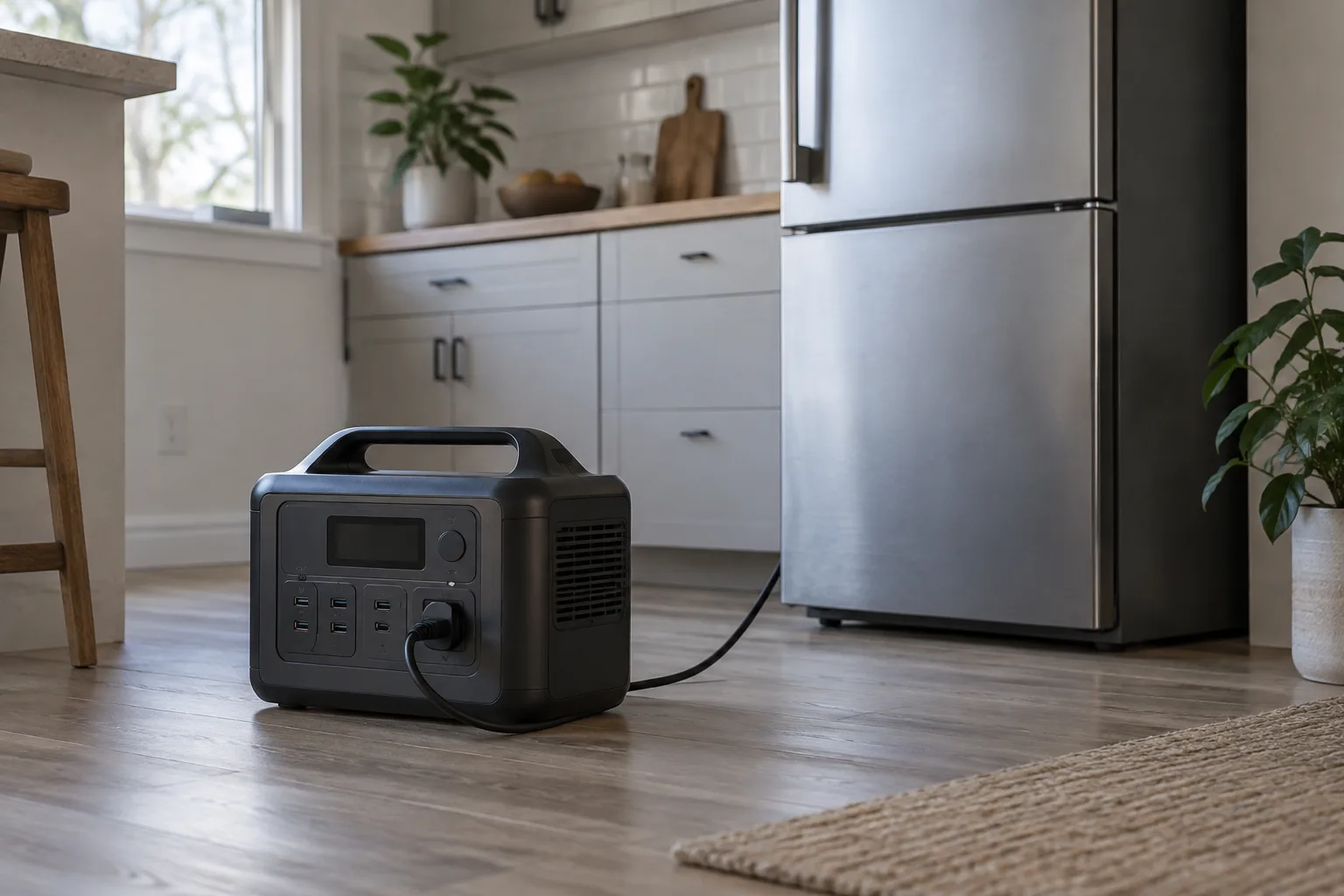
Compare your fridge’s running and starting demands with the station’s continuous and surge output. Extra Wh cannot fix a failed compressor start, and an advertised boost mode doesn’t prove compatibility. All eight stations in the cited test met their continuous-power ratings; your motor is still the test that matters. Door openings, defrost cycles and inverter draw can also shorten the calculated hours.
Even 2 kWh runs a space heater for barely an hour
A 1,500 W heater uses 1.5 kWh per hour at full power. Even with enough AC output, the 1 kWh station’s assumed 850 usable Wh lasts about 34 minutes; the 2 kWh station’s assumed 1,700 Wh lasts about 68 minutes. A compatible heated throw may draw much less, depending on its model and thermostat, but it warms a person rather than a room. Use it as instructed, and plan a safe warm place if the home becomes dangerously cold.
For USB essentials, carry the smaller battery
A bank around 20,000 to 27,000 mAh suits phones, USB lights and perhaps a suitably powered laptop. Tested 20,000 mAh banks weigh about 342 to 450 g, making one easier to take with you if home becomes unsafe. Some banks have an AC socket, but that doesn’t give a roughly 74 Wh battery station-sized endurance.
For a laptop, match its USB-C Power Delivery requirement and cable to the wattage of one port. A headline 220 W shared across ports doesn’t mean one port supplies 220 W, let alone 220 W from a household socket. For the router, confirm that every box can run from the bank’s outputs before relying on those table hours.
Compare large power banks
Live prices from more than 20 shops, updated daily.
For plug-in essentials, output comes before capacity
A 200 to 500 Wh station suits modest lights and broadband equipment, though a fridge may defeat its starting output. Around 0.7 to 1.5 kWh makes more sense for several hours of selected plug-in loads, provided the station starts any motor you intend to use. Around 2 kWh extends refrigeration or supports more essentials if you have a way to recharge. Added battery capacity doesn’t necessarily raise continuous or surge output.
The capacity step has a price. In September 2026 US manufacturer listings, a roughly 240 Wh station was US$219 and a sub-1 kWh station was US$389, about 80% more. That buys more stored energy, with no assurance either starts your fridge. Compare like-for-like models and included accessories. A claimed “was” price or percentage saving doesn’t establish what you would otherwise pay: in a UK study of 175 Black Friday deals, 83% were the same price or cheaper at another point from May 2024 to May 2025. Buy and try a backup before you need it.
Add the watts of everything you’ll use together, then allow for the largest motor start. If either figure exceeds the appropriate output rating, choose a compatible station before increasing Wh. Match its AC voltage and frequency to your appliances; a travel-plug adaptor changes neither. For a low-wattage router, look for measured AC idle draw and an output that stays on. Check recharge time and storage-charge guidance too: “solar generator” doesn’t mean winter replenishment is guaranteed, and compatible panels may be sold separately.
Winter changes where you can keep and refill a station. Follow the particular unit’s temperature limits: one model permits discharge from -10 to 45°C but charging only from 0 to 45°C. A sealed battery pack doesn’t make exposed sockets weatherproof. Keep the unit dry and ventilated, and follow its indoor-use instructions.
Compare portable power stations
Live prices from more than 20 shops, updated daily.
Four details can change the outage plan
How many phone charges will a 20,000 mAh bank give?
You can’t divide the bank’s advertised mAh by your phone’s mAh without allowing for losses and the phone’s use. Three tested large banks gave 4.3 to 5 charges to a specified 4,000 mAh test phone; your result may differ.
How long will food stay cold without fridge backup?
US guidance gives about 48 hours for a full, unopened stand-alone freezer or 24 hours if half-full. A fridge-freezer compartment may differ. Keep doors shut, use appliance thermometers and follow local food-safety guidance rather than treating those times as guarantees.
Can a power station work as a UPS for my computer?
Pass-through charging alone doesn’t promise an uninterrupted transfer. One station manual specifies a 30 ms changeover. If avoiding a reboot is the sole aim, compare a dedicated UPS at your actual load and check its transfer behaviour.
Will a solar panel refill a station during a winter cut?
Only if the panel matches the station’s input limits and there is sufficient daylight. Panels are often sold separately. Plan essential hours using the charged battery first.
The verdict: buy for the loads that matter first
For a short cut, choose a large bank for phones, a USB light and a pre-checked DC router. Choose a station around 1 kWh when plug-in essentials need longer, and include the fridge only after checking compressor startup. Leave room heating out of the battery budget.
This article was created using AI, following our team's editorial standards.