

Your fastest useful decision is to match the device to one room you can actually control. During the June heat, some marketplace reports saw floor-standing fan sales rise more than 80 times, which fits a region where AC ownership is only about one in five homes.
The heatwave comparison table: where the heat goes
The useful test is where the device sends heat after it starts running. If heat stays in the room, the device can still help you cope, but it cannot turn a hot bedroom into a cooler one.
| Category | Where the heat goes | What you feel | Main failure point | Best emergency use |
|---|---|---|---|---|
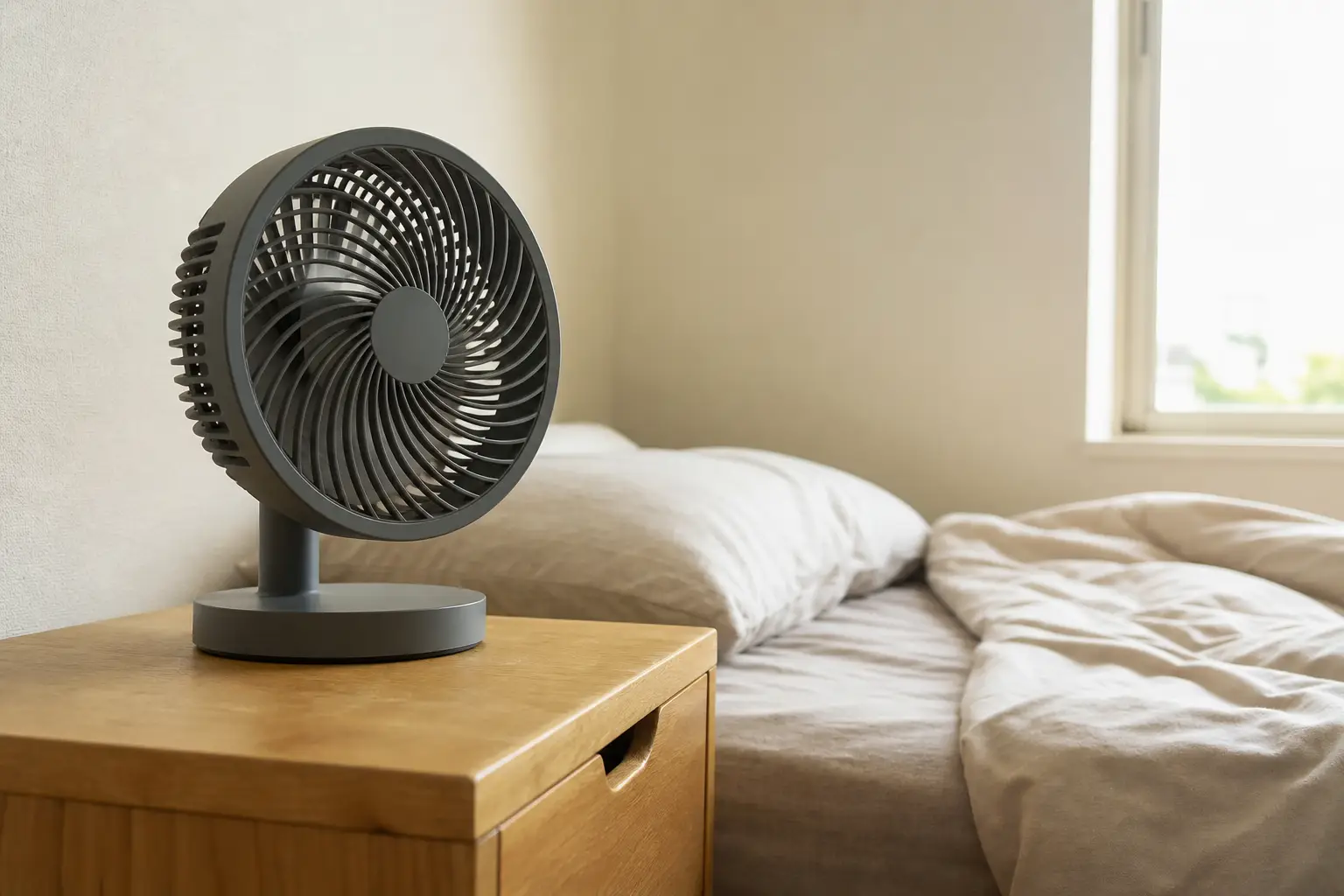
| Fan | Stays in the room, plus a little motor heat | Airflow over skin helps sweat evaporate | Indoor air remains hot | Tolerable rooms, bedside airflow, use with cool cloths or moderate AC |
| Portable single-hose AC | Hot air and moisture go out through the hose, while replacement air leaks in | Real cooling in one closed room if sealed well | Open or leaky window, negative pressure, noise | Emergency bedroom cooling when the seal kit fits |
| Dual-hose, mobile split or fixed split | More heat rejection happens outdoors, with fewer hose losses | Stronger one-room cooling and better control | Cost, bulk, permissions or installation | Repeated heatwaves, top floors, owners or long-term homes |
| Evaporative cooler | Heat is traded for added moisture in the room | Can feel cooler in dry moving air | Humid rooms become clammy | Dry climates or ventilated spaces |
Fans are personal cooling, and 35°C changes the risk
A fan buys comfort by moving air across your skin, so its value falls as the room itself becomes dangerously hot. It helps most when the air is below skin temperature, when you can sweat, and when you keep drinking.
Public health guidance says fans may give relief, but above about 35°C they may not prevent heat-related illness. That matters more for older adults, infants, pregnant people, people with chronic illness, and anyone dehydrated or stuck in a top-floor room.
- A bedroom that cools down overnight, where you mainly need airflow across the bed.
- Desk or sofa use during the day, especially if you can aim the fan directly at one person.
- Pairing with AC set around 27°C. Health guidance notes that AC plus a fan can feel about 4°C cooler than AC alone.
- Moving cooler night air through the flat, if outside air has actually dropped and security allows safe ventilation.
Portable AC works for one closed room if the exhaust is sealed
A portable compressor AC can lower one room’s temperature and humidity, but the hose setup decides how much of that promise reaches the bed. The machine makes cold air inside and hot air at the condenser, and that hot side has to leave the apartment.
Most emergency units are single-hose. They use indoor air to cool the condenser and push that air outside, creating negative pressure that drags hot air back through hallway gaps, vents, chimneys or the same open window. The more sun, leakage and long hose bends you have, the more the unit works for the street.
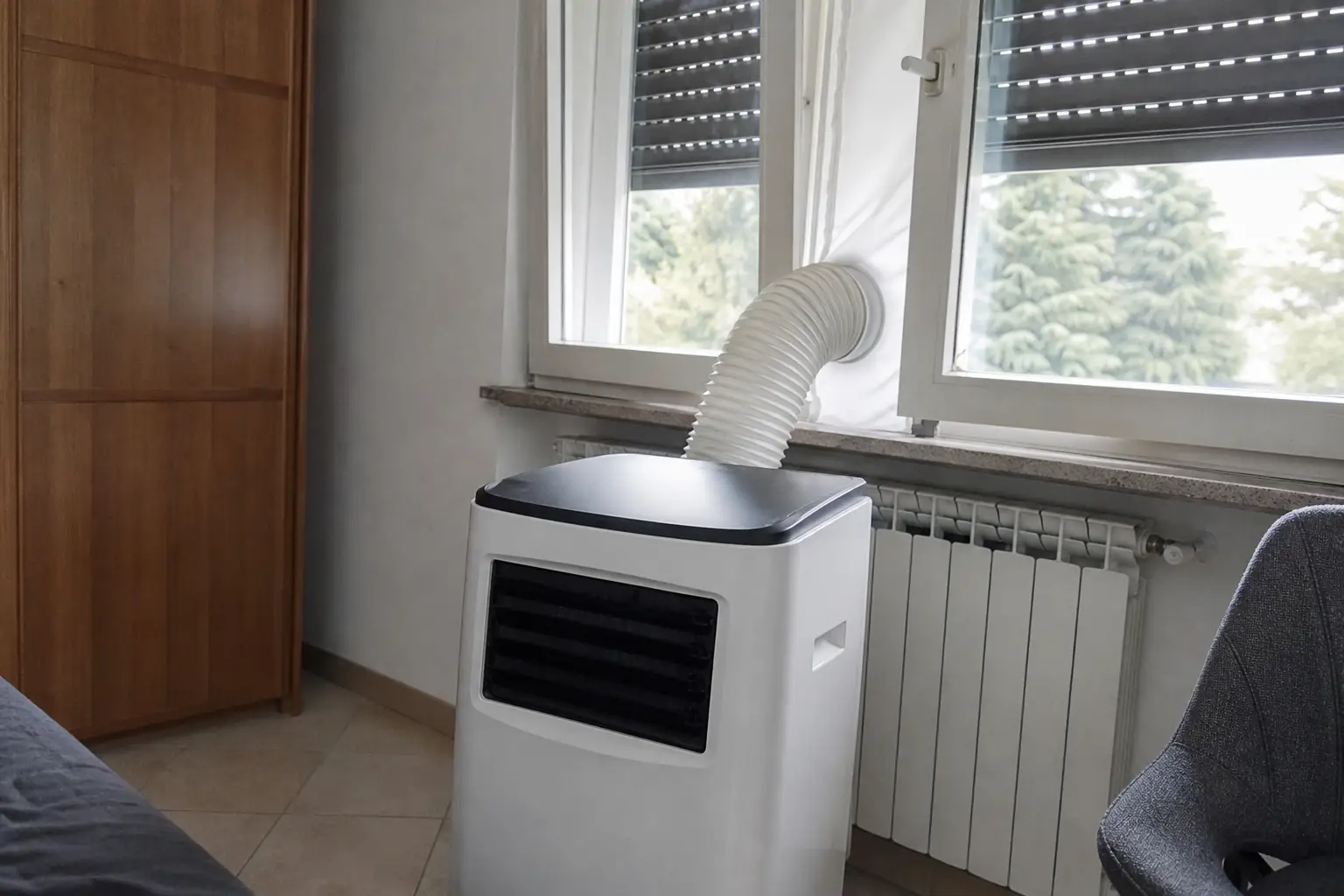
- Check your window style before ordering. Tilt-and-turn, casement and inward-opening windows often need a zip or Velcro fabric seal, or a rigid panel cut for the hose.
- Check hose diameter, number of hoses and the maximum seal perimeter. A dual-hose unit needs two clean openings.
- Keep the hose short and straight where possible. A long, hot, kinked hose adds heat back into the room.
- Close the door, shade the glass and cool one room. A portable AC is usually a bedroom tool, not a whole-flat system.
- Remember the weight and storage. Many units are bulky, often in the 20 to 35 kg class, and “portable” mostly means rolling across one floor.
Night use exposes the weak spots: noise and electricity
A cooling device that ruins sleep has failed the main heatwave job. A fan’s steady sound is usually easier to ignore than a compressor starting, stopping and pushing air through a hose.
Portable ACs commonly sit around 50 to 65 dB(A), depending on model, mode and measurement method. EU labels use sound power in dB(A), while reviews may use sound pressure, so avoid comparing the two as if they were the same figure.
- Pre-cool the bedroom for 1 to 3 hours before bed, then lower the setting overnight only if needed.
- Treat sleep mode as reduced disruption, not silence. It may lower fan speed or adjust the setpoint, but the compressor is still in the room.
- Inverter portable ACs can ramp more smoothly than fixed-speed units, although they still make compressor and fan noise.
Energy cost is rarely the only reason a portable AC disappoints, but it is real. As of 2026, many European household tariffs sit roughly around 0.25 to 0.35 per kWh, with large local variation. Multiply by your own tariff:
- Fan, 20 to 80 W for 10 hours: 0.2 to 0.8 kWh, roughly 0.05 to 0.30 in local currency at those tariffs.
- Portable AC, 0.9 to 1.5 kW for 6 hours: 5.4 to 9.0 kWh, roughly 1.35 to 3.15.
- Portable AC, 0.9 to 1.5 kW for 8 hours: 7.2 to 12.0 kWh, roughly 1.80 to 4.20. A sealed, shaded room may cycle down. A sunny, leaky room may run hard all night.
Evaporative coolers disappoint in humid flats
Evaporative coolers look attractive during stockouts because they are cheaper and hose-free, yet their cooling method works against you in humid rooms. They pull air through a wet pad or over water, which can lower air temperature only when the air is dry enough to absorb more moisture.
- Consider one only in dry heat, with ventilation and a willingness to refill water, clean pads and dry the unit before storage.
- Avoid one for a closed humid bedroom, a damp or mould-prone flat, or a heatwave where the air already feels heavy.
- Treat mini USB “air coolers” as desk airflow with a wet pad or ice pack. They will not cool a room.
Cool the room that matters first
In an emergency, spend effort on the smallest closable room where sleep or health is at stake. Cooling a large sunny living room can waste money while the bedroom stays unbearable at 02:00.
- Bedroom: close the door, shade it during the day, seal the AC hose properly and pre-cool before sleep.
- Living room or home office: a fan may be enough for personal comfort because daytime noise matters less than night noise.
- Open-plan flat: a single portable AC usually struggles unless the space is tiny and well shaded.
- Top-floor or attic room: heat soak from the roof and walls makes fans fade quickly. Plan for compressor cooling or access to a cooler place.
Who should buy what today
The right buy today depends more on permission, room exposure and vulnerability than on the largest cooling number in the listing.
- Renter, small bedroom, occasional hot week: buy a good pedestal fan or air circulator first. Add portable AC only if the bedroom stays too hot and the window can be sealed.
- Renter, top-floor bedroom, repeated tropical nights: buy a portable compressor AC for that room. Prefer better controls, dual-hose or mobile split if feasible and allowed.
- Owner, every summer from now on: plan a fixed split AC or air-to-air heat pump, plus shading and insulation improvements. Get quotes outside heatwave season.
- Vulnerable household: prioritise an actually cooled room. If you cannot cool the flat, use cooler public spaces, family, friends or a temporary stay elsewhere during the worst nights.
- Dry inland climate: an evaporative cooler can be worth a look if ventilation is possible. Humid coastal or northern heatwave: skip it indoors.
Compare cooling devices before stock runs out
Live prices from more than 20 shops, updated daily.
Panic-buy mistakes that leave you hot, noisy and out of pocket
Most bad heatwave purchases fail before the device is switched on.
- Buying an “air cooler” because the listing sounds like AC, without checking for a compressor, exhaust hose or outdoor unit.
- Trusting the highest BTU claim while ignoring room size, sun exposure, ceiling height, leakage and noise.
- Assuming the included window kit fits a tilt-and-turn window.
- Hanging the hose out of an open window and wondering why the room never settles.
- Using a high-load AC on a cheap extension reel or travel adapter. Use a suitable wall socket or correctly rated, uncoiled lead.
- Forgetting filters, condensate tanks, drain hoses and storage space. “Self-evaporating” does not mean zero maintenance in humid weather.
FAQ: fan safety, BTU claims, tilt-and-turn windows, dual-hose units and air coolers
The last checks are small, but they stop the most common wrong purchase.
Can I run a fan all night during a heatwave?
Yes, if the room is still tolerable and you feel well. Keep water nearby, place the fan safely, and use it with a cool shower, damp cloth or open windows only when outside air is cooler. If the room is around 35°C or someone is vulnerable, plan for a cooler space.
What cooling capacity should I search for in a bedroom?
Use kW as well as BTU. 1 kW is about 3,412 BTU/h. A 10 to 15 m² bedroom often starts around the 2.0 to 2.5 kW class if shaded and sealed. A 15 to 25 m² room often needs about 2.5 to 3.5 kW. Add capacity for roof rooms, strong sun, high ceilings, people and electronics.
Will a tilt-and-turn window seal really work?
It can, but measure the full opening perimeter and check the adhesive surface before ordering. Fabric seals are renter-friendly and cheap, but they can leak, flap in wind, affect security and look messy. A rigid panel usually seals better if you can fit one.
Is dual-hose portable AC worth paying for?
Often, especially in hot or draughty rooms, because it reduces the negative pressure problem of single-hose units. It still needs a good two-port window seal, short hose runs and enough separation between intake and exhaust so it does not pull in its own hot air.
How do I tell an air cooler from a portable AC in a listing?
Look for the heat exit. A real portable AC has a compressor system and an exhaust hose or outdoor unit. A water tank, ice packs, USB power and no hot exhaust path usually mean a fan-based evaporative cooler.
Can I run a portable AC without venting while I wait for a kit?
Use fan mode only if the unit has one. In cooling mode without venting, it dumps the removed heat back into the same room and adds compressor heat, so the room gains heat overall.
Verdict: choose the device that can remove heat from your specific room, not the biggest cooling claim
If the room is still tolerable, buy a good fan and combine it with shading, cooler-night ventilation, cool showers and damp cloths. If the bedroom stays dangerously hot or someone vulnerable lives there, a compressor AC for one sealed room is the emergency buy, provided the window and hose setup are realistic.
If you cannot vent and seal a portable AC, do not spend heatwave money on a machine that will fight your flat all night. If every summer is becoming a problem, stop repeating the panic cycle and plan fixed cooling, external shading and insulation before the next heatwave arrives.
This article was created using AI, following our team's editorial standards.