


Start with the dog, not the biggest claim on the bag. The right food first fits your dog’s life stage, breed size and medical needs, then it earns a closer look for protein quality, format, calories and label details.
Start with your dog’s profile, not the front-of-pack claims
The safest first filter is fit. A food can have a tidy ingredient list and still be wrong for a large-breed puppy, a pregnant dog, a sedentary adult or a dog on a veterinary diet.
Treat words such as premium, natural, grain-free and high protein as secondary claims. For a main diet, first check that the food is meant to be a complete daily diet for dogs and for the life stage your dog is actually in.
- Age and life stage: puppy, adult, pregnant or lactating, or senior with changing needs.
- Expected adult size for puppies, especially large-breed puppies.
- Body condition: underweight, healthy weight, gaining weight or overweight.
- Activity level: sedentary pet, very active dog or working dog.
- Eating practicalities: picky appetite, chewing difficulty, dental concerns or hydration support.
- Veterinary restrictions: kidney, urinary, digestive, pancreatic, heart, diabetic, weight-control or allergy workups.
Match the AAFCO adequacy statement to life stage and breed size
Read the nutritional adequacy statement before the ingredients. On many labels this uses AAFCO-style wording, or a local equivalent, to say whether the food is complete and balanced and which life stage it supports.

AAFCO recognizes life-stage categories such as gestation or lactation, growth, maintenance and all life stages. Local labels may use different wording, but the job is the same: tell you whether the product is suitable as the main diet for a specific dog.
Puppies and large-breed puppies
Puppies need a food labeled for growth or for all life stages. Large-breed puppies need extra care because the adequacy statement may specify whether the food is suitable for growth of large-size dogs.
On AAFCO-style labels, large-size dogs are described as dogs expected to be 70 lb or more as adults. For a large-breed puppy, choose wording that includes growth of large-size dogs, not wording that excludes it.
Adult maintenance and “all life stages”
Most healthy adult dogs do well on a maintenance food unless they are pregnant, lactating, underweight, highly active or medically managed. Foods made for growth and reproduction can be more calorie-dense than many less-active adult dogs need.
All life stages does not mean ideal for every dog in every home. It means the food is formulated to cover demanding stages such as growth and reproduction, so portion control matters for adult dogs that gain weight easily.
Put veterinary needs, weight control and allergy workups before food trends
A diagnosis changes the shortlist. If your dog has a medical condition, use the veterinarian’s feeding plan before choosing by flavour, protein source or grain-free wording.
Therapeutic and veterinary diets still need clear feeding and adequacy information, but some are labeled for intermittent or supplemental feeding, or for use only as directed by a veterinarian. That matters because a diet designed for one condition may not fit a puppy, a pregnant dog or a dog with more than one issue.
- Weight management: check calories per serving and use body condition, not the scoop size, to adjust.
- Digestive sensitivity: follow the vet’s plan if the dog has ongoing gastrointestinal disease.
- Pancreatitis risk or low-fat needs: do not choose a rich food just because it has better palatability.
- Kidney disease: phosphorus control may be part of the veterinary plan.
- Urinary issues: stone prevention diets should be selected with veterinary guidance.
- Heart disease, diabetes or dental disease: choose the diet type the care plan calls for.
- Suspected food allergy: use a structured elimination diet plan rather than changing proteins at random.
Judge ingredient and protein quality without falling for “meat first” shortcuts
The first ingredient is not a full quality test. Ingredients are listed by weight including water, so fresh meat can appear high on the list while contributing less concentrated protein than a named meat meal.
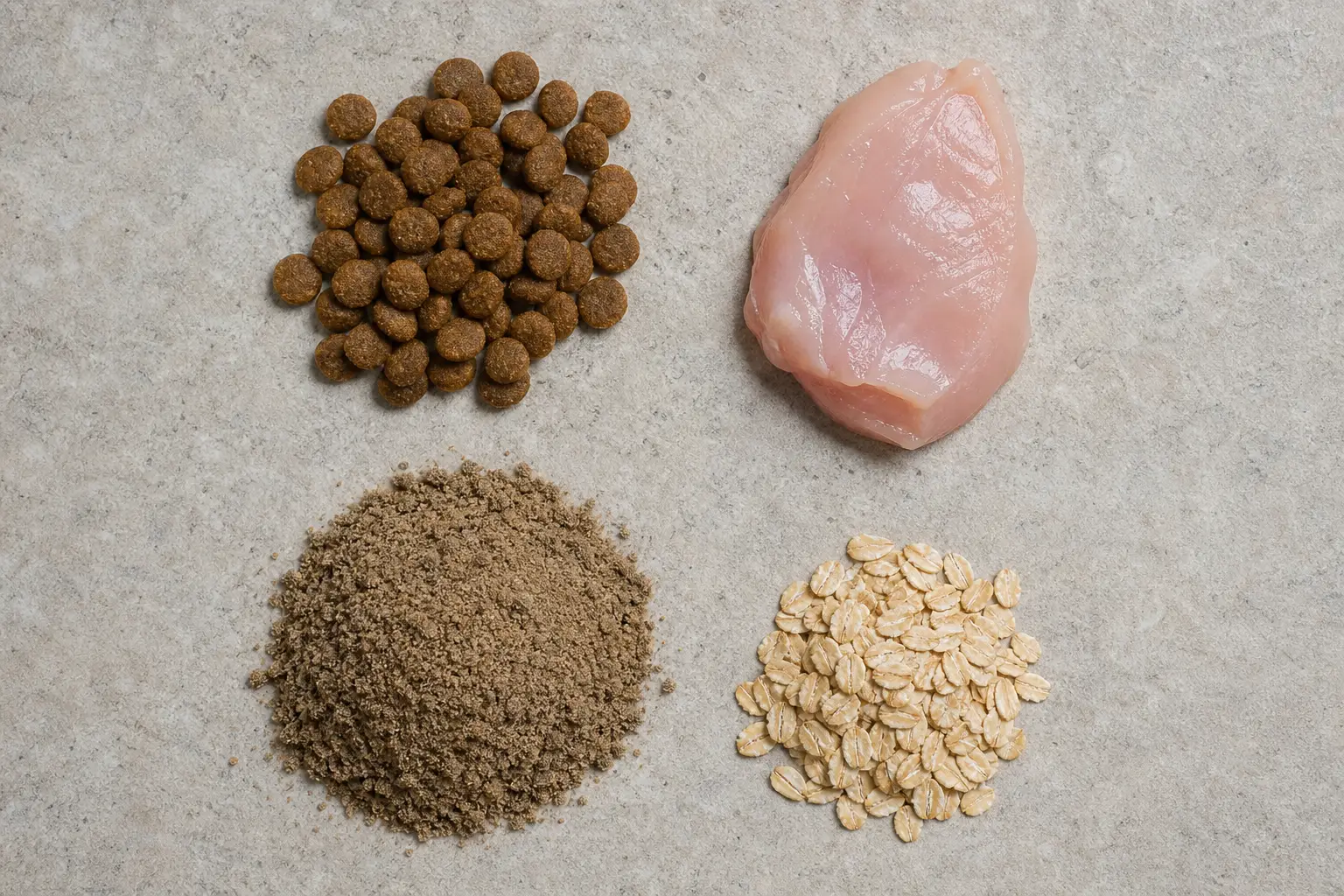
Ingredient lists can also be made harder to read by splitting related ingredients into separate entries. The list does not tell you ingredient quality, amino-acid balance or digestibility by itself.
Do not reject chicken meal or by-products automatically. Meals are concentrated after rendering, and by-products such as organ meats can be nutrient-dense. Grains are not just fillers either, since they can supply vitamins, minerals, fatty acids and fibre.
- A complete-and-balanced statement for the right life stage.
- A manufacturer that can explain who formulates the diet.
- Finished-product testing and quality-control information.
- Clear calorie information and feeding directions.
- Transparency about nutrition expertise and research, where available.
- Protein claims that make sense next to the dog’s needs, not just a high number on the front of pack.
Compare dry, wet, fresh and mixed feeding by calories, cost and practicality
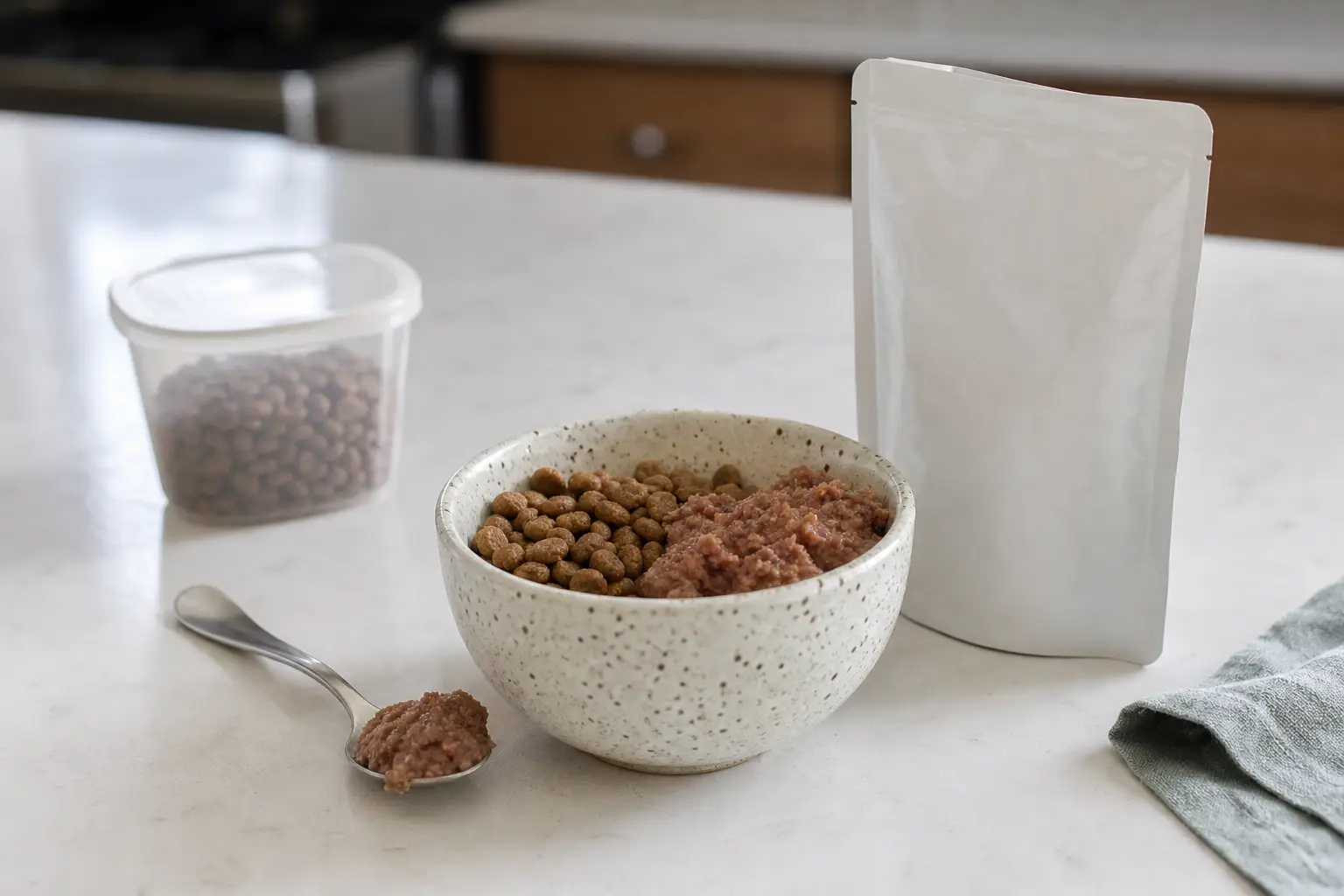
Format affects daily cost, storage, moisture and portion control. The best format is the one your dog can eat consistently while staying at a healthy weight on a complete diet.
| Format | Good fit for | Trade-offs to check |
|---|---|---|
| Dry kibble | Owners who want easy storage, easy measuring and usually lower running cost per calorie. | Calorie-dense, so portions can creep up. Dry foods commonly have around 10% moisture. |
| Wet food | Picky dogs, dogs that benefit from a stronger aroma, dogs with chewing difficulty, and dogs that may need more moisture in the diet. | Often higher cost per calorie. Wet foods may be around 78% moisture, so compare nutrients on a dry-matter or calorie basis. |
| Fresh, frozen or refrigerated food | Dogs that accept these textures well and owners who can handle perishable storage and serving. | Higher storage burden and usually higher cost. Handle it like perishable food. |
| Mixed feeding | Owners who want the practicality of kibble with the palatability or moisture of wet food. | Total calories still count. Both foods should fit the dog’s life stage and needs. |
Do not compare a wet food and a dry food by the as-fed protein percentage alone. Wet food contains far more moisture, so its label percentage can look lower even when the nutrient contribution is different once moisture or calories are accounted for.
Running cost depends on daily calories more than the package price. Large dogs and very active dogs multiply the cost quickly, and wet or fresh diets usually cost more per calorie than kibble.
Read the label in the order that actually matters
A label is useful if you read it in the right order. Start with adequacy and life stage, then calories and feeding directions, then ingredients and protein claims.
- Check that it is a complete daily diet for dogs, or your market’s equivalent wording.
- Match the life stage: growth, maintenance, gestation or lactation, all life stages, or the local equivalent.
- For a large-breed puppy, confirm that the growth statement includes large-size dogs rather than excluding them.
- Look for any veterinary-use wording, supplemental-feeding wording or “use only as directed” wording.
- Read calories per cup, can, pouch or weight unit, then use the feeding table only as a starting point.
- Adjust the amount if your dog gains or loses weight, because feeding directions are guidelines.
- Read ingredients last, with water weight, ingredient splitting and digestibility limits in mind.
- Check the company behind the food: nutrition expertise, formulation responsibility, quality control and testing transparency.
Use a quick-match shortlist to narrow the aisle
Use this as a first pass before comparing brands. It keeps the search focused on your dog rather than the loudest claim on the front.
| Dog profile | Start with | Be careful with |
|---|---|---|
| Small or medium puppy | Complete food labeled for growth or all life stages. | Adult maintenance foods that are not designed for growth. |
| Large-breed puppy | Growth food that includes growth of large-size dogs in AAFCO-style wording, or the local equivalent. | Any growth statement that excludes large-size dogs. |
| Healthy adult with normal weight | Adult maintenance food with calories that match activity level. | All life stages foods if the dog is sedentary or gains weight easily. |
| Overweight adult | A calorie-aware plan and feeding amount adjusted by body condition and weight trend. | Free-feeding, large scoops and high-calorie puppy or all life stages diets without a reason. |
| Picky eater or chewing difficulty | Wet food, mixed feeding or another complete format the dog will eat reliably. | Adding extras without counting calories. |
| Diagnosed medical condition | Veterinary feeding plan first, including any therapeutic diet instructions. | Self-selecting a trend diet that conflicts with the diagnosis or life stage. |
| Suspected food allergy | A structured elimination diet plan agreed with the vet. | Repeatedly swapping proteins without a clear plan. |
Compare dog food by life stage, size and format
Live prices from more than 20 shops, updated daily.
Common mistakes that can make a “good” dog food the wrong choice
- Choosing by “chicken first” alone. Fresh meat includes water weight, and the ingredient list does not prove digestibility.
- Using all life stages food for a quiet adult dog without checking calories. These diets may be denser than needed.
- Buying adult food for a puppy. Growth has different requirements.
- Missing the large-breed puppy wording. This is one of the most useful checks for dogs expected to be very large as adults.
- Comparing wet and dry protein as-fed. Moisture changes the percentage, so use dry-matter or calorie-based comparisons.
- Treating grain-free as automatically better. It is not a substitute for adequacy, calorie control or veterinary guidance.
- Following the feeding chart without watching weight. Feeding directions are a starting point, not a fixed rule.
- Using a veterinary diet casually. Therapeutic foods should match the condition, life stage and veterinary instructions.
FAQ: choosing dog food with confidence
Is an “all life stages” food okay for my adult dog?
It can be, but check calories and body condition closely. All life stages foods are formulated to cover growth and reproduction, so they may be more nutrient- and calorie-dense than a less-active adult dog needs.
Is chicken meal worse than fresh chicken?
Not automatically. Fresh chicken includes water weight, while chicken meal is more concentrated after rendering. Judge the whole food by adequacy, formulation, testing and fit for your dog, not one ingredient.
Should I choose grain-free dog food?
Choose grain-free only if it fits your dog’s needs or veterinary plan. Grain-free wording is not a quality guarantee, and grains can provide nutrients such as vitamins, minerals, fatty acids and fibre.
Is wet food better than dry food?
Neither format is always better. Dry food is easy to store and usually lower cost per calorie. Wet food brings more moisture, aroma and softness, which can help picky dogs or dogs with chewing difficulty.
How do I compare protein in wet and dry food?
Do not use the as-fed percentage alone. Wet food contains much more moisture, so compare on a dry-matter or calorie basis if you need a fair comparison.
Can I mix dry and wet dog food?
Yes, if both foods are suitable for your dog and you control total calories. Mixed feeding can improve palatability, but it can also cause weight gain if you add wet food without reducing kibble.
Verdict: choose the safest fit first, then compare brands
Shortlist foods that match your dog’s life stage, breed size and health needs first. Then compare format, calories, manufacturer transparency and ingredients. If a food fails the first filters, a better-looking label does not make it the right main diet.
This article was created using AI, following our team's editorial standards.