

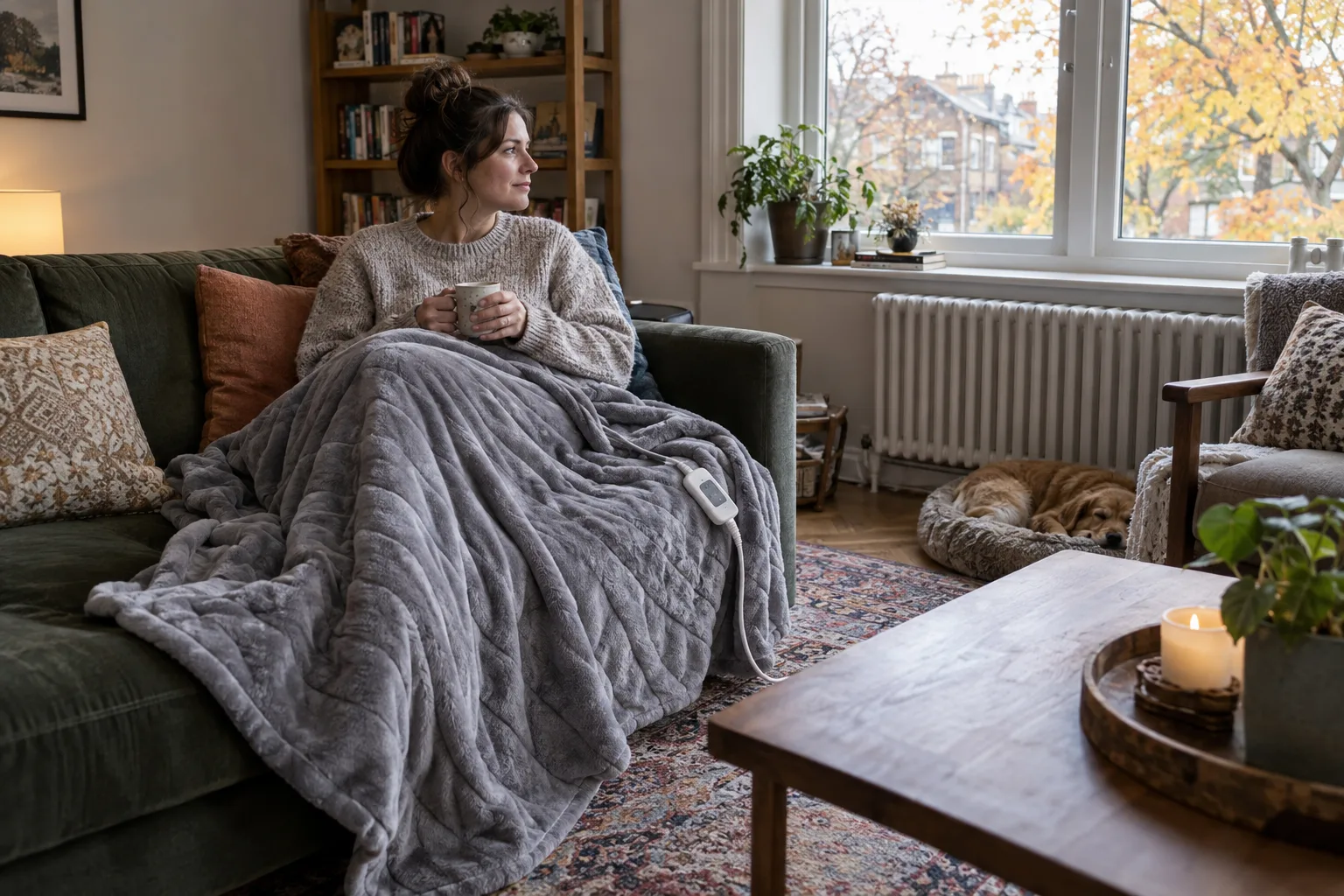
You settle under a heated throw for four hours, but leave the thermostat and heating schedule alone. You feel warmer; your household bill goes up. The saving starts only when the throw lets you use less heating.
A cheap-to-run throw saves money only when heating use falls
Compare the heat you can stop paying for with the electricity the blanket uses. At an illustrative price of 0.25 currency units per kWh, the gap between warming one person and heating a room is large. It still won’t lower a household bill by itself.
A 100 W underblanket drawing full power for 30 minutes uses 0.05 kWh, costing 0.0125 units to pre-warm a bed. Run a 100 W throw at full power for four hours and it uses 0.4 kWh, costing 0.10. A 2 kW resistance room heater operating for 25% to 100% of the same four hours uses 2 to 8 kWh, costing 0.50 to 2.00. Its thermostat may cycle it off; neither its maximum wattage nor the throw’s tells you what either will consume in your room.
The 100 W examples assume full power throughout. One monitored 120 W-rated throw used 64.6 Wh in its first hour on high, 33.1 Wh on a middle setting and 20.2 Wh on low. Its users often found low too cool and high too hot for prolonged use. Judge a running-cost claim against a setting you’d want to sit under.
Here’s what the saving has to beat. Suppose a household pays 600 units a year in variable heating charges. The International Energy Agency’s broad guide says lowering a thermostat by 1°C saves around 7% of heating energy: about 42 units in this example. A 100 W throw drawing full power for four hours a day over 150 days uses 60 kWh, or 15 units at 0.25 per kWh. That leaves about 27 units saved before purchase; a 60-unit throw would take roughly 2.2 such seasons to pay for itself. Keep the old heating settings and the same throw adds 15 units instead.
To see whether that bargain holds in your home, compare heating-meter readings on days with similar weather and occupancy, and measure the throw with a plug-in meter. Record the heating schedule and room temperatures too. Gas and electricity can have different unit prices, so a 2 kW electric heater is a poor stand-in for the cost of central heating. If you have a heat pump, ask your installer before making large setbacks that could trigger less efficient backup heat.
For a cold bed, buy a fitted underblanket
Once you know where the warmth is needed, the bed choice is simple. If the mattress feels cold when you get in, a fitted underblanket warms the surface beneath the sheet; pre-heating it and switching it off before sleep may be enough. It won’t warm the bedroom air while you dress or get up.
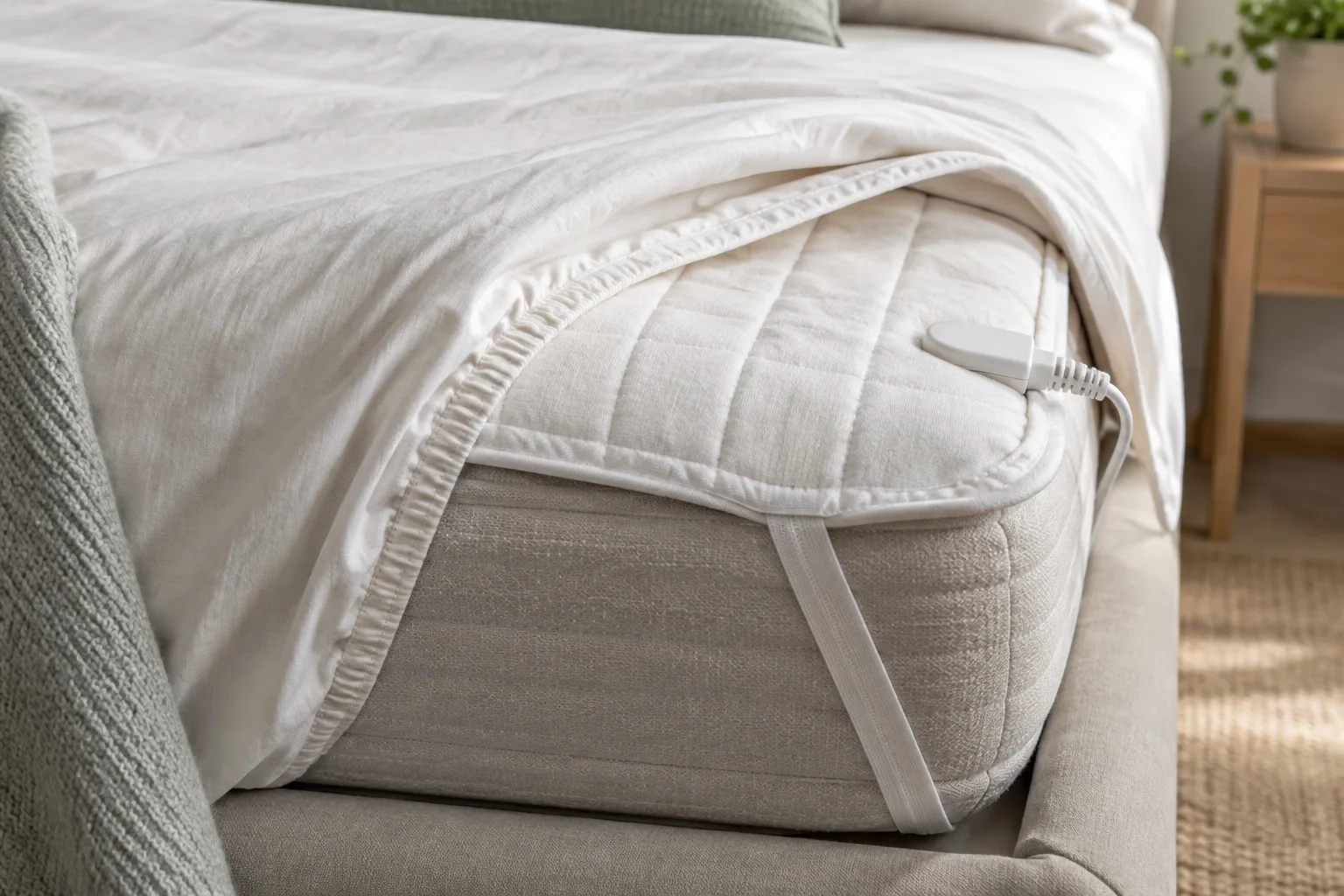
Match the pad to your mattress dimensions and depth, then look at where the heated area ends. A pad that stops short of your feet won’t solve cold feet. Evenness matters more than a high wattage claim: in Which? tests, the fastest bed blankets warmed in under 10 minutes, while the slowest took more than 20 minutes and could leave cold spots. For partners with different preferences, pay for independently controlled sides. Check the description carefully, because “dual control” can mean separate body and foot zones instead.
Compare fitted bed underblankets
Live prices from more than 20 shops, updated daily.
For a settled sofa evening, choose a throw
The sofa calls for heat you can take with you when you sit down. Over four hours, a throw can cover one person’s lap and torso, though exposed hands may still feel cold in chilly air. If you move regularly between rooms, there’s less opportunity to use it in place of room heating.
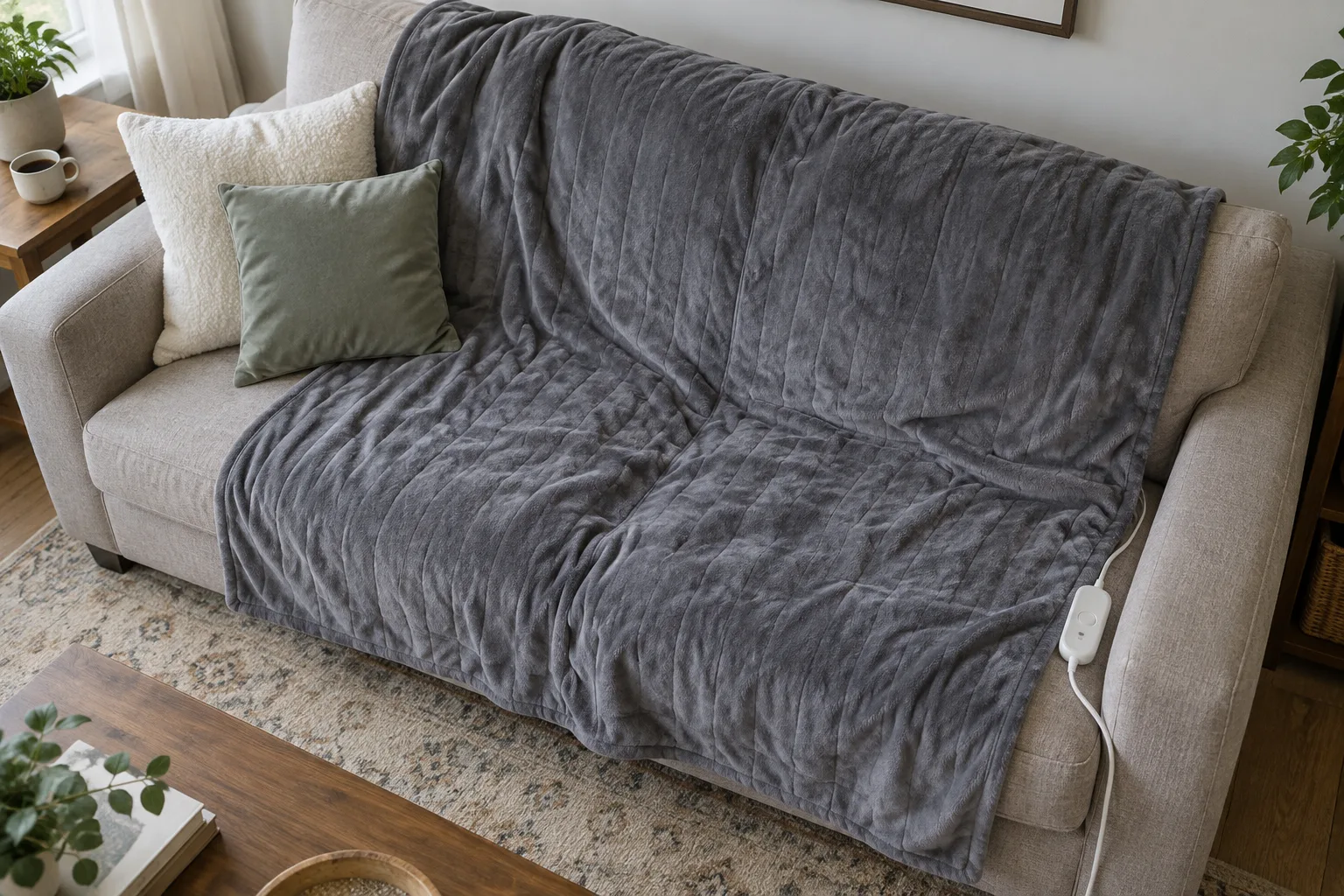
Buy by heated area rather than fabric size: tested throws include examples roughly 120 to 135 cm by 160 to 180 cm, and decorative edges needn’t contain heating wires. Make sure the controller is reachable, the shut-off time covers your usual sitting spell and the lead reaches a socket without being trapped beneath the sofa. Fabric feel matters here, where the throw rests against your clothing; extra heat settings won’t rescue one that barely covers you.
Compare heated throws
Live prices from more than 20 shops, updated daily.
A warm lap cannot stand in for a warm room
The throw wins for one seated person. It cannot warm shared air for several people moving about, or keep a room suitable for someone vulnerable to cold. The World Health Organization proposes 18°C as a suitable minimum indoor temperature for the general population in cold seasons; older people, young children and people with health conditions may need more. A healthy adult asleep with adequate bedding may have different needs from someone sitting still. Use a room thermometer, because personal comfort under a throw tells you little about the air around it.
| Buyer’s need | Bed underblanket | Heated throw | Room heating | Better choice |
|---|---|---|---|---|
| A cold bed at bedtime | Warms the sleeping surface | May be unsuitable for bed use | Warms the air | Bed underblanket |
| One person seated all evening | Stays on the bed | Warms the person it covers | Warms the whole space | Heated throw |
| Several people moving around | Helps someone in bed | Covers one seated person | Warms shared air | Room heating |
| Rooms getting too cold or damp | Leaves the room cold | Leaves the room cold | Helps maintain suitable room conditions | Room heating, alongside moisture control |
Watch condensation as you adjust the schedule. Cooler rooms can develop mould when moisture from cooking, showers or indoor laundry builds up, so keep extractors and ventilation working. Persistent damp from a leak needs a repair. There’s no single safe thermostat setback for every home.
For one occupied room, try existing heating zones and radiator controls before buying a portable heater. A 2 kW resistance heater can help for a short spell, but a heat pump can deliver around three times as much heat per unit of electricity as standard electric resistance heating. What costs less depends on the home, fuel prices and controls.
Bedtime changes which electric warmer is safe to use
A shut-off timer tells you when power stops; it doesn’t establish approval for sleeping with the blanket on. Follow the particular bed model’s overnight instructions. London Fire Brigade advises unplugging before getting into bed unless it has a thermostat control for safe all-night use. Keep a sofa throw on the sofa: don’t lie on it, tuck it in or run it overnight unless its instructions expressly permit that use.
Buy a locally rated plug and voltage from an identifiable seller. Cheap online-marketplace blankets have failed electrical safety checks, so verify the applicable mark or independent listing rather than trusting a logo in a photo. CE or UKCA markings and verified UL or ETL listings serve different markets; no mark makes misuse safe. Skip used or untraceable blankets with unknown histories. London Fire Brigade advises replacing electric blankets at least every 10 years, sooner if worn.
An adjustable or sofa bed can pinch wiring; check both the bed and blanket instructions before use. Someone vulnerable to cold still needs suitable room heat even if a blanket feels comfortable.
Pay for the controls that change your routine
The basic fitted underblanket earns its place with 30 minutes of bed pre-heating for one sleeper. Separate sides are worth paying for when two people want different warmth or only one side is occupied. In selected product ranges checked in September 2026, the priciest tested bed blankets cost around four times the least expensive; throws spanned roughly a two-and-a-half-fold range. More money can buy better fitting, fabric, controls or warranty, without a proportionate increase in warmth.
For one person who regularly sits on the sofa, a throw is the more useful purchase if it lets you safely shorten room-heating time. If your bedding is already comfortable and the heating schedule cannot change without rooms getting too cold, keep your money. Buying an appliance to run alongside unchanged heating adds a cost.
A sale needn’t change that choice. Autumn and winter promotions happen, but there’s no dependable cheapest month. A “was” price or recommended price alone doesn’t establish the usual selling price: compare the identical model and size from the same seller with its multi-month price history, then consider the heating you could have reduced by buying sooner.
Questions buyers ask
Does turning the thermostat higher warm a room faster?
Generally, no. A conventional heating system keeps running toward the higher target, so it usually heats for longer.
Can I machine-wash an electric blanket?
Only if its care label permits it. Remove the controller as instructed, follow the stated wash temperature and let it dry fully before reconnecting. Tumble-dry only if the label allows it.
Will closing radiators in unused rooms cut the bill?
Use heating zones or radiator valves if your system has them, but find out where the main thermostat senses temperature. Closing the radiator in that room can frustrate the controls; watch cooler rooms for condensation.
Would a heated seat cover use less power than a throw?
It can suit someone who needs warmth only where they sit. One monitored seat cover used 38.9 Wh in its first hour on high, compared with 64.6 Wh for a monitored throw; it warms less of the person, too.
Verdict
For most people trying to spend less during a seated evening, buy a heated throw only if you can reduce heating while keeping rooms suitable. Choose a fitted underblanket for a cold bed. If people need warm air or rooms are becoming cold and damp, keep the room heating and treat personal heat as extra comfort.
This article was created using AI, following our team's editorial standards.


