

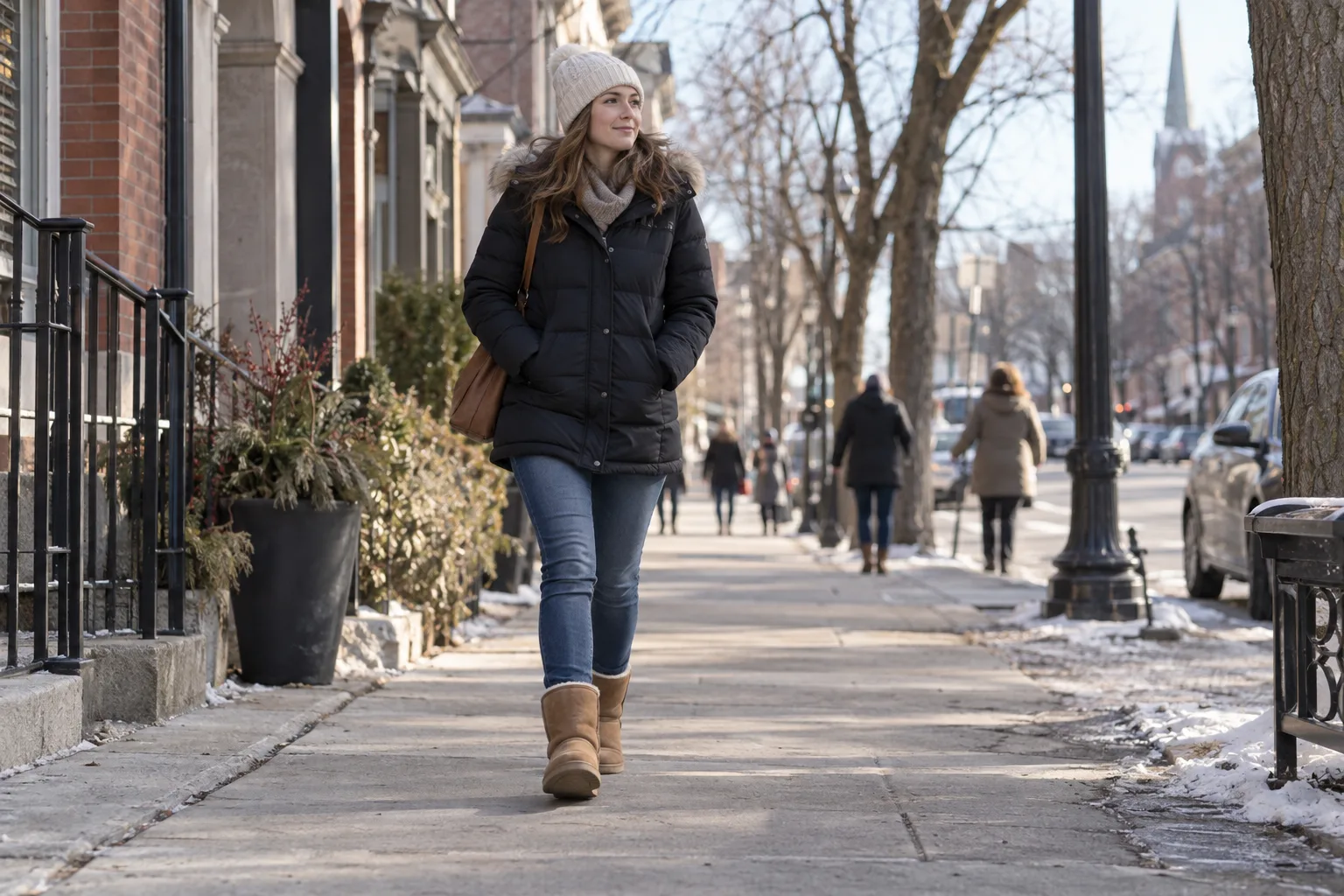
Your 15-minute walk to the shops crosses one slushy kerb. That’s enough to change the boot you should buy: choose waterproof insulation for the wet route, and save the sheepskin pull-on for the same trip when the streets stay dry and cleared.
Sheepskin earns its place on dry streets
On that dry, cleared route, a classic sheepskin boot is a pleasure: warm fleece close to the foot, little snow-boot bulk and an easy pull-on shape for errands. UGG Classics and EMU Stinger boots do this well. The soft upper offers little ankle support, though, and a heel that slips now may feel looser as the fleece settles.
| Boot type | Choose it for | Main limitation |
|---|---|---|
| Classic sheepskin pull-on | Dry, cleared streets and short everyday trips | Treated suede, often modest tread and limited heel hold |
| Insulated waterproof walking boot | Slushy commutes, wet pavements and longer walks | Can feel warmer and less easygoing indoors |
Read the exact model’s materials. Genuine double-face sheepskin, wool-blend lining and faux fur are different purchases, however similar the boots look. If you already own a waterproof pair that fits securely and copes with your streets, buy sheepskin for the dry-day comfort you’ll use.
Compare sheepskin boots
Live prices from more than 20 shops, updated daily.
Snow tread needs separate proof on ice
That slushy kerb also makes the sole matter. Angular, well-spaced rubber lugs bite into snow and shed muck; more than 4 mm of lug depth is a useful guide for strong snow traction. A fairly flat casual sole is a poor choice for regularly icy pavements. For ice, look for independent testing, a purpose-designed ice-grip compound or suitable removable traction aids. Deep lugs and a general “slip-resistant” claim cannot establish grip on smooth, wet ice.
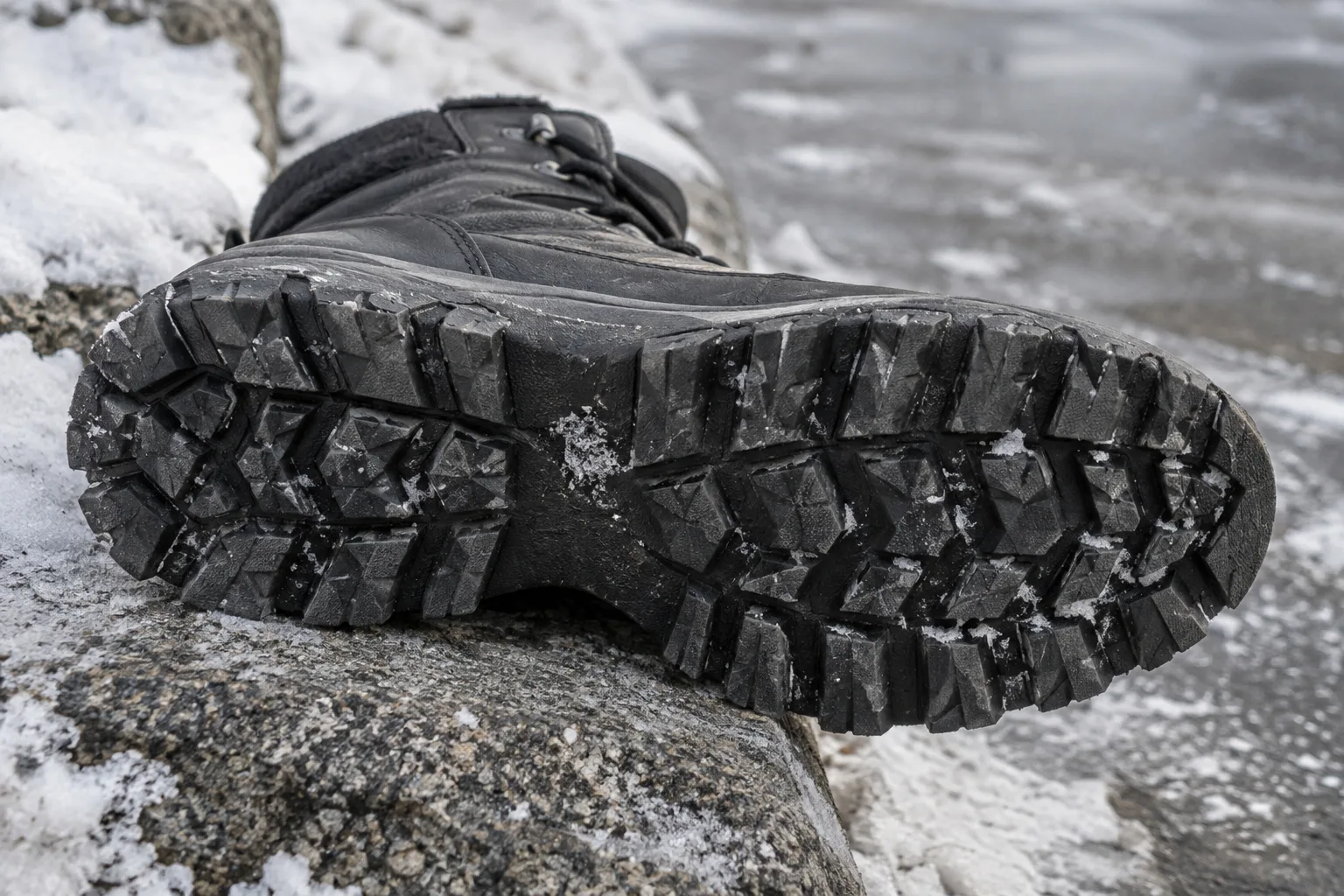
Ice can defeat reassuringly rugged boots. In a 2026 study, 27 people took 8,503 steps on level ice in 11 boots. The least slip-resistant category slipped on 36% of steps; boots rated to negotiate a 9 to 10° icy incline still slipped on 4 to 5%. Choose for demonstrated ice performance if your usual route demands it.
Repeated slush calls for waterproof construction
For the wet version of the shops trip, choose a boot with stated waterproof construction, sealed seams and a tongue that protects where it joins the upper. EMU says its water-resistant sheepskin eventually soaks through; its waterproof models use a membrane and sealed seams. UGG describes the treated Classic Short II as a casual boot. Protector spray helps repel marks, but it cannot seal seams or turn water-resistant suede into a waterproof boot.
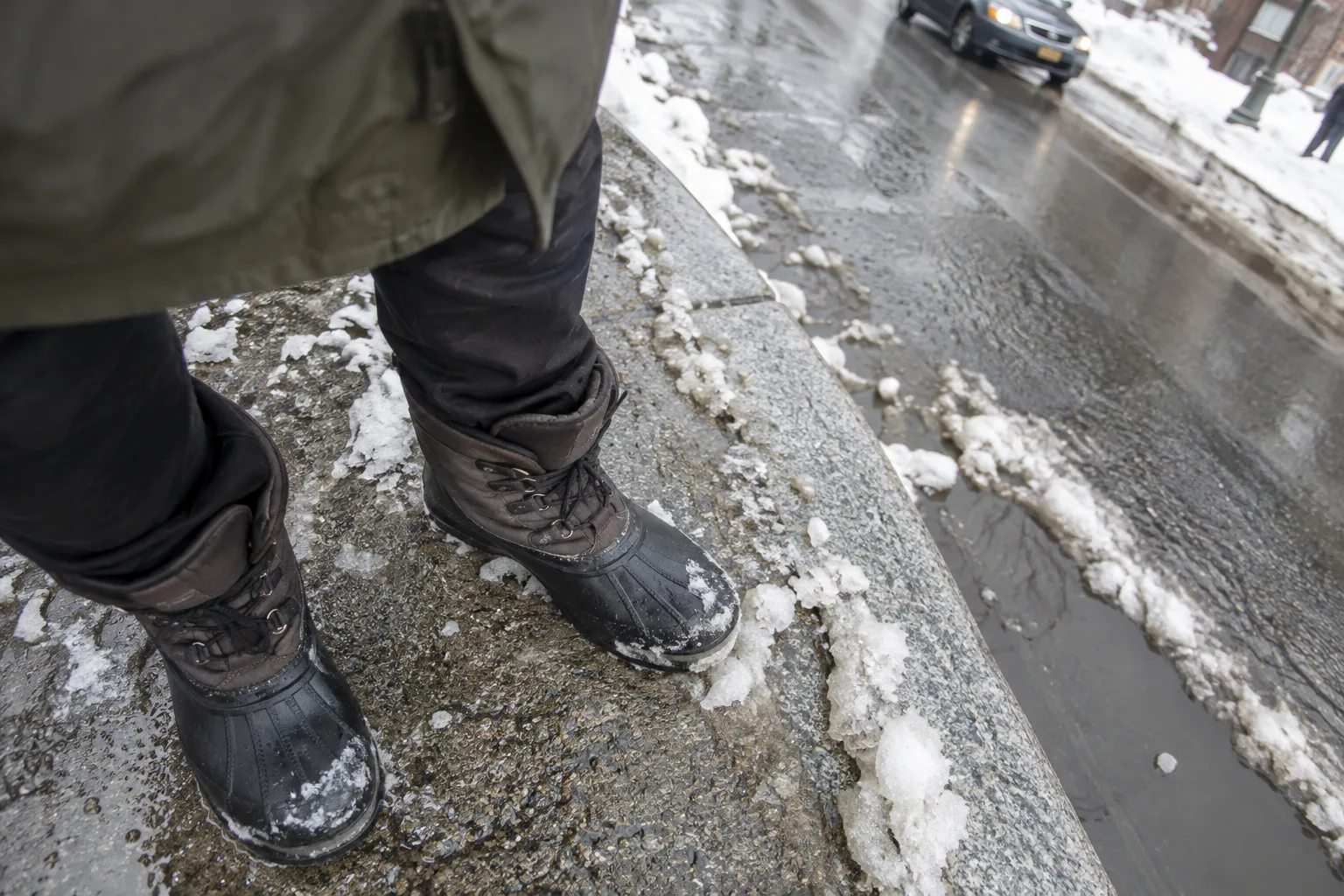
Height only helps if the waterproof protection reaches high enough and the collar closes well. The Classic Short II has an approximately 20 cm shaft with treated suede; the approximately 23 cm Sorel Caribou has seam-sealed construction and a rubber lower shell, though its laces aren’t waterproof. Snow can enter either opening. For repeated deep snow, buy a taller waterproof boot with a secure closure and add gaiters if snow reaches the collar. A membrane can feel clammy on an active walk.
Compare waterproof winter boots
Live prices from more than 20 shops, updated daily.
A roomy fit keeps the insulation working
Whichever boot your route needs, don’t squeeze into it for warmth: pressure on the forefoot reduces circulation and can leave toes colder. Try both boots late in the day with your winter socks and any orthoses. On a removable insole, about one thumb-width beyond the longest toe is a useful walking-boot starting point. Toes should wiggle without hitting the front downhill; the heel should stay reasonably secure on a slope. Fleece may compress, but it won’t fix painful toes, and a loose pull-on can become sloppier. Laces and a firm heel cup give more adjustment for uneven walks.
Match warmth to what you’ll do after leaving the shops. Around 200 g insulation is a useful grade for active winter use; 400 g or more suits colder, slower outings. Those figures describe the insulation grade, not the filling weight in each boot. Underfoot insulation and dry socks matter too. Advertised comfort claims such as −20°C or −40°C aren’t interchangeable standard ratings: one boot advertised at −25°F (about −32°C) left testers comfortable while moving at 10 to 20°F (about −12 to −7°C), but cold when standing still there. A removable liner, such as the Caribou’s 9 mm felt inner boot, helps when it needs drying.
For longer paved walks, compare weight per shoe in the same size. Two listed women’s size 7 examples show the spread: a Columbia Minx Shorty IV is about 354 g per shoe; a Timberland Premium 6-Inch Waterproof is about 660 g. More structure may suit rougher ground but tire your legs on a commute. On boots you own, rounded tread, a worn heel edge or a splayed upper that lets the heel move are reasons to reassess grip and fit.
If socks get wet or toes go numb, get dry and warm. Persistent numbness, or pale or unusually firm skin, needs medical assessment.
A higher price can buy two very different benefits
The price jump buys either plusher materials or stronger weather construction. In October 2026 US listings, a faux-fur lookalike at the upper end of budget prices was around $40, a Columbia Minx Shorty IV around $120, an UGG Classic Short II around $195 and a Sorel Caribou around $250. So a budget pair could cost about one-fifth of the premium classic; the mid-range waterproof boot about three times the budget pair; and the premium snow boot about twice the mid-range waterproof one.
At budget level, inspect the upper, lining, insole and sole separately before buying the cosy shape for dry outings. Mid-range offers distinct choices: a Bearpaw Emma Short around $80 lists faux fur, while an EMU Stinger Lo around $150 specifies double-face sheepskin; you can instead spend there on a waterproof walking boot. The premium UGG Classic Short II specifies a 17 mm sheepskin lining and insole. A premium snow boot can put its cost into a rubber shell, sealed construction and a removable liner, with more bulk. Price alone proves nothing about ice grip.
Check the seller before paying for discounted UGGs
An honestly labelled lookalike is one choice; a boot falsely sold as UGG is a counterfeit. Your strongest check happens before payment.
- Find the brand’s official site independently and verify the shop or marketplace seller as an authorised retailer in your market. The platform’s logo doesn’t verify its sellers.
- Leave a lookalike “official outlet” site if its business details or returns are unclear.
- Question an unusually steep discount on an in-demand style, especially alongside borrowed-looking photos. Compare the identical model through an authorised seller.
- Choose payment with dispute recourse; skip a seller pushing a route with poor recourse.
If a delivered pair looks wrong, compare its exact model and season with UGG’s genuine-versus-fake gallery, including the box, lining, stitching, heel logo and sole. Security labels have changed, so a convincing tag alone cannot verify the seller’s stock. Keep the listing, packaging, photos and payment record for a dispute.
Salt makes suede a higher-maintenance choice
If your dry-city pair will occasionally meet salted streets, protect it before wear and deal with residue promptly. Test a maker-approved treatment on a hidden area; UGG’s suede and sheepskin instructions specify 24 hours of air-drying before brushing. Brush off dried surface dirt, then treat salt marks with a cleaner suitable for that boot. Let wet boots air-dry away from a radiator, removing insoles or liners where possible; don’t machine-wash sheepskin. Renew suitable exterior repellency when water stops beading on a waterproof boot. Conditioner intended for smooth leather can change suede’s appearance.
Questions buyers ask
Are all UGG-style boots lined with real sheepskin?
No. Check the exact model’s upper, lining and footbed separately. “Sheepskin”, “wool-blend” and “faux fur” describe different materials, and a familiar silhouette won’t identify what surrounds your foot.
Does a slip-resistance label mean a boot grips ice?
Read what product and surface were tested. ISO 13287:2019 is a slip-resistance test method for protective footwear; its existence does not certify a fashion boot for ice.
Does “made outside Australia” mean UGG boots are fake?
No. Check which brand was promised, whether the seller is authorised and whether the delivered boot matches that exact model.
Should I wait for a winter boot clearance sale?
Buy early if you need a particular fit, width or waterproof construction. A UK UGG sale showed selected classic styles at 20 to 60% off, but waiting narrows your choice. Compare the identical model, colour and size, and check returns before paying.
Verdict: buy for the ground you walk on
For most people buying one pair for an unpredictable winter, choose a secure, insulated waterproof walking boot with an outsole suited to your streets. On dry, cleared city routes, a well-fitting sheepskin pair is the more comfortable everyday choice. For a wet, slushy city, buy the waterproof pair first; for snowy rural weekends, add more waterproof height, secure laces and snow-shedding tread. If your winter swings between dry cold and messy thaw, two pairs make sense: sheepskin for dry days and waterproof boots for the wet ones, with time for the latter to dry.
This article was created using AI, following our team's editorial standards.