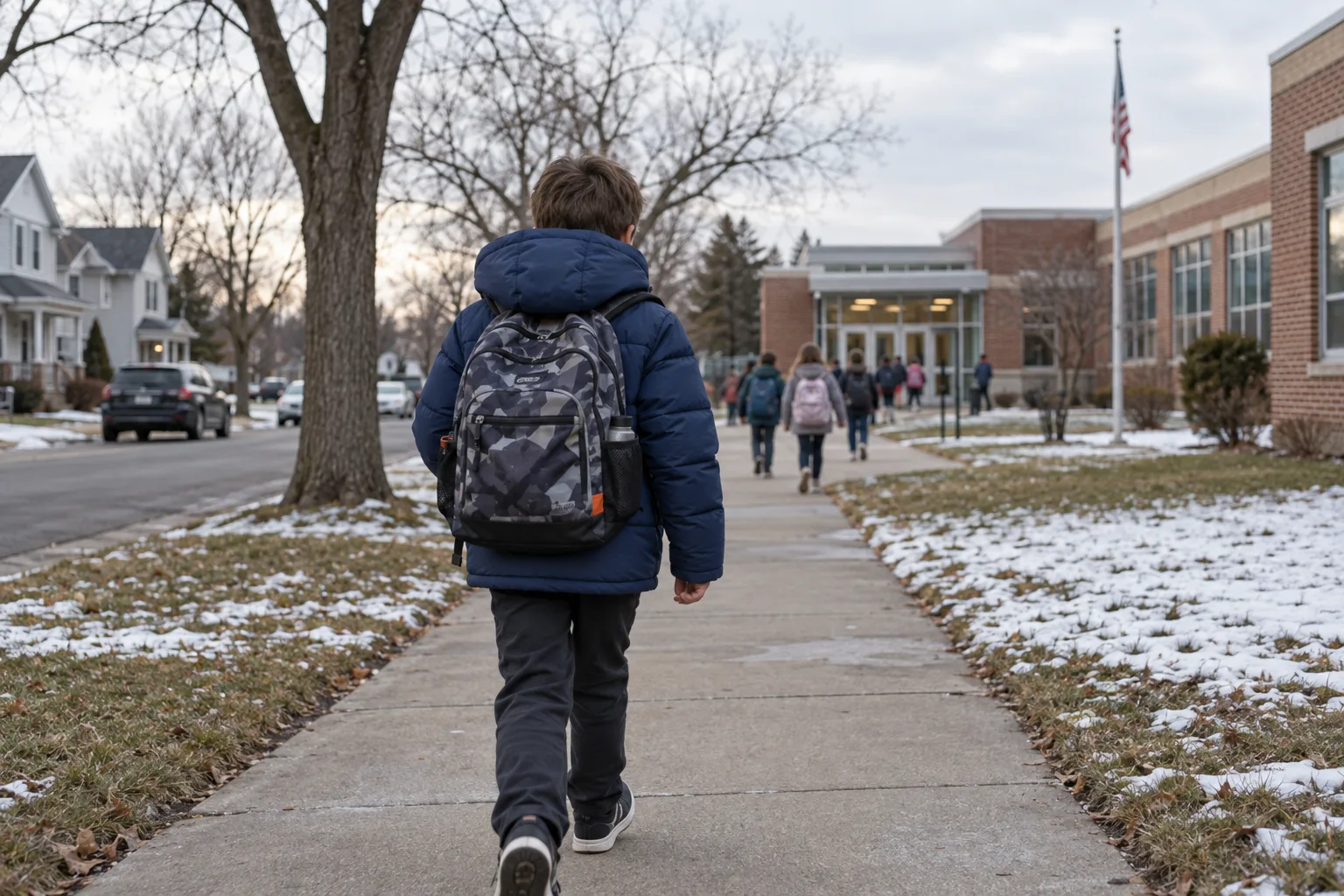


Take the child and a few real school items before the late-July rush narrows the shelves. A first satchel has to carry dense A4 books close to a small torso, stay visible on the route, and keep doing that after hundreds of openings, drops and wet pavements.
Decide before the August rush: treat it as fitted safety kit
The safest choice is made with time for try-on, exchange and a calm refusal to let the motif decide the model. Back-to-school shelves fill from late July in many European markets, but last-minute buying leaves fewer sizes and colours, and less patience for a proper loaded fit.
Age labels are too broad. A 105 cm child and a 125 cm child can both be first-graders, but they need different back lengths. The bag has to fit now in a T-shirt and over a jacket.
Compare fitted primary school backpacks and Schulranzen
Live prices from more than 20 shops, updated daily.
Judge weight with books inside
Use weight as a filled-pack check, because empty grams hide the real carrying problem. Mainstream first school satchels commonly sit around 18 to 22 L and about 0.9 to 1.3 kg empty; older pupil backpacks often move into 24 to 32 L. A 300 g saving can disappear when a full bottle, a tablet case or one unused hardback stays in the bag.
Health guidance commonly puts a loaded school backpack at around 10 to 20% of body weight, with some physiotherapy advice using about 10% as a stricter rule. Watch the child: leaning forward, red shoulder marks, pain, tingling or numbness mean the load or fit needs fixing.
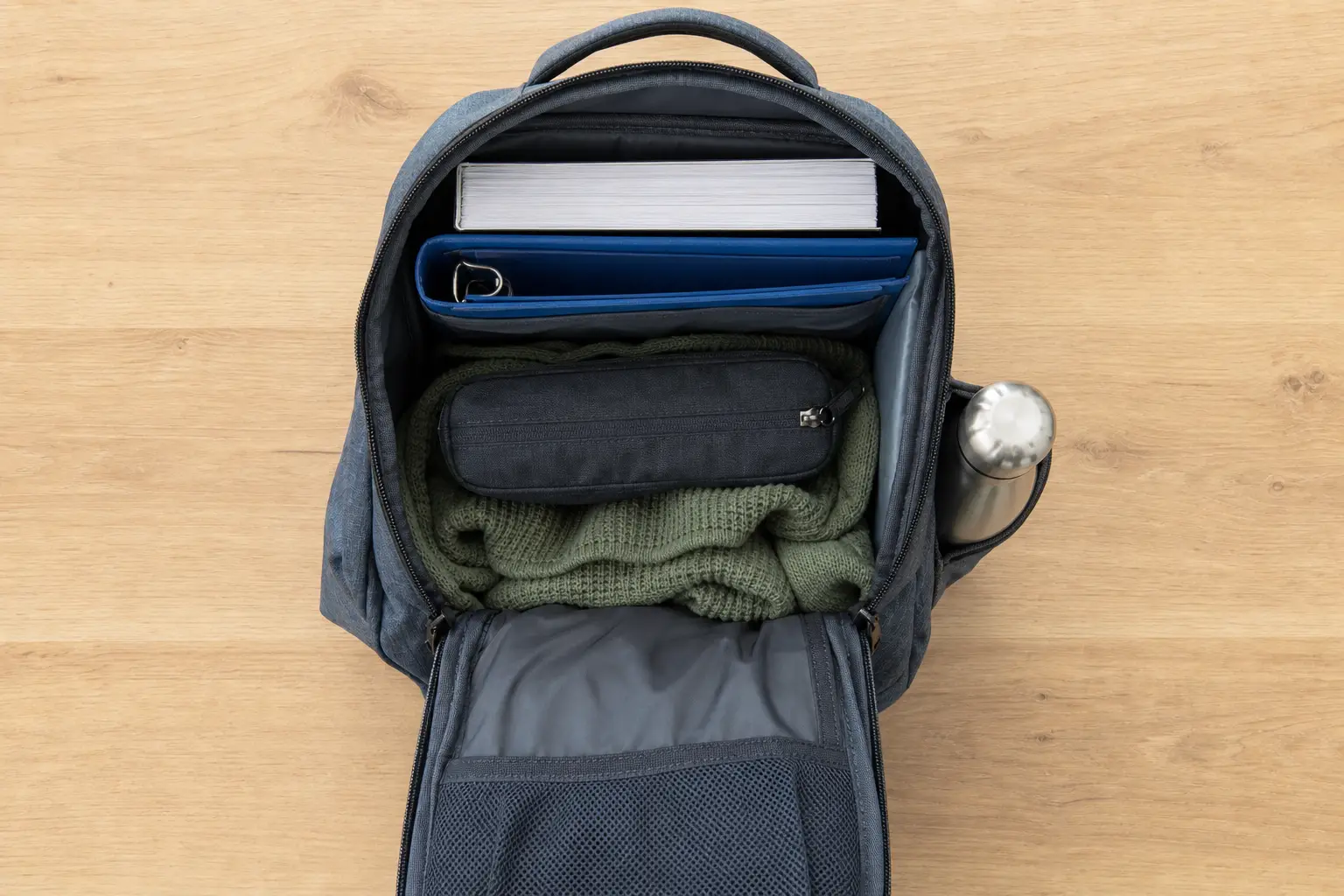
Fit it in the shop: shoulder height, trunk length, chest strap and hip belt
A good shop fit takes ten minutes and should happen with a realistic load. Measurements help, but the child’s posture under load tells you more.
- Bring the child, a winter jacket if possible, and the school’s usual A4 folder size if you already know it.
- Load the bag with books, folders or shop weights before tightening anything.
- Set the back length first. Use the child’s trunk length from shoulder line to top of pelvis as the working range.
- Check the outline: top edge around shoulder height, width within the shoulders, base on the upper pelvis and clear of the buttocks.
- Tighten both shoulder straps evenly. The back panel should sit against the upper spine without a hollow gap.
- Clip the chest strap so it stops strap slip while staying away from the throat.
- Fasten the hip belt on the pelvis. If it lands on the belly or ribs, it cannot stabilise the load properly.
- Ask the child to walk, turn, crouch, climb a few steps and open the closure. Reject models that pull away, swing, need over-tightening or block head and shoulder movement.
For primary satchels, look for wide padded shoulder straps, with DACH ergonomic guidance citing at least 40 mm, plus a padded back. A chest strap controls slipping; a hip belt only helps when it hits the pelvis.
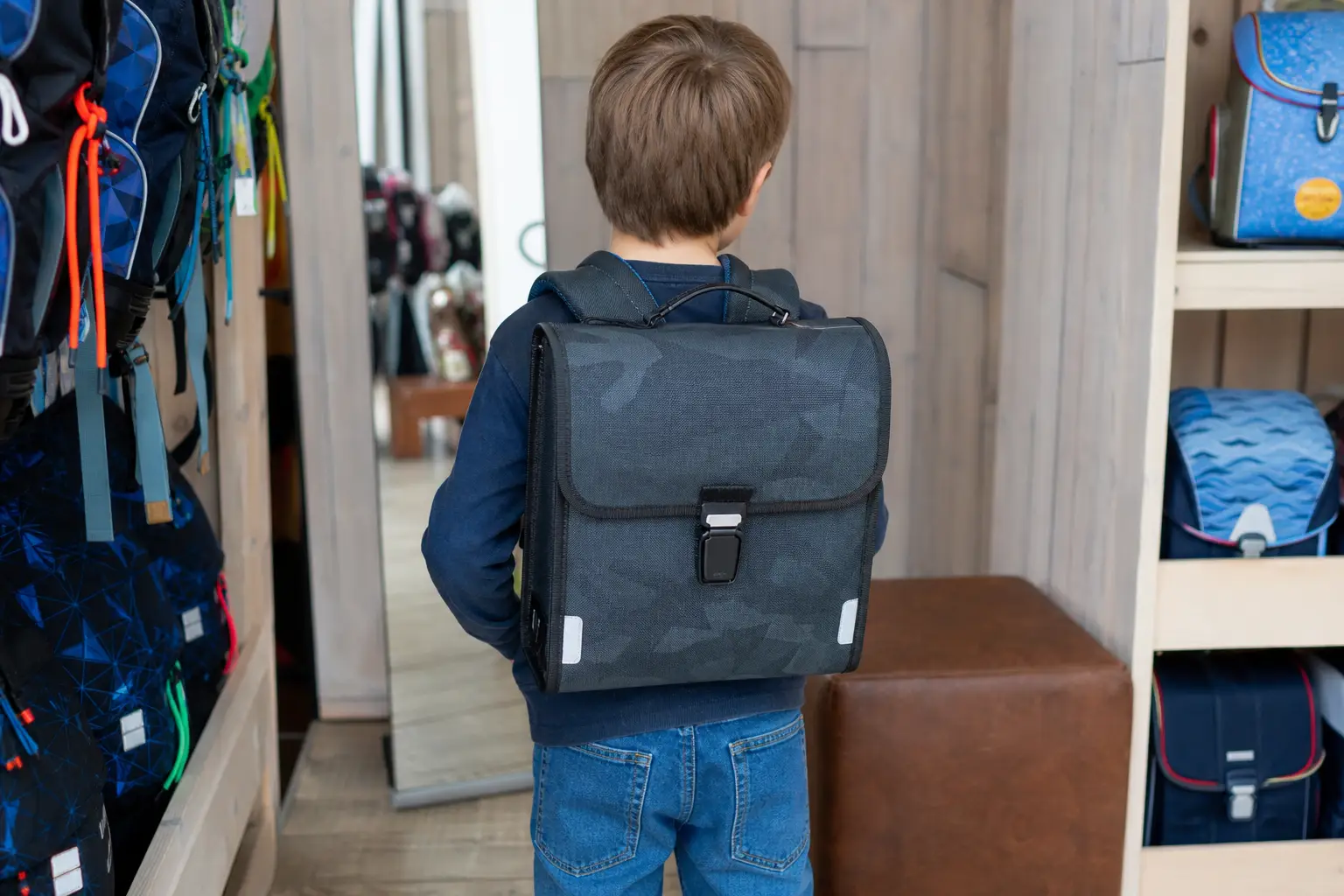
Pick the right format for the child’s age
The format should follow the child’s body and daily load, because primary and teen bags solve different problems.
| Format | Best use | What to check |
|---|---|---|
| Classic boxy Schulranzen or cartable | First-graders and smaller primary children carrying A4 folders; structured shell and stable base. | Top around shoulder height, no excess width, easy closure, and DIN-level visibility where available. |
| Hybrid Schulrucksack | Bigger primary children who want a sportier look but still need structure. | Adjustable back, chest and hip straps, book compartment against the back, and real warning surfaces. |
| Slim or light satchel | Narrow-shouldered or very small starters. | Capacity for bulky folders, plus decent padding and hip-belt quality. |
| Large primary satchel | Tall children or schools with unusually bulky daily folders. | Current fit under load; avoid if the torso or shoulders are overwhelmed today. |
| Secondary-school backpack | Older pupils carrying laptop or tablet, more books and personal items, often 24 to 32 L. | Compression, a back book pocket or laptop section, and added visibility if fluorescent panels are absent. |
| Basic fashion backpack | Older pupils with light loads, lockers or short routes. | Two padded straps, back padding, correct size and visibility aids; weak for a small child if it sags. |
Do not compromise on visibility
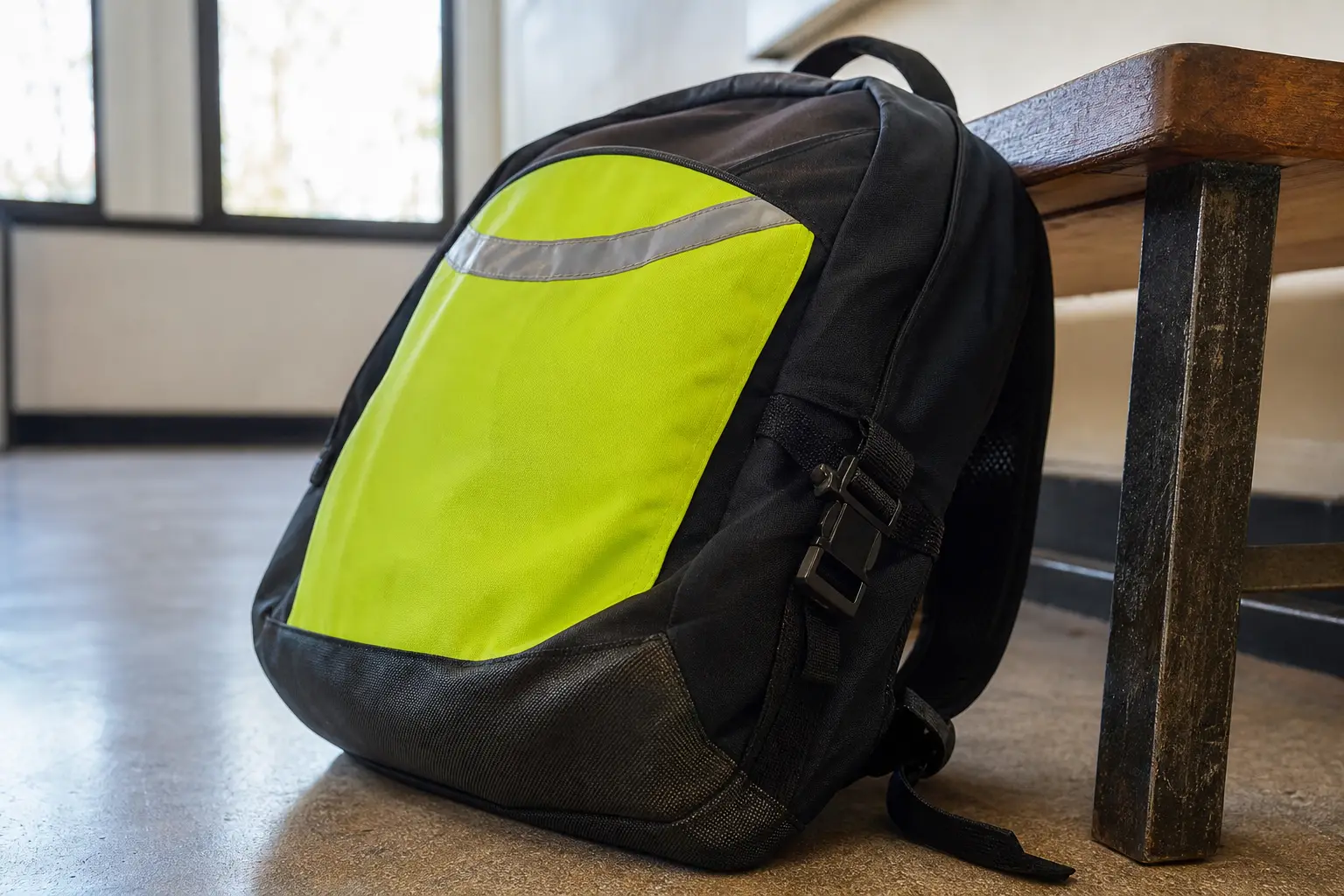
In the DACH market, ask for the exact wording “entspricht DIN 58124” or “nach DIN 58124” on the specific model and colourway. Reflective details alone do not cover the same daylight problem.
- DIN 58124 is the current German-style satchel standard for requirements and testing, including visibility by day, dusk and darkness.
- The warning surface principle is at least 20% fluorescent material and 10% retro-reflective material on visible front and side areas, considered from 0°, 45° and 90°.
- Fluorescent panels help in daylight, rain and dusk; retro-reflective panels return headlight beams in darkness.
- Similar names and prices can hide safer and less visible sibling designs. Check the exact colourway, not only the series name.
Elsewhere in Europe, no open source shows an exact Europe-wide schoolbag-specific equivalent. EN 17353 is a Europe-wide standard family for enhanced-visibility clothing and equipment in medium-risk situations, but it is not a general schoolbag certificate. Apply the same function: bright or fluorescent surfaces for daylight and poor light, reflective material or accessories for darkness.
Buy the model that survives four school years
Durability lives in the stress points, so inspect the hardware before you fall for the print.
No public independent failure-rate ranking was found for school satchels. Brand warranty and repair language still points parents to the parts that take daily abuse: repeated opening, rough set-downs, wet floors and desk falls.
- Zips: look for smooth sliders, protected corners and zip tape that is not already wavy or exposed.
- Bottom corners and base feet: check abrasion protection, standing stability and seams at the corners.
- Buckles and magnetic closures: the child can close them with cold hands, and they stay shut when the bag is realistically packed.
- Shoulder anchors and hip-belt stitching: pull gently and look for clean, reinforced stitching.
- Bottle pockets: mesh and elastic fail early if the bottle is heavy; drainage and isolation reduce damage after leaks.
- Visibility surfaces: fluorescent panels fade and reflective strips can peel or turn cloudy.
Several major satchel brands offer four-year manufacturer warranties for main bags, matching the usual primary-school use pattern. The useful detail is in the exclusions.
- Is the warranty measured from purchase date or school start?
- Are accessories and set parts covered?
- Is normal wear excluded? It usually is.
- Do you need proof of purchase?
- Are repairs offered after warranty ends?
- Does the warranty follow the bag, or only the original buyer?
Compare options by use case
A deal is only good if the bag fits the child and the school routine you actually have.
| Buyer situation | Sensible target | Watch-outs |
|---|---|---|
| Small first-grader | Slim or classic primary satchel that stays within shoulder width. | Do not let a 20 to 22 L label override a narrow torso. |
| Taller primary child | Structured large satchel or hybrid Schulrucksack. | Check current trunk length and hip-belt position under load. |
| Teen commuter | Ergonomic secondary backpack with 24 to 32 L capacity and organiser space. | Visibility is often weaker; add bright and reflective accessories if needed. |
| Budget buyer | Previous-season or discounted primary set. | Verify fit, warranty and visibility wording instead of trusting the word “school set”. |
| Secondhand buyer | Known brand, clean stress points, loaded try-on and proof of purchase if available. | Hidden frame and padding wear can turn a cheap bag into a poor carry. |
As of mid-2026, expect basic soft bags to sit in a low-price tier, previous-season primary sets in a budget tier, mainstream fitted sets in a three-figure tier and licensed or special-reflex editions above that. The higher price may buy accessories, motif rights or special materials; it does not guarantee the best fit for your child.
Avoid the classic regrets
Most bad purchases share one excuse: the child will grow into it.
- Buying two sizes up: extra volume invites extra items, and a long adjustment range helps only when the lowest current setting fits. If shoulder width or trunk length fails today, leave it.
- Letting the design decide: motifs change faster than torso length. Choose from models that pass fit and visibility, then let the child pick within that shortlist.
- Trusting reflectors alone: add-on reflectors help after dark, but bright or fluorescent daytime area still matters on dull mornings.
- Taking secondhand on faith: a known brand and a low price do not show hidden foam fatigue or a bent internal frame.
Secondhand can be sensible if you inspect brutally. Look for a straight frame, padding that rebounds, smooth strap adjustment, locking buckles, intact zip teeth and tape, clean base corners, bright fluorescent panels, clear reflective strips, and no mildew or bottle-leak smell.
Walk away from compressed back padding, loose shoulder anchors, a creased frame plate, cloudy or peeling reflective strips, faded fluorescent panels, frayed zip tape at corners, cracked buckles, a crushed base, or a bag that fits only after every strap is hauled tight. Frames and foam padding can wear invisibly, and public data quantifying that hidden wear is lacking. Brand name alone is a poor reason to buy online.
FAQ
How many litres should a first school satchel have?
Many mainstream primary satchels are around 18 to 22 L, but the school routine decides. Ask whether A4 folders, indoor shoes, PE kit or tablets travel daily; if sports kit has a separate bag, a narrower satchel may be easier for a small child.
Can my child use a trolley instead of carrying the bag?
A trolley can help in special medical or very flat commutes, but pulling one can twist the trunk and it is awkward on stairs, kerbs, buses and crowded corridors. Check school rules before buying.
How often should we readjust the backpack?
Check after the first week, when winter coats start, after growth spurts and whenever shoulder marks or slipping appear. Children rarely notice gradual loosening until the bag starts bouncing.
What if the school requires a tablet or laptop?
Use a padded sleeve or compartment close to the back panel. Count charger, case and water bottle in the filled weight check, because digital kit can push a neat-looking bag over the child’s comfortable load.
Can a Schulranzen go in the washing machine?
Follow the care label. Many satchels are better cleaned with mild cleaning solution, water and a brush; machine washing can harm structure, coatings, padding or reflective surfaces.
Verdict
Choose the bag that fits the child standing in front of you with real books inside. It should sit around shoulder height, stay within the shoulders, rest on the pelvis, keep dense items close to the back, show daylight and darkness visibility, and have clear repair or warranty terms for the stress parts. If the purchase needs a future growth spurt to make sense, choose another model.
This article was created using AI, following our team's editorial standards.