

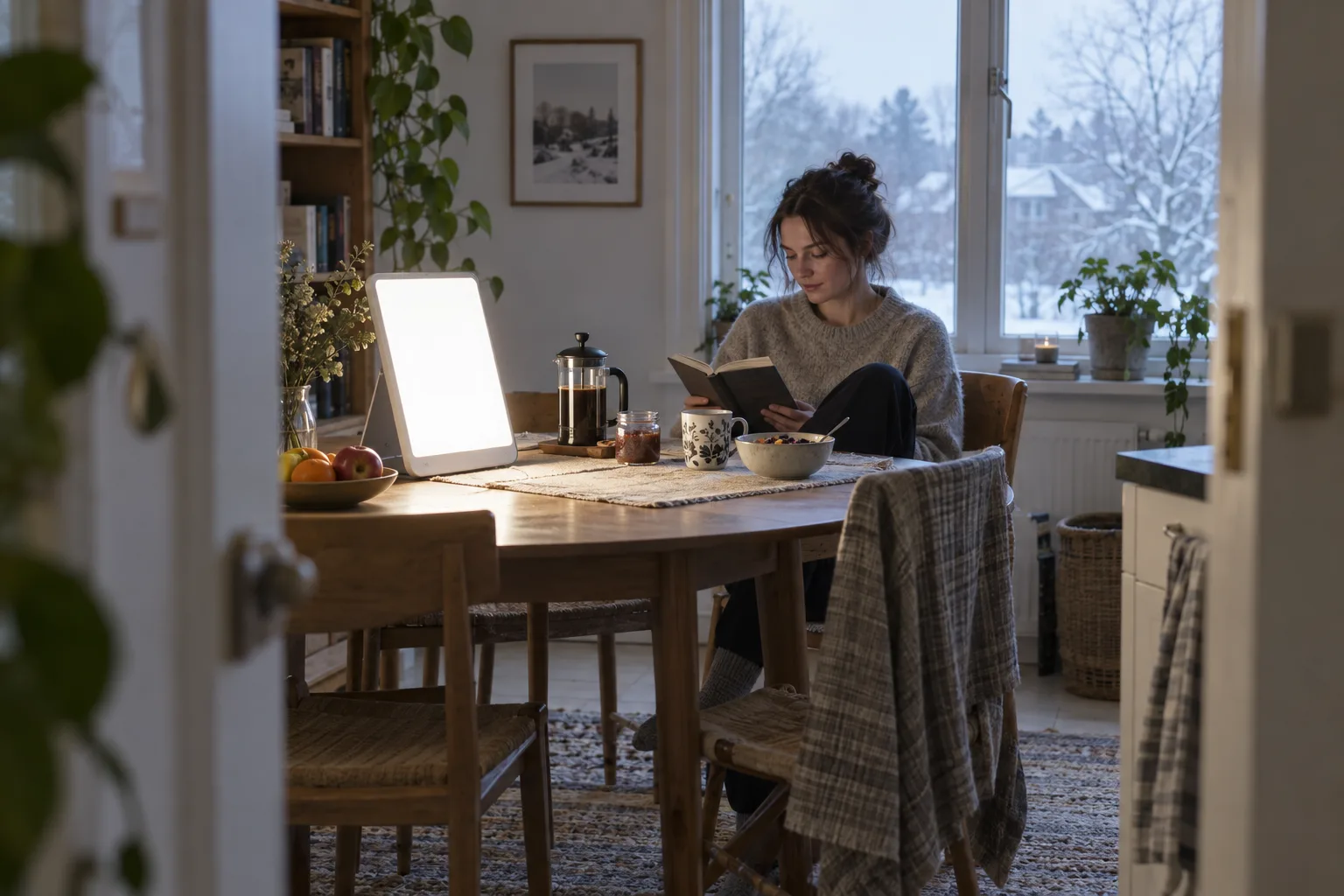
You put a lamp 50 cm from your eyes at breakfast and allow half an hour. The Beurer TL80 specifies only 2,500 lux there, with a two-hour session; its 30-minute, 10,000-lux session calls for about 20 cm. Buy the distance and duration that fit your morning, rather than the biggest number on the box.
Depression needs an assessment alongside a lamp
That calculation matters, but so does the reason you're shopping. Seasonal affective disorder (SAD) is a recurring pattern of depression; a clinician may diagnose it when depression returns at a particular time of year for at least two years. If low mood, loss of interest or difficulty functioning persists, seek clinical advice. Thoughts of self-harm call for urgent help. A clinician can discuss a lamp alongside talking therapy or medication. If dark mornings bother you but your mood and daily life remain steady, SAD treatment trials offer no reason to assume you need one.
SAD trials support an option, not a winter-blues promise
For winter-pattern SAD, bright light has evidence of benefit without a guarantee for any individual. A 2020 review of 18 placebo-controlled trials involving 610 patients found a modest average reduction in depression scores. Across 16 trials involving 559 patients, response was 1.42 times as likely with bright light. Results varied, and the studies had moderate to high risk of bias.
Guidance reflects that uncertainty. The US NIMH describes light therapy as a longstanding SAD treatment. UK NICE advises telling people who prefer it to antidepressants or psychological treatment that evidence of its effectiveness is uncertain; the NHS says it is not usually provided there because the evidence is insufficient to determine effectiveness. CBT adapted for SAD produced similar immediate symptom improvement to light therapy in direct comparison, with benefits that appeared to persist better across the next two winters.
Those SAD trial results don't predict a mood boost for someone who's simply tired of grey mornings. The 2020 review excluded people with recurring seasonal symptoms below the threshold for major depression, known as subsyndromal SAD. Research on light and general wellbeing varies widely, so there's no sound numerical promise of better mood, focus or productivity for an otherwise healthy buyer.
The useful lux figure is measured where your eyes will be
Lux describes illumination at a position. At that breakfast table, a 10,000-lux claim measured 20 cm from the panel tells you little about your seat 50 cm away. Measure the eye-to-panel distance at the place you'll use the lamp, then find the lux figure for that distance and brightness setting in its manual. If neither the listing nor the manual gives a measurement distance, choose a better-documented lamp.
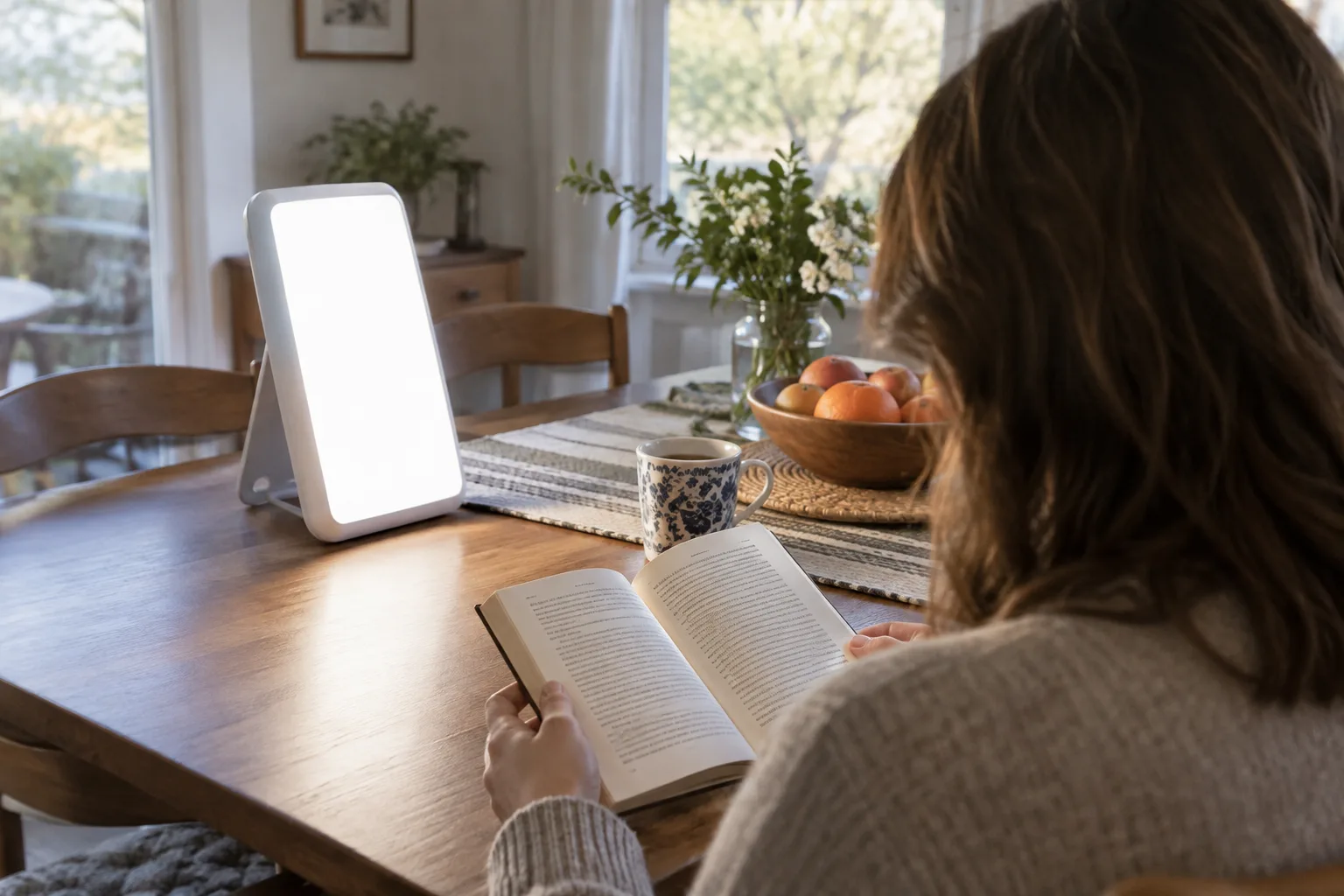
Watts describe electricity use; lumens and colour temperature cannot tell you the lux reaching your eyes. Light falls as you move away, but a simple distance formula won't reliably predict exposure close to a broad panel. Position and angle matter too. Documented 10,000-lux distances include about 10 cm for a small Beurer TL20, 20 cm for a Lumie Vitamin L and 15 cm for the much larger Beurer TL90. Size alone won't settle the question.
Moving back can turn half an hour into two hours
The distance table must also give you a session you can finish. The TL80 manual pairs approximately 20 cm and 10,000 lux with 30 minutes, 35 cm and 5,000 lux with one hour, and 50 cm and 2,500 lux with two hours. These are that lamp's specified positions and times. Our breakfast-table reader gets a two-hour commitment at 50 cm; someone who can comfortably sit 20 cm from it while working gets the 30-minute option.
Moving the TL80 to 50 cm and keeping its 30-minute timer doesn't reproduce the close-range session. Nor do its figures provide a universal formula for trading lux against minutes on other lamps: timing, illumination across your field of view and the routine you can sustain matter too. Don't extrapolate an across-room session from the headline rating.
Commonly described morning routines for winter-pattern SAD span 20 to 45 minutes: NIMH describes 10,000 lux for 30 to 45 minutes daily, while Mayo describes 20 to 30 minutes within the first hour after waking. Mayo's example sitting distance of 41 to 61 cm is subject to the manufacturer's instructions. That qualification is crucial for compact lamps specifying 10,000 lux only at 10 to 20 cm. Agree on session length with a clinician if you're using light to treat depression.
A useful distance still needs a useful lit area
Even at the right distance, a narrow beam can miss your eyes when you turn toward breakfast or a keyboard. Look for a stable panel that reaches eye height from in front or slightly to the side, with adjustable angle, even diffusion and tolerable glare. If you have to hunch, squint or hold your head precisely still, that position is unlikely to suit a daily session.
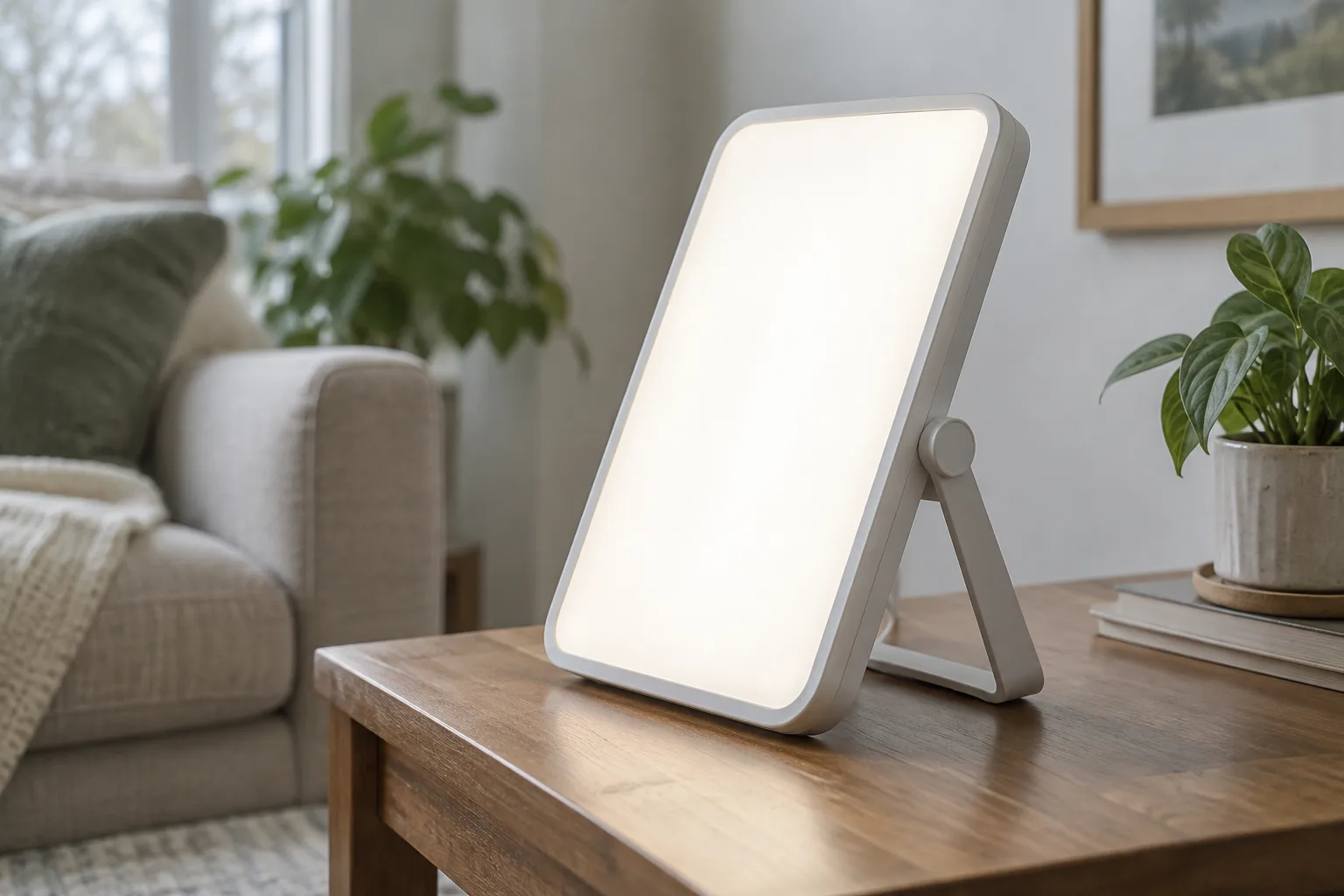
In a 2019 laboratory assessment of 24 manufacturer-supplied devices, Yale researchers found three resembling full-size research boxes and three more smaller devices meeting their usability criteria. Those included at least 7,500 lux at 28 cm, at least 5,000 lux after moving the head 13 cm in different directions, and acceptable glare and uniformity. It's a good test of the advertised position, rather than a failure rate for products sold now. An independently assessed large box delivered about 10,000 lux at 61 cm; a small advertised 10,000-lux box reached that level only around 18 cm. Neither example is a current model ranking.
Choose the format that fits the session
Those measurements make a conventional, raised light box the starting comparison for a seated SAD routine, provided its manual confirms useful output at your chair. A compact panel can work for the reader happy to sit close; it may crowd the breakfast plate for our 50 cm reader. Other formats solve different morning problems, with different evidence.
| Type | Best fit | Main trade-off |
|---|---|---|
| Large, raised light box | A regular seated session with documented output at your eye distance | Takes desk space; size alone guarantees no working distance |
| Compact LED panel | A portable setup when its specified close position is comfortable | Some reach 10,000 lux only at 10 to 20 cm |
| Wearable visor or directional beam | Someone who needs to move and can follow the device's positioning instructions | Angle, glare and evidence differ from a conventional white box; don't assume an equivalent dose |
| Dawn simulator | Someone chiefly seeking a gentler wake-up | Gradual bedroom light differs from a seated 10,000-lux session |
Dawn simulation has been studied as its own intervention, including protocols rising to about 200 to 300 lux over 1 to 2.5 hours. A generic sunrise alarm cannot be assumed to match those protocols or a bright-light box. Likewise, a wearable's convenient beam or a panel advertised as "blue-enhanced" or "full spectrum" cannot establish an equivalent SAD dose. Clear UV-filtering information and a workable position matter more.
Price follows design as well as usefulness. In 2026, illustrative design-led desk lamps cost roughly four to five times as much as portable panels; that premium doesn't establish better lux at your seat. Portability has its own catch: the TL20 weighs roughly 230 g against the TL90's 3 kg, yet their specified 10,000-lux distances are about 10 cm and 15 cm respectively. Decide whether the stand, footprint, cord reach, accessible switch and timer suit the chair before paying for extra modes.
For running cost, use electrical watts and your actual session length. At 30 minutes daily for 120 days, a 7.2 W TL20 implies about 0.43 kWh; an older TL90 with two 36 W tubes implies about 4.32 kWh, before additional electronics losses. These are two product calculations, not a category-wide power range, and longer sessions change the comparison. For tubes, check replacement availability; for a sealed LED panel, check the adapter, warranty and returns. Advertised LED hours don't establish the life of the whole lamp. Confirm the supplied power adapter suits your market.
Morning timing matters more than a seasonal bargain
Once you have a position you can maintain, keep the session in the morning: evening use can disturb sleep. If a lamp crowds your breakfast plate, find one documented for a more comfortable distance instead of increasing an unverified across-room exposure. Report troublesome headache, eye strain, agitation or sleep disruption to a clinician rather than increasing exposure.
A deal is useful only if that same model's recent local selling price and distance table hold up. One named lamp was advertised at 32% off from 20 November to 2 December 2025; that says nothing about a typical discount or the best time to buy. A late-autumn offer may arrive after symptoms begin. Allow time to read the instructions, test your sitting position and seek clinical advice where needed.
Compare SAD light boxes
Live prices from more than 20 shops, updated daily.
A few remaining questions can change the choice
Can I check a lamp's lux with a phone app?
A reading at approximate eye position, with the phone facing the lamp, can flag a large mismatch. Treat an uncalibrated app as a screening check, not clinical certification; use the manual's measured distance table to decide.
Will a light therapy lamp raise my vitamin D?
An ordinary UV-filtered SAD lamp isn't a vitamin-D lamp. Its intended light reaches the eyes; UV exposure on skin isn't part of the treatment.
Does a CE or UKCA mark mean the lamp will improve my mood?
No. The UK NHS advises choosing a UV-free, 10,000-lux lamp with a UKCA or CE mark. Where applicable, these marks concern product conformity; they promise neither a response nor useful lux at your seat. In the US, "FDA registered" likewise does not mean FDA approved or cleared.
How quickly should I feel better?
There's no reliable personal deadline. In a trial of 96 people with winter SAD, light had an advantage over fluoxetine at one week, but both groups had a 67% response rate after eight weeks; remission was 50% with light and 54% with fluoxetine. The trial compared two active treatments. If symptoms persist, seek clinical review.
Can I start using a lamp before symptoms to prevent SAD?
Prevention remains uncertain. A review found only one eligible preventive light-therapy trial, involving 46 people with a history of winter depression. Don't count on an autumn purchase to prevent an episode.
The verdict: buy for your seated distance
Choose a UV-filtered SAD light box whose manual pairs useful brightness with a session you can complete at your measured eye distance. If seasonal low mood is affecting daily life, arrange an assessment as well.
This article was created using AI, following our team's editorial standards.


