

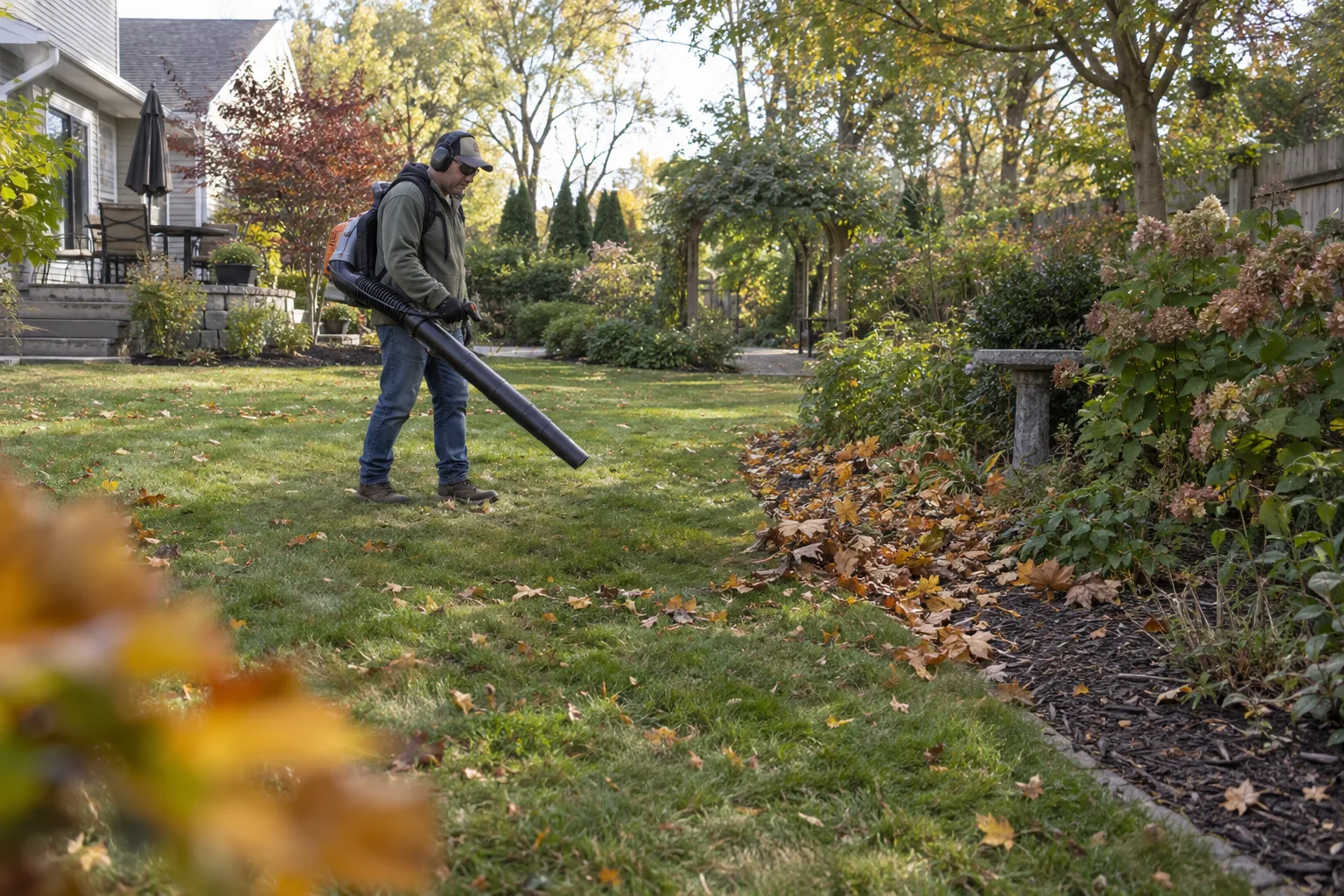
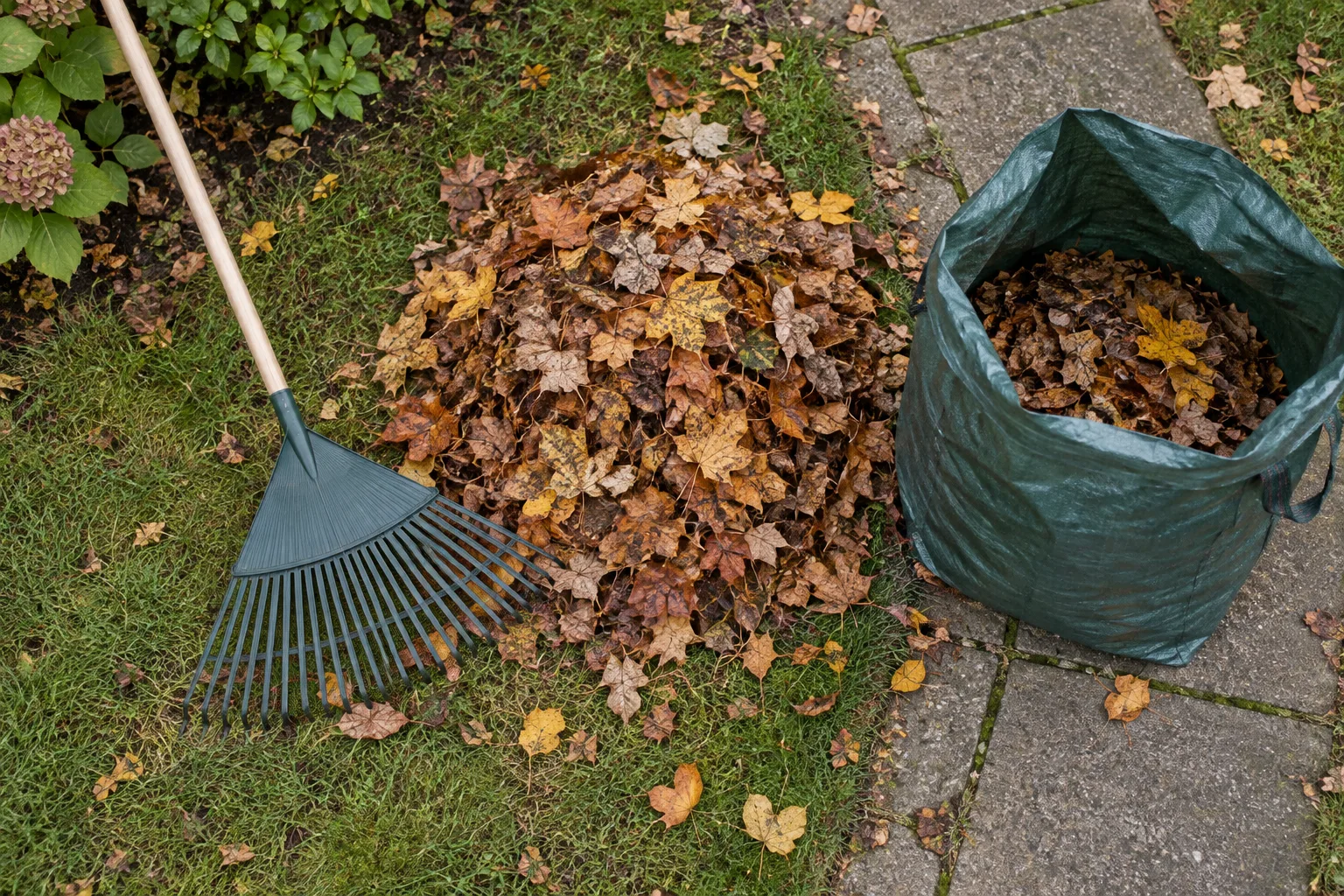
The 20-foot path is clear, but the pile beside the gate still needs lifting into the compost heap. A blower can sweep leaves about twice as fast as a rake. That doesn't mean it finishes this job first.
The leaves' destination decides the winner
For that short path and nearby heap, a fan leaf rake makes a pile you can lift as you go. Change the job to a broad, dry lawn with a direct route into a suitable bed, and a handheld blower has a better case: moving the leaves can finish the work. If they must go into bags, the pile is only halfway there. No reliable three-way test establishes which tool finishes fastest across small gardens.
| Job or criterion | Fan leaf rake | Handheld blower | Handheld vacuum | Likely choice |
|---|---|---|---|---|
| Short path, nearby bag or heap | Makes a pile ready to lift | Leaves a pile to collect | Needs setup and emptying | Rake |
| Open, dry run into a suitable bed | Needs repeated pulling | Moves leaves to their destination | Has a narrow intake | Blower |
| Dry leaves scattered around paving or shrubs, bound for a bin | Needs a scooping pass | Needs collection after blowing | Collects and shreds as it goes | Vacuum, if emptying is manageable |
| Wet leaves with twigs or gravel | Pulls clumps together | Can scatter loose material | Can block or take in stones | Rake |
| Noise during clearing | No motor noise | Motor runs while moving leaves | Motor runs while collecting | Rake |
| Small, occasional job with little storage | Quick to fetch and put away | Needs space and power | Adds a bag and possible tube changes | Rake |
Bagging can erase a blower's head start
That open-bed route is the blower's advantage. Once bagging enters the job, speed at sweeping tells you much less. A 2011 Consumer Reports exercise found a handheld blower swept leaves about twice as fast as a rake, but stopped before bagging and disposal. In one contractor's own walkway trial, a blower took 11 minutes 56 seconds against 9 minutes 17 seconds for rake and broom, a 2 minute 39 second reversal. That single trial also stopped short of disposal; neither result promises a finished-job time for your garden.
On the 20-foot path, the rake's pile is ready to scoop into the heap by the gate. To find out whether a blower saves you time there, count everything you do before the tool goes back into storage. Keep motor-on time separate: lifting a pile is quieter than blowing one.
- Fetch and set up each tool, including any battery, extension cord, tube, scoop or tarp.
- Clear the same surface and record motor-on minutes separately.
- Lift or empty the leaves, carry them to their accepted destination, then clean and store the tool. Stop the clock when both path and leaves are dealt with.
Dry, scattered leaves give a vacuum its chance
Where the blower leaves collection for later, a handheld garden vacuum collects as it moves. Its best job is dry leaves scattered around paving or shrubs, headed for a bin as shredded material. On a large open area, the narrow intake and repeated stops to empty its bag can give back the time saved on scooping.
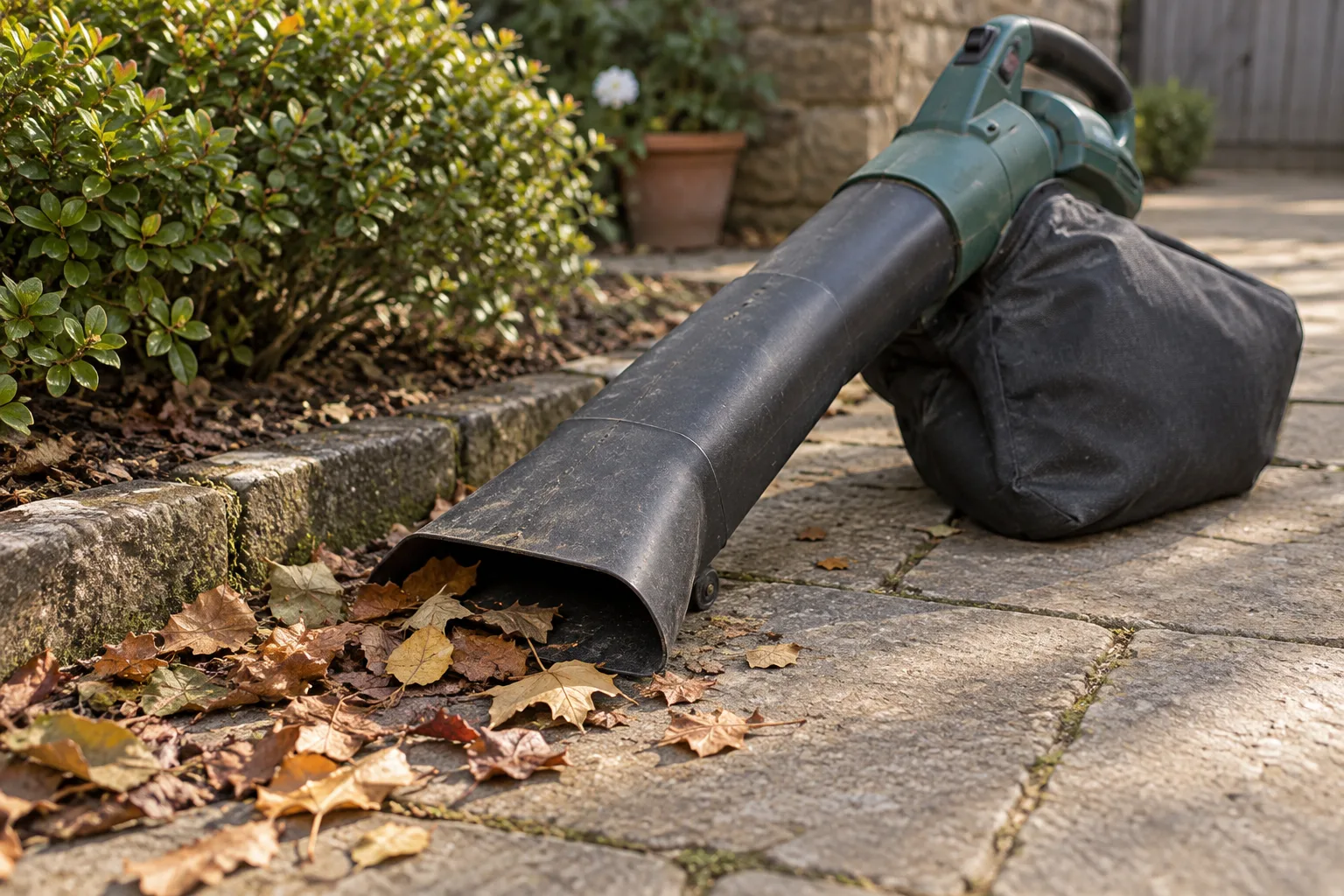
Portable examples have bags of about 9 to 12 gallons. If your usual fall fills several, picture carrying and emptying each one before buying. Try the closure and any switch from blow to vacuum mode: some machines need a tube change. Advertised 10:1 or 16:1 shredding ratios describe volume reduction under unspecified conditions. The leaves still weigh the same, and those claims don't establish how many disposal bags or minutes you'll save.
A replaceable bag and accessible impeller matter more than a promise of two functions; some low-cost combined tools with parallel tubes have been weak in vacuum mode. Pick up stones and twigs first because they can damage or block the machine. Wet clumps can block it too, which brings the rake back into contention.
Wet clumps favor a flexible rake
For damp, flattened leaves on the path, a fan rake pulls clumps together without feeding them through a vacuum. Its flexible tines suit grass and beds; a broom finishes fine debris on paving. A rigid soil rake is the wrong tool for gathering leaves.
Width isn't an automatic shortcut. In a Consumer Reports comparison, a roughly 24-inch head needed less downward pressure than an extra-wide one of about 36 inches. Choose a handle you can use upright, wear gloves and take breaks. Pull while standing straight, bend your knees to collect the pile and turn your feet rather than twisting with a loaded bundle.
Powered minutes carry a noise cost
The rake also sets the quiet baseline for the 20-foot path. Powered tools bring an exposure for the operator as well as noise for neighbors. Groundskeeping measurements have recorded leaf-blower maximum readings of 95 to 106 dBA, though those peaks don't describe every domestic machine or a whole session. CDC/NIOSH recommends limiting workplace noise exposure to 85 dBA averaged over eight hours, and halves the recommended exposure time with each 3 dBA increase, reaching 15 minutes at 100 dBA. That's a workplace recommendation, not a guarantee that a shorter gardening session is safe.
For noise comparisons, look for an operator-ear reading and a bystander reading at the same distance and power setting. A sound-power label and a sound-pressure figure at 50 feet measure different things; neither gives the level at your ear. Electric blowers are generally quieter than gas-powered ones, though they're far from silent. In a small, seven-model 2018 commercial study, machines with similar stated 64 to 65 dBA ratings at 50 feet differed farther away: one gas-powered blower measured 56 dBA at 200 feet, against 46 to 49 dBA for battery models. That isn't a forecast for your garden.
Before buying, check local rules on use and operating hours. There is no single nationwide residential leaf-blower use limit; noise and operating-hour rules are mainly state and local matters. Check your city or county code for any quiet hours, seasonal restrictions or limits that apply. Product sound figures may be sound pressure at a stated distance, sound power or an operator-position reading; they aren't interchangeable. The ANSI/OPEI B175.2 method for gas-powered handheld and backpack blowers can measure bystander sound pressure at 50 feet. A short powered sweep followed by quiet hand collection has a different noise cost from running a vacuum throughout, even if both jobs take the same total time.
Battery convenience costs more than a rake
If those motor-on minutes buy useful reach, the price may make sense. Typical US prices in September 2026 were about $10 to $30 for a manual leaf rake, $100 to $400 for a cordless handheld leaf blower kit, and $190 to $300 for a cordless leaf vacuum or blower/vac kit. A corded blower/vac typically cost about $60 to $130. Prices depend on the model and kit contents, so check whether the listing includes the battery, charger, collection bag and tubes. Home Depot and Lowe's are common places to shop, along with other home-improvement stores and outdoor power equipment dealers. A corded blower/vac can be a cheaper powered option when a GFCI-protected outlet is close enough.
Read the kit contents before comparing prices: some vacuums require two batteries, and matching voltage doesn't establish compatibility. Look for a UL or ETL certification mark as an indication of third-party testing, and use only batteries and chargers approved for your exact tool model. Listed handheld blowers weighed about 3.5 to 9.5 pounds across different models, blower/vacs around 8 pounds, and one sampled corded vac 13.5 pounds. Lift one with its battery or bag fitted. Listed battery working times ran from 7 to 40 minutes across different blowers; one maker's estimate for a single blower ranged from 55 to 10 minutes depending on setting. Check a tested runtime at a setting that clears your leaves.
A cord avoids recharging but needs a safely routed extension cord that reaches the whole job. For scale, a hypothetical 3,000-watt corded tool drawing that power for 20 minutes uses 1 kWh; multiply that by your utility's rate, shown on your bill. The EIA's 2025 US residential average was about 17 cents per kWh, but your rate may differ. Battery replacement may matter more than electricity for occasional use. Backpack and walk-behind machines bring size, storage demands and cost intended for larger loads.
A direct route into a bed earns a blower its place
That higher spend has its strongest case on the broad, dry lawn: with an unobstructed route to a suitable bed or collection point, the blower can move leaves straight to their destination. Beside gravel, delicate planting or parked cars, variable speed and a controllable nozzle matter more than headline maximum airspeed. A compact battery blower can also suit frequent quick path clearances, though a low-output sweeper may struggle with a wet lawn covering.
For the 20-foot path with a nearby heap, you'd still have to lift the blower's pile. If collection requires bags or a bin, count that work too. Keep leaves out of streets, drains and neighboring property, even when blowing them there would clear your own ground.
A few leaf questions have different answers
Must I collect every leaf from a small garden?
No. Keep paths clear for footing and drainage, and remove accumulations that smother grass. A mower you already own can shred a relatively dry, thin fall into the lawn, possibly with a second pass. Guidance suggests roughly half an inch of shredded leaves can be manageable; that doesn't apply to a mat of whole leaves. Whole leaves in suitable beds or sheltered corners can provide insect habitat.
Can wet leaves go into a leaf-mold heap?
Yes. Collect them with a rake and put them in a heap or suitable perforated bags. Moisture helps leaf mold form; the problem is pushing wet clumps through a blockage-prone powered vacuum.
Does an electric blower mean no emissions or dust?
It has no exhaust at the tool, but electricity generation and manufacturing still have an impact, and airflow can raise dust. Nor is a gas-powered model automatically stronger: performance varies by model.
Should I wait for a post-autumn blower sale?
There's no dependable nationwide clearance window. Selected US spring offers in 2026 showed 13% and 19% reductions; selected early-September offers showed 7%, 13% and 19%. Those aren't typical discounts. Spring lawn-and-garden sales and late-summer or fall cleanup promotions are worth watching, including Labor Day sales. Compare the normal price of the same complete kit, including battery count, capacity and charger, especially if leaves already need clearing.
For a small collected job, start with the rake
Choose a fan rake for the short path, nearby heap or wet leaves. Choose a blower when dry leaves can travel directly to a suitable destination; choose a vacuum for manageable dry leaves you need collected. Count the minutes through disposal, then decide whether the powered minutes buy enough to justify their noise. Check your local waste department's rules if you're using municipal yard-waste bags, bins or a drop-off site.
Compare fan leaf rakes
Live prices from more than 20 shops, updated daily.
This article was created using AI, following our team's editorial standards.


