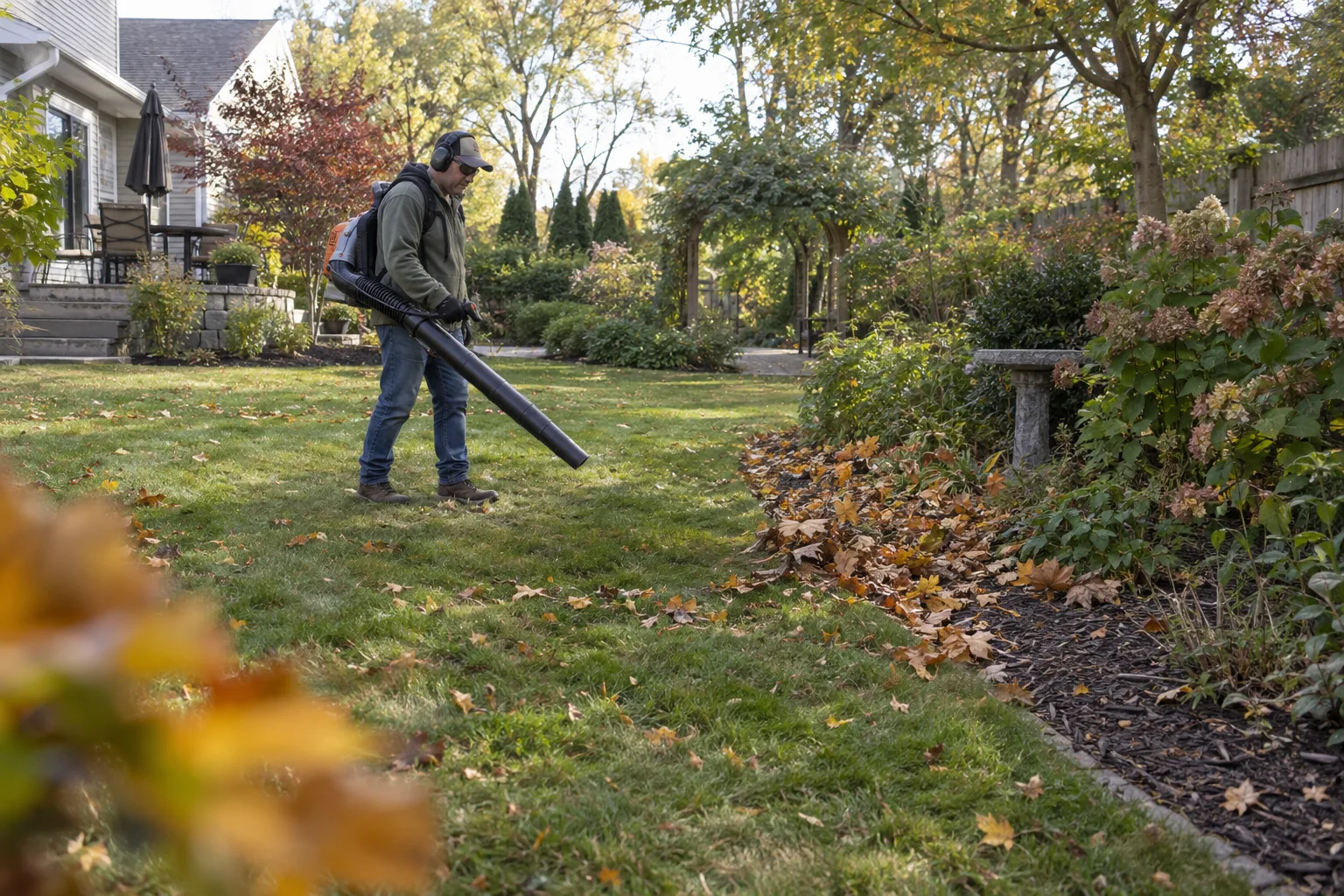


Before opening a product page, measure the hedge’s length, height, top depth and woody stems. Those figures reveal the blade, cutting capacity and runtime you need, while local wildlife rules decide when the heavier work can begin.
Measure the late-season job and check local cutting rules before deciding to buy
Measure the whole cutting surface and inspect the hedge for active nests before choosing a machine. Legal windows vary across Europe and by land status: agricultural hedge cutting generally reopens on 1 September in Ireland and England, while Germany prohibits heavy cutting through 30 September. French rules can vary by location and land status.
Record these details at the hedge, including several woody stems inside the foliage:
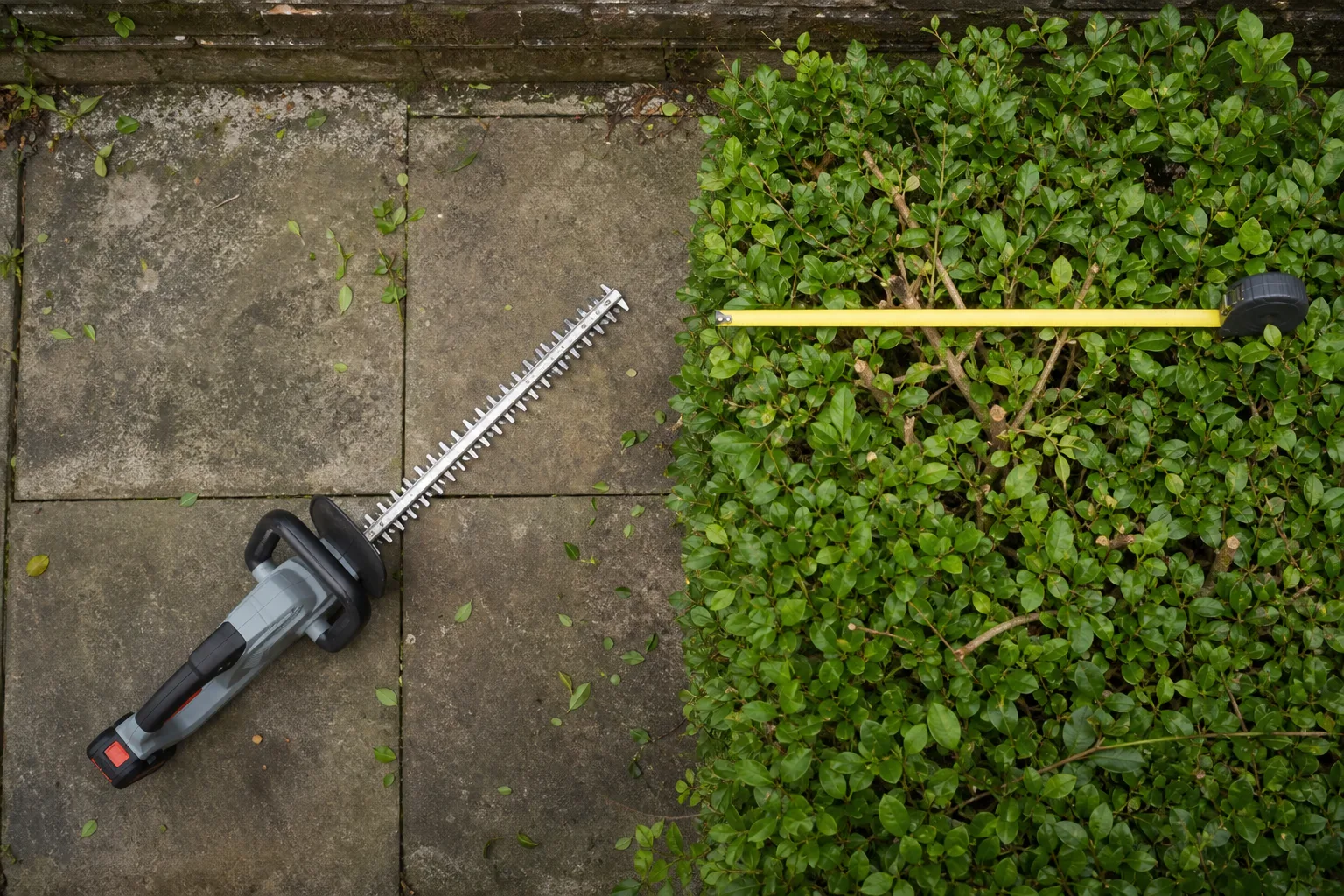
- Total length, average cut height and top depth.
- Access from one side or both sides, plus the tallest point and nearby obstacles.
- Representative stem diameter, measured on established wood.
- Hedge species and whether it regrows from old wood.
For both faces and the top, estimate cutting surface per linear metre as 2 × height + depth. A hedge 1.8 m high and 0.8 m deep has about 4.4 m² of cutting surface per metre. A 20 m run therefore presents roughly 88 m², which explains why hedge length alone gives poor runtime guidance.
Keep your current trimmer if its rated capacity covers the measured stems, its controls and guard are sound, and it can finish the job without forcing. Small topiary may need only manual shears or a compact shrub shear. Hire help where safe access requires a ladder, roof or unstable support, or where heavy structural branches dominate the job.
Match blade length to hedge depth and rated capacity to the woody stems
Choose the shortest blade that covers most of the top from a comfortable working position. A longer bar reduces sweeps on broad, straight hedges, yet its extra tip leverage makes corners, irregular shrubs and shoulder-height work harder to control.
- 40 to 45 cm: narrow hedges, detailed shaping and work near walls.
- 50 to 55 cm: the general-purpose domestic range.
- 60 to 65 cm: broad or long, uniform faces where fewer sweeps help.
- 70 to 75 cm: extended straight runs, with greater weight and tip leverage.
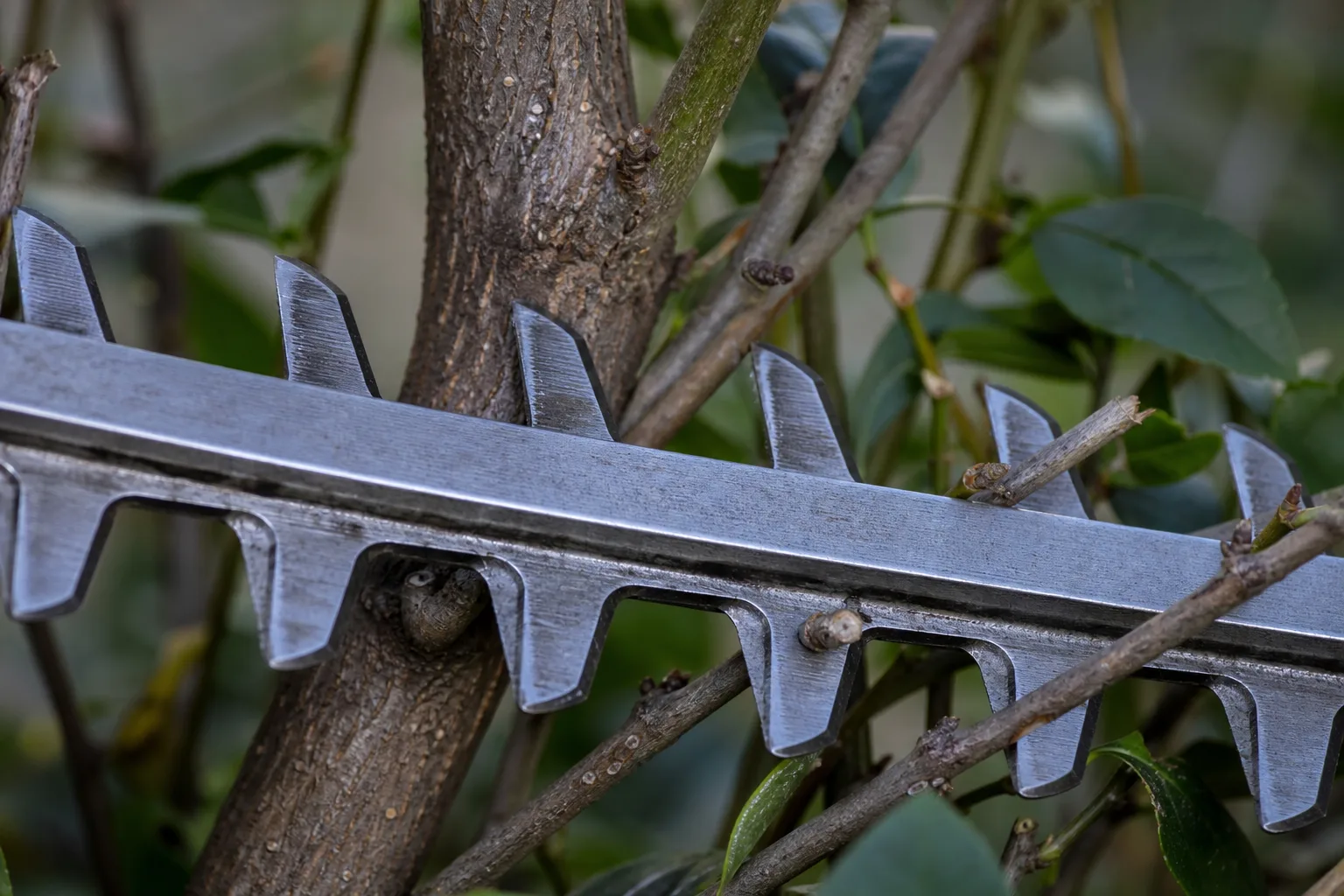
Use the manufacturer’s recommended maximum branch or twig diameter from the manual. Tooth spacing only shows what can enter the blade. Light domestic tools commonly have 15 to 22 mm openings, while stronger machines reach roughly 26 to 34 mm. A tool with a 30 mm gap can still carry a lower recommended twig diameter.
Up to about 15 mm suits frequent trimming of soft growth. Around 20 mm covers many mixed domestic hedges. Ratings around 25 to 30 mm suit demanding growth where the maker explicitly approves it. Pre-cut anything above the rating with loppers or a pruning saw.
Estimate cordless runtime from hedge surface area, then price the whole battery platform
Plan cordless runtime from square metres of hedge, then verify the estimate on a dense section. Manufacturer figures use different internal tests, so minutes and area claims rarely support fair cross-brand comparisons.
If a maker claims 300 m² and your hedge presents 4.4 m² per linear metre, the theoretical figure is about 68 m. Treat that as an ideal ceiling. Time the fully charged machine over a representative 3 to 5 m section, scale the result to the full hedge and leave reserve for dense patches, jams and finishing passes.
- Compare battery energy in watt-hours, calculated approximately as voltage × amp-hours.
- Check whether the price covers a bare tool, one-battery kit or complete kit with charger.
- Confirm the exact battery family. Matching voltage doesn’t guarantee compatibility.
- Price replacement packs and check local availability before committing to a platform.
Battery size changes handling. An 18 V, 2.5 Ah pack stores about 45 Wh and one current example weighs 0.363 kg. A 187 Wh professional pack weighs 1.3 kg. Paying for the larger pack buys roughly four times the stored energy, while adding about 0.94 kg to the tool.
Sampled manufacturer prices in July 2026 placed entry corded machines in the lowest tier. Cordless kits cost more than bare tools because they include a battery and charger, and a professional battery can cost as much as an entry corded trimmer. Existing platform ownership can therefore change the value calculation completely.
Choose reach you can control
Judge weight with the required battery fitted and the blade held in a cutting position. A machine that feels manageable beside your leg can become tiring when extended horizontally at shoulder height.
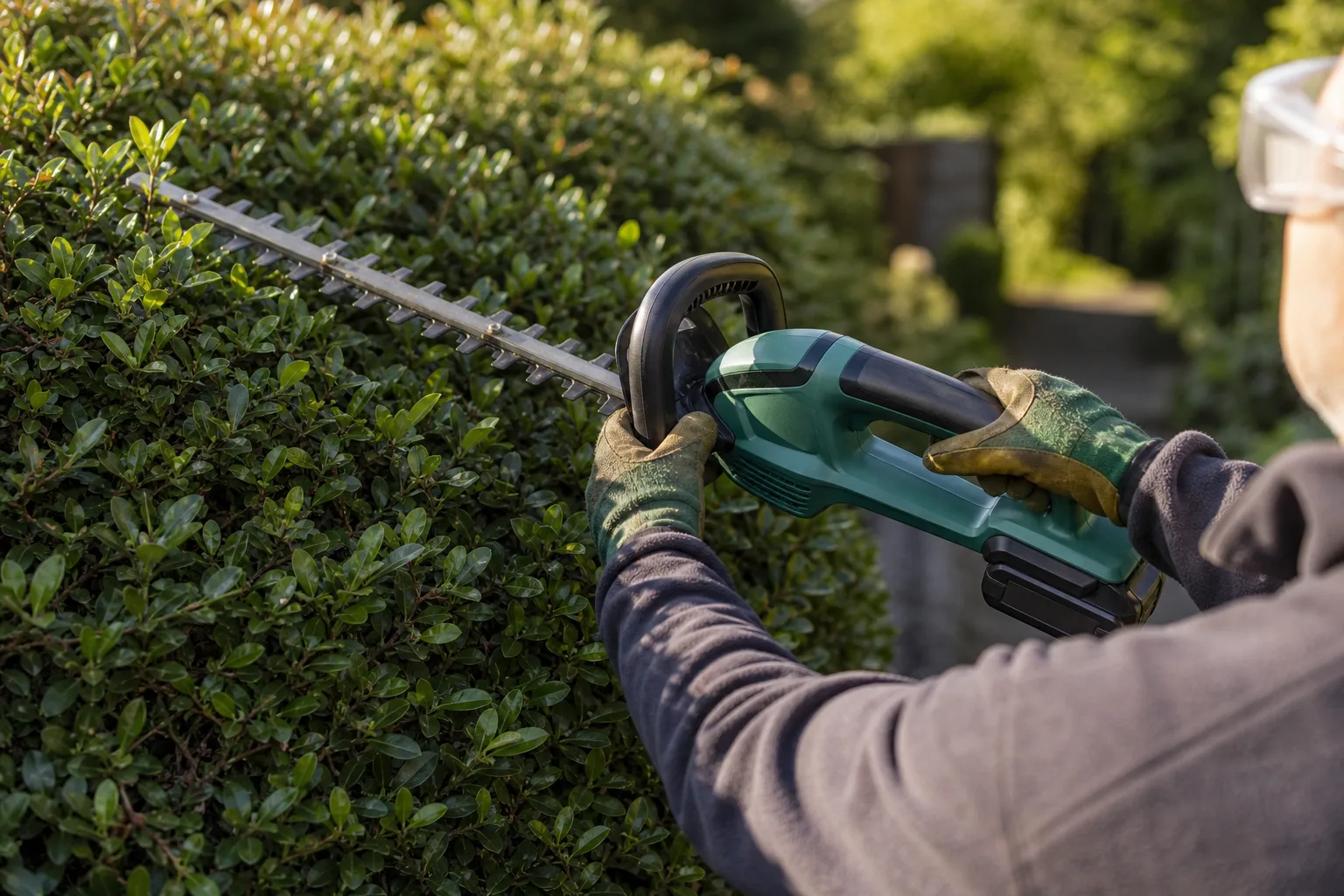
Domestic corded handheld models commonly weigh about 2.6 to 4.1 kg all-in. Cordless handheld tools often weigh 2.0 to 3.3 kg before the battery. Pole and long-reach cordless models commonly reach 4.2 to 5.5 kg before a battery, with leverage making them feel heavier at the cutter head.
- Hold the exact tool with its planned battery at vertical-side and horizontal-top angles.
- Check that the front handle supports several secure two-handed grips.
- Choose a rotating rear handle for substantial vertical-face work.
- For repeated shoulder-height cutting, favour a shorter blade and lighter pack.
- Use a pole tool from firm ground and within comfortable reach. Never operate a hedge trimmer from a ladder.
Shortlist by hedge: corded, 18 V cordless, high-output cordless or long-reach
For a typical domestic boundary hedge, begin with a 50 to 55 cm handheld model. Cordless suits multiple garden areas and existing battery owners. Corded gives better value where one safely routed lead reaches the entire job.
| Type | Choose it when | Useful characteristics | Main compromise |
|---|---|---|---|
| Corded handheld | The hedge is within safe cable reach and cutting sessions are infrequent but long. | About 45 to 70 cm blades and 2.6 to 4.1 kg all-in across current examples. | Cable routing, dry-condition limits and socket access. |
| 18 V cordless handheld | The garden is small to medium, or you already own compatible batteries. | Usually the lightest cordless class, often suited to regular growth and easy movement between hedges. | Limited reserve on neglected woody growth and possible battery changes. |
| High-output cordless handheld | The hedge is long, deep or tough and cable-free work justifies the battery cost. | Larger cutting capacities, more stored energy and stronger under-load performance. | Higher all-in weight and a more expensive battery platform. |
| Pole or long-reach | Tall or very wide sections can’t be reached comfortably with a handheld tool. | Articulating head and ground-level access to hedge tops. | Typically 4.2 to 5.5 kg before battery, with greater leverage and less precision. |
Most residential buyers can skip petrol. Its weight, noise, maintenance and fuel handling make little sense for an annual boundary cut within reach of modern electric tools. Compact shrub shears are also the wrong purchase for a long hedge, while loppers and pruning saws remain necessary for occasional oversized branches.
Avoid the spec traps and unsafe shortcuts that ruin a heavy cut
Treat headline claims as screening information and let the manual settle capacity, weather use and safety requirements.
- “Cuts up to X mm” can describe fresh material in favourable conditions. Use the recommended capacity in the manual.
- “Up to” runtime changes with hedge density, temperature, battery condition, speed and technique.
- An anti-block or reverse function releases smaller jams. It doesn’t raise branch capacity.
- A brushless motor can improve efficiency and reduce maintenance, but blade, gearbox and service quality still matter.
- A conformity mark confirms applicable requirements. It isn’t a performance or durability award.
Set up the cut safely
Inspect the complete work area before switching on, including the hidden side of the hedge.
- Look for nests, wire fencing, lighting cables, washing lines, stones, metal stakes, people and animals.
- Check the blade, hand guard, tip protector, fasteners and two-hand controls. Stop if noise or vibration changes suddenly.
- Wear eye protection, sturdy nonslip footwear, close-fitting clothing and long sleeves. Use hearing protection where the manual or measured noise level requires it.
- Keep both hands on the tool and cut only where you can see the blade area.
- Release the trigger and wait for the blades to stop before dealing with a jam. Unplug the cord or remove the battery before touching the blade area.
- Take breaks before grip, shoulder strength or balance deteriorates. Follow the exact manual on rain and damp conditions.
- Fit the blade scabbard for transport and storage. Isolate the machine before cleaning or inspection.
FAQ: late-season sizing, batteries, cables and cutting windows
The manual, the measured hedge and local wildlife rules settle the common edge cases.
Is a 600 W corded trimmer stronger than an 18 V cordless model?
Those figures can’t be compared directly. Corded watts usually describe electrical input, while battery voltage identifies part of the electrical system. Compare rated branch capacity, blade length, all-in weight and sustained performance on your hedge.
Do two batteries guarantee continuous cordless work?
Only if the charger can replenish one pack before the other is exhausted. Time one battery on a representative section, then compare that working time with the charger’s full recharge time.
How much electricity does a corded hedge trimmer use?
A 500 W machine running for one hour uses about 0.5 kWh. Purchase price, cable suitability and battery replacement costs usually have a larger financial effect than the electricity used during trimming.
Can I start heavy cutting as soon as the local restriction ends?
Check for active nests first and confirm which rules apply to the land and hedge. Legal reopening also doesn’t guarantee ideal horticultural timing. Wildlife guidance can favour January or February where retaining autumn berries matters.
Should conifers receive their heavy cut in early autumn?
Some conifers are better trimmed earlier and can develop bare patches if cut after August. Identify the hedge species and check suitable local horticultural guidance before making a deep cut.
Compare cordless hedge trimmers
Live prices from more than 20 shops, updated daily.
The verdict: buy for the measured hedge, not the biggest wattage or voltage
Most medium domestic hedges suit a well-balanced 50 to 55 cm handheld trimmer with a manual-rated capacity covering the established stems. Choose cordless if a timed section proves the battery can finish the surface area, especially when you already own compatible packs. Choose corded when a safely routed lead reaches everything and the work is lengthy but infrequent. For unreachable tops, move to a controllable long-reach tool or hire a professional.
This article was created using AI, following our team's editorial standards.