


A roof box should solve one job: carry bulky vacation overflow without making the car awkward, thirsty, or unsafe for a long interstate run. Before you chase the biggest capacity number, check rent versus buy, the roof rack fit, the real load limit, and the speed rules on your route.
Decide first: rent or buy, then size the box around a real 560-mile interstate trip
Renting is often the safer first move for a family that takes one predictable summer trip a year. It avoids storage, gives you a fitted system for that exact vehicle, and lets you learn what size you actually use before you spend on a box and crossbars.
As of July 2026, rental examples in some U.S. markets sit roughly around $55 to $90 for a week with a small 10 to 12 cubic foot box, or $165 to $240 for two weeks with a 16 to 18 cubic foot family box. Buying a quality box plus the correct crossbars can land anywhere from about $650 to $2,050 all in, depending heavily on the vehicle and rack system.
- Rent first if you travel once a year, have poor storage, lack crossbars, or need a fitting appointment anyway.
- Buy if you use it several times a year, want last-minute flexibility, keep the car long-term, or need a particular long, low, or large shape every season.
- Book early in July. The first summer holiday weekends can drain both rental stock and vehicle-specific crossbar kits.
Capacity that actually works for a family of four: why 14 to 18 cubic feet is usually enough
A family of four usually lands in the 14 to 18 cubic foot range for a summer hotel, vacation rental, or beach trip. Around 14 cubic feet can handle soft bags, coats, towels, and beach overflow; 16 to 18 cubic feet gives breathing room for a travel crib, stroller, bedding, or bulky toys.
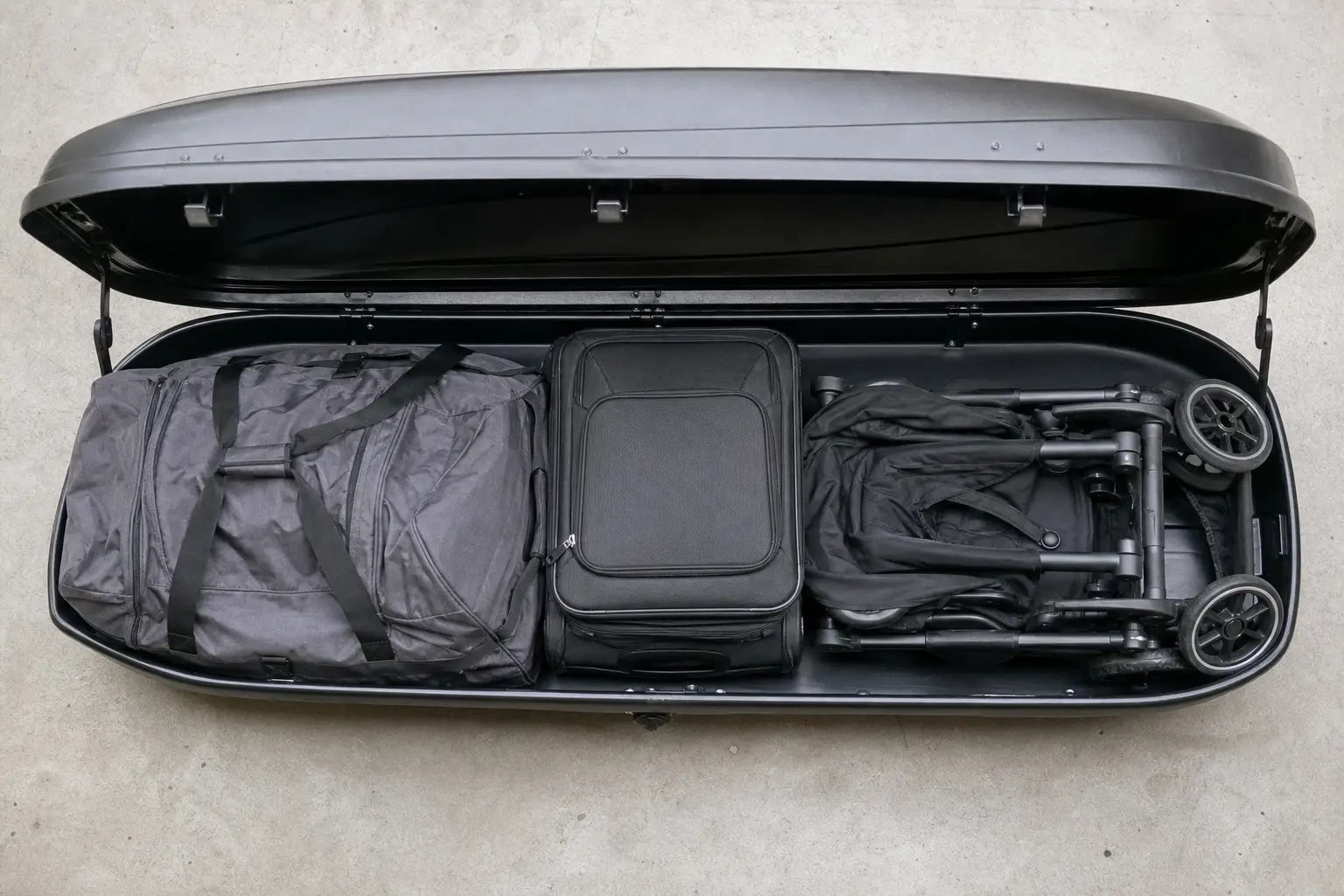
- 10 to 12 cubic feet suits couples, compact cars, ski boots, and short trips where lower height and less noise matter.
- 13 to 16 cubic feet is the usual first family choice, with a useful balance of capacity, weight, cost, and ease of mounting.
- 16 to 19 cubic feet suits camping gear, five people, or bulky kids' gear, but it makes overloading easier and storage harder.
- Long or alpine boxes suit skis, snowboards, long umbrellas, and narrower roof layouts, but they are less useful for tall soft bags.
Cubic feet can flatter a box. Independent testing has found some claimed capacities about 10% above usable space, with one tested box coming in around 20% below its claim. Internal clamps, hinge shapes, and uneven floors all eat into the space you can actually pack.
Fit comes before brand: roof racks, crossbar spread, clamps, and rear hatch clearance
Start with the vehicle and rack system, because the shell only works if the bars, spread, and clamps match. A good box on the wrong rack is a bad purchase.
- Check the vehicle roof-load limit in the owner's manual. This is the ceiling for crossbars, empty box, and luggage together.
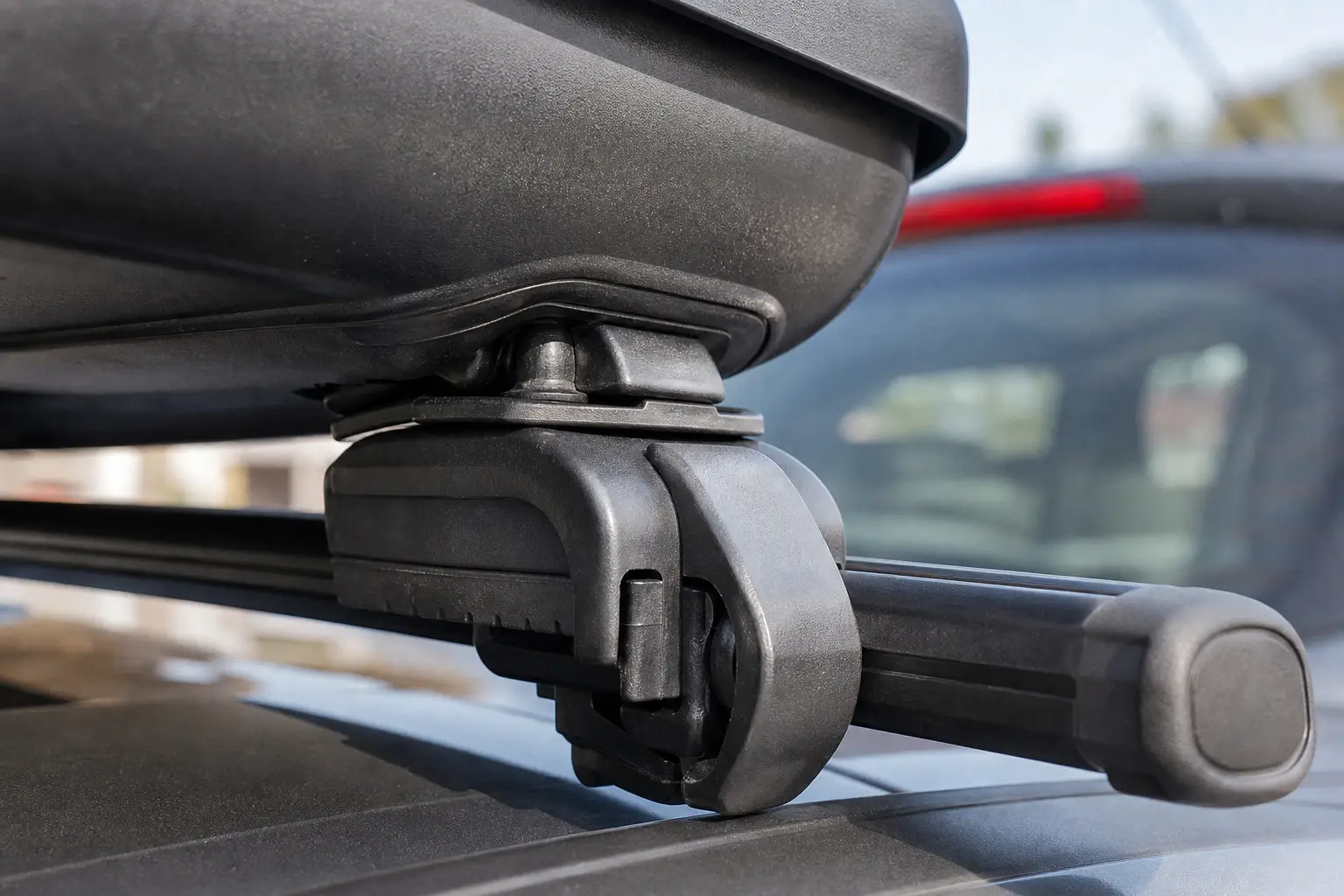
- Check the bar load rating and crossbar spread. Many boxes have model-specific front-to-back spacing windows, commonly around 24 to 37 inches, but the box manual decides.
- Check clamp fit. U-bolts, claws, and quick clamps must suit the bar width, height, and profile. Wide aero or platform bars may need T-track adapters.
- Check rear hatch clearance. If the box sits too far back, the liftgate hits it; too far forward can increase lift and wind load.
- Check factory crossbars carefully. Some sit too low, have poor spread, sag under load, or use proprietary slots that limit future choices.
Mounting style changes the whole vacation morning. U-bolts are cheaper and often fiddly. Quick clamps are faster for repeat use. Torque-indicating clamps reduce the chance of under-tightening or crushing the system. Dual-side opening helps on tall vehicles and in tight parking spaces.
The roof-load calculation: how to avoid filling 18 cubic feet with too many pounds
The roof-load number runs out faster than the volume. Use this formula before packing: available cargo weight equals vehicle roof-load limit minus crossbars minus empty roof box.
One example used a vehicle with a 165-pound roof-load limit, a 53-pound box, and 11 pounds of crossbars. That left 101 pounds for luggage. Four people can blow past that quickly if heavy suitcases go on the roof.
- Put heavy suitcases in the trunk, low and forward.
- Use the roof box for light, bulky items: soft bags, coats, towels, sleeping bags, helmets, and beach gear.
- Strap the contents inside the box. A locked lid does not restrain luggage in a crash.
- Keep most of the weight between the crossbars, with a rough quarter at the front, half in the middle, and a quarter at the rear.
- Stop after the first few miles and recheck clamps, straps, and the lid.
What the box will cost you at 75 to 80 mph: fuel, EV range, wind noise, and handling
At interstate speed, a roof box is a real fuel and range penalty. In one test at 80 mph, a diesel vehicle went from about 38.6 mpg without roof load to roughly 33 to 35 mpg with the tested boxes, averaging more than an 18% increase in fuel use.
For a 560-mile holiday drive, that test range translates to about 2 to 3 extra gallons, with around 2.5 gallons as a useful planning figure. For an EV, an 18% rise in consumption cuts usable range by about 15%, so a car that manages 250 miles at highway pace may behave more like 210 to 215 miles in similar conditions.
Expect more wind noise from both crossbars and box. Aero bars usually help compared with square bars, but a poorly seated aero setup can still whistle. The box also adds side area and raises the center of gravity, so take care in crosswinds, after tree gaps, on bridges, and when passing semis.
Cheap, mid-range, or premium: the comparison that separates two-summer boxes from 15-year boxes
Long life usually comes from better mounting hardware, shell stiffness, hinges, locks, strap anchors, and spare-parts support. Crash security matters most: independent tests have found weak straps, torn fixings, broken lids, and even boxes detaching from carriers in impact tests.
- Look for wide, stable mounting points and clear load ratings.
- Choose strong internal strap anchors, not flimsy loops.
- Check that keys, locks, hinges, struts, and clamps are available as spares.
- Open and close the lid. Twisting, sticking, or uneven locking is a warning sign.
- Prefer central locking that releases the key only when the lid is properly shut.
- Store the box dry and out of the sun to reduce UV and heat aging.
| Tier, rough July 2026 U.S. price band | Best fit | What you gain | Watch-outs |
|---|---|---|---|
| Unverified very cheap boxes, sometimes below $220 | Tempting for rare use | Low upfront cost | Treat as high risk unless certification, load rating, clamp fit, and spares are clear. |
| Reputable budget or rack shop, about $330 to $440 for many 12 to 14 cubic foot boxes | Occasional family trips | Usable capacity at a sensible cost | Often slower U-bolt fitting, single-side opening, and weaker long-term parts support. |
| Mid-market branded, about $440 to $710 | Most yearly family users | Better clamps, hinges, locks, and spares, often dual-side opening | Still check crossbar spread, rear hatch clearance, and roof load before paying. |
| Premium large or low boxes, about $710 to $970 plus | Frequent users, high-roof vehicles, EV drivers sensitive to noise and range | Stiffer shells, nicer mounting, quieter shapes, and longer ownership support | Glossy finish alone is weak value. Pay for fit, hardware, and durability. |
U.S. interstate rules and speed limits: the practical checks before crossing state lines
There is no single U.S. roof-box speed law, so plan around the posted limit, the box maker's recommendation, and the weather. A practical ceiling of around 75 to 80 mph is common in manufacturer guidance, but local signs and conditions take priority.
- Posted limit: whatever the sign says is the rule, and a roof box is not a reason to ignore it.
- Rain, snow, or strong crosswinds: slow down, because wet roads and gusts can make the box feel much bigger.
- Fast western interstates: some states post 75 or 80 mph, but a loaded roof box is still better kept at the lower end of that range.
- Busy urban freeways: lane changes, merges, and truck wakes can be harsher than the speed limit suggests.
- Mountain passes and open plains: wind noise and drag climb fast, so leave more margin.
- Tolls, ferries, parking garages, and drive-throughs: measure the final height after the box and crossbars are on.
- Crossing into Canada or Mexico: recheck the local signs and road rules, because limits and markings can change at the border.
Measure the final vehicle height after fitting the crossbars and box. Box plus bars can add roughly 14 to 20 inches, enough to matter at ferries, hotel garages, parking garages, and home garages.
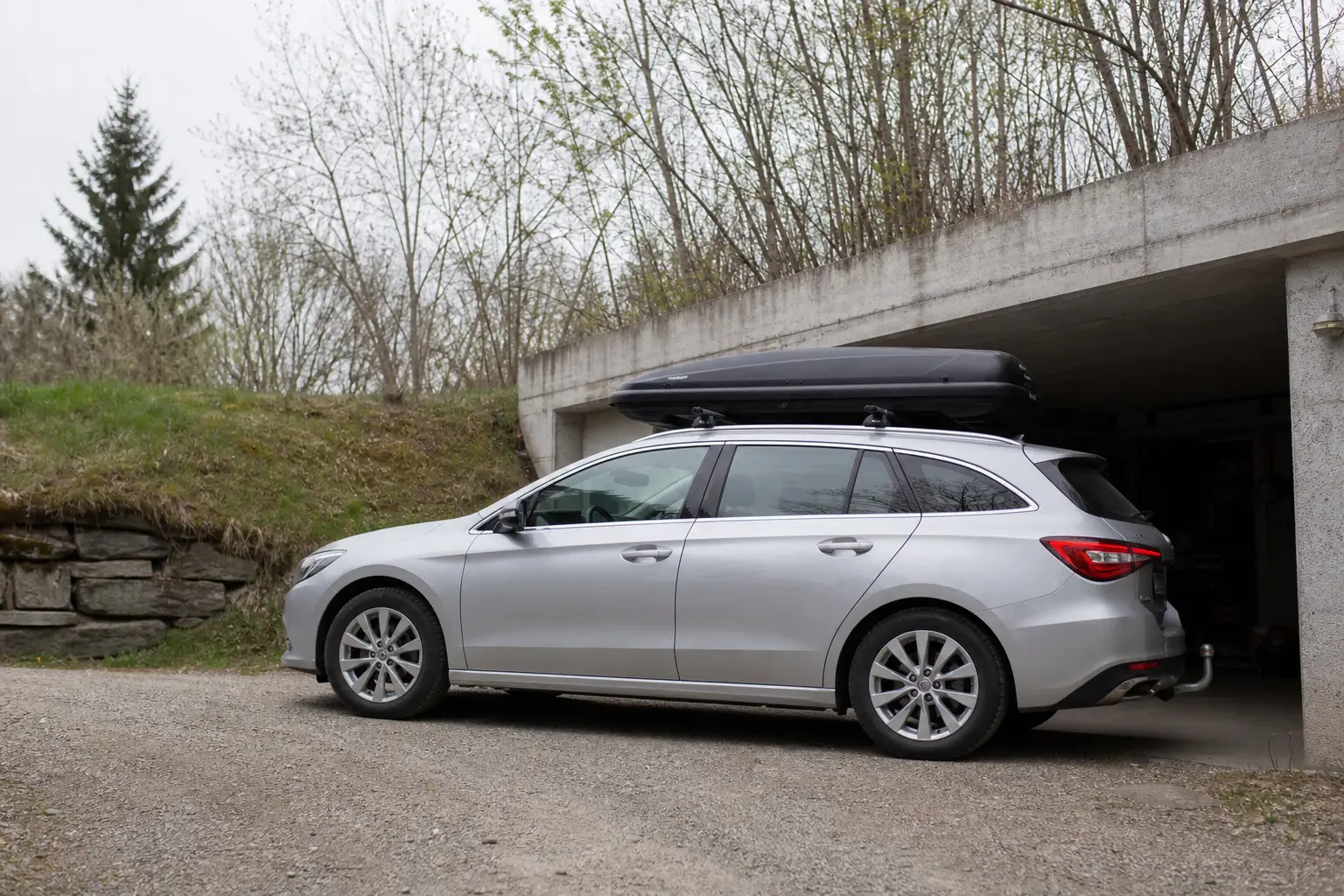
Most correctly fitted roof boxes stay within the vehicle outline. Long skis, surfboards, kayaks, or a very long box on a small car may trigger overhang and marking rules, including warning panels in some states and countries.
Common first-time roof-box mistakes that can ruin departure morning
Most first-timer problems show up before sunrise on departure day, when there is no time to buy adapters or rethink the packing.
- Buying a 21-cubic-foot box before checking the roof-load limit.
- Assuming raised roof rails are the same as crossbars.
- Forgetting that crossbars may cost almost as much as a budget box.
- Finding out too late that the liftgate hits the box.
- Skipping the short test drive and first retightening stop.
- Putting valuables in the box at highway rest stops. The lock deters casual theft; it is not secure storage.
- Leaving the box and crossbars fitted all summer, wasting fuel or electricity and exposing the shell to sun.
Compare roof cargo boxes and roof racks
Live prices from more than 20 shops, updated daily.
FAQ: roof boxes for summer vacation drives
These are the questions that usually come up after the family has picked a size and started checking the vehicle.
How early should I reserve a rental box for a July trip?
Aim for 4 to 8 weeks before departure, especially for the first summer vacation weekends. The box is only half the booking; the provider also needs the right crossbar kit and time to fit and test it.
Can I take the car through an automatic car wash with the box fitted?
No. Remove the roof box and crossbars before using an automatic car wash. Many rack instructions prohibit it, and brushes can catch on clamps, lids, and crossbars.
Is a used roof box a good idea?
It can be if it is a durable branded box with intact locks, keys, hinges, struts, clamps, straps, and base. Avoid shells with cracks around mounting slots, UV chalking, missing internal straps, seized locks, or no compatible clamps.
Are car-brand roof boxes safer than accessory-brand boxes?
Not automatically. Independent testing has found that car-brand boxes do not generally outperform accessory brands. A proprietary fit can also be a drawback if you change vehicles.
Can I use a roof box on a car with a panoramic glass roof?
Only if the vehicle manual and rack maker allow it for that roof type. The deciding points are the approved crossbar kit, roof-load limit, clamp clearance, and whether the glass can open or tilt with the bars fitted.
Verdict: choose for the trip, then for the price
For most first family interstate trips, start with a 14 to 18 cubic foot box, correct vehicle-specific crossbars, quick secure clamps, and enough roof-load margin for light, bulky luggage. Rent if this is one annual vacation and storage is poor. Buy if you will use it often, can store it dry and out of the sun, and the mounting system is easy enough that you'll fit it properly every time.
This article was created using AI, following our team's editorial standards.

